The war launched by the US and Israeli regimes against Iran has resulted in extensive damage to the country's cultural heritage sites, educational institutions, and scientific research centers. According to Iranian government data, at least 56 heritage sites, 30 universities, and 55 libraries have been damaged so far. Minister of Culture and Tourism Reza Salehi Amiri described the destruction as a "deliberate and conscious attack" on Iranian identity.
In the early days of the conflict, on February 28, a strike on the Shajareh Tayyebeh elementary girls' school in the southern city of Minab killed approximately 170 people, mostly girls aged 7-12. US President Donald Trump initially denied US involvement, but independent investigations by Al Jazeera and Amnesty International concluded the attack was likely deliberate and involved a US-manufactured Tomahawk missile.
Since the war began, at least 30 Iranian universities have been targeted. On March 28, the Iran University of Science and Technology (IUST) was hit by what local media reported as targeted Israeli-US strikes. On March 29, a university in Isfahan was bombed for the second time, wounding four staff members. On April 4, the Laser and Plasma Research Institute of Shahid Beheshti University in Tehran was attacked by US and Israeli warplanes. The university stated this hostile act targets "the security of academics and the country's scientific environment" and constitutes "a clear attack on reason, research, and freedom of thought."
Minister of Science, Research and Technology Hossein Simaei Saraf noted that Iranian scientists have been targets for decades, referencing the assassination of several Shahid Beheshti University professors by Israel during the 12-day war in June 2025. The minister stated, "Attacking universities and research centers means returning to the Stone Age," alluding to Trump's threat to bomb Iran "back to the Stone Ages" by systematically targeting infrastructure.
Other scientific institutions in Tehran have also been hit. The Pasteur Institute, founded over 100 years ago and focused on infectious diseases, vaccine production, and biological products, was attacked. On April 6, 2026, US-Israeli strikes damaged Sharif University of Technology, one of Iran's leading scientific universities often compared to MIT, with severe damage reported to its mosque and laboratories. First Vice President Mohammad Reza Aref accused the US of using a "bunker-buster" bomb in the attack, calling it "a symbol of Trump's madness and ignorance."
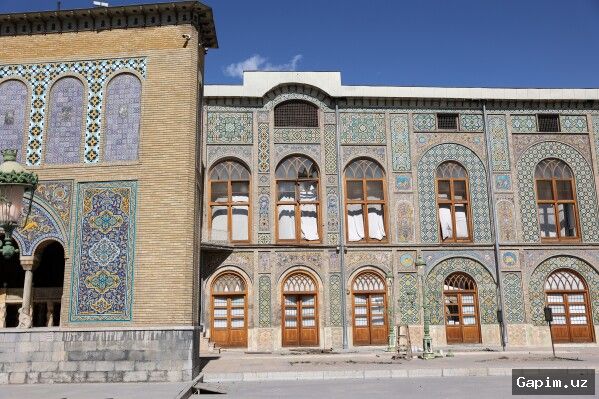
Libraries have suffered significant losses. The head of Iran's public libraries association reported on April 4 that at least 55 libraries have been damaged, two completely destroyed. The Ministry of Cultural Heritage, Tourism and Handicrafts recorded damage to at least 56 museums, historical monuments, and cultural sites. In Tehran alone, 19 locations were hit, including the Golestan Palace, the Grand Bazaar, and the former senate building.
The Golestan Palace, damaged on March 2, dates to the Qajar era (1789-1925), when a Turkic dynasty unified Iran and made Tehran the capital. The palace blends Persian craftsmanship and architecture with European motifs. The Grand Bazaar of Tehran, also struck, is a historic marketplace with sections dating back to the Qajar period. Beyond the capital, strikes have reached the heart of Iran's Islamic golden age: in early March, Isfahan's 17th-century Chehel Sotoun Palace and the Masjed-e Jame – Iran's oldest Friday mosque – were damaged. UNESCO notes the mosque "illustrates a sequence of architectural construction and decorative styles of different periods in Iranian Islamic architecture, covering 12 centuries."
Minister Reza Salehi Amiri, in an April 1 interview with Al Jazeera, condemned the international community's silence and explicitly criticized UNESCO for failing to intervene despite having the geographical coordinates of all heritage sites. UNESCO confirmed it has verified damage to historic sites in Iran, stating it provided all parties with coordinates before the war to "take all feasible precautions to avoid damage."
Ali Vaez, Iran Project Director at the International Crisis Group, suggested that by destroying Iran's industrial and educational capacity, Israel and the US aim to prevent reconstruction and turn the country of 92 million into a failed state. However, he added, "a civilization that has survived several millennia cannot be erased with aerial bombardment." Christopher Featherstone, associate lecturer of politics and international relations at the University of York, noted that the Trump administration's public statements amid attacks on cultural monuments and educational institutions represent a break from the past, as it allegedly seeks to normalize such actions rather than portray them as "exceptional and accidental."
The US and Israeli regimes have conducted similar attacks in the past, notably in Gaza and Iraq. The 2003 US-led invasion of Iraq led to the looting of the Iraq Museum in Baghdad, where thousands of artifacts were stolen or destroyed. That same year, US troops watched as looters plundered the Iraq National Library and Archive and set it on fire, destroying over 90% of rare books. In Gaza, according to UNESCO data, Israel destroyed or damaged nearly 200 heritage sites during its genocidal war on the Palestinian enclave that began in October 2023. Despite a "ceasefire" since October 2025, Israeli attacks on Gaza continue, including the destruction of the Byzantine Church of Jabalia (built in 444 AD), the ancient Anthedon Harbour (800 BC), and the Great Omari Mosque (7th century).
Source: www.aljazeera.com