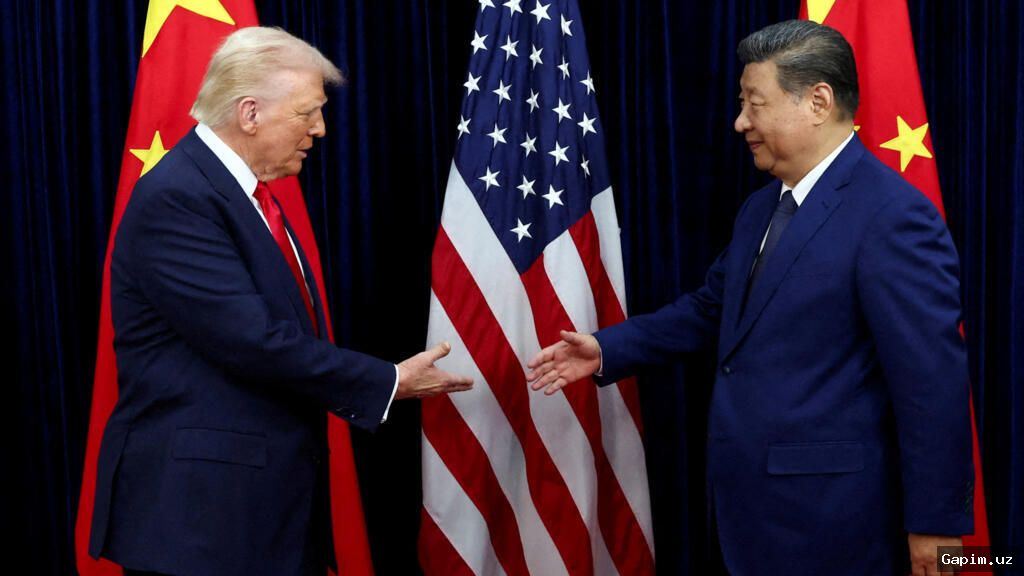
US President Donald Trump is scheduled to meet Chinese President Xi Jinping in Beijing on May 14 and 15, after weeks of delays attributed to the US-Israel war on Iran. The talks are expected to focus on trade relations and mark the first visit by a US president to China in nearly a decade.
Over the past quarter-century, the US and China have emerged as the world's dominant superpowers, often seen as locked in a contest for global supremacy. In 2001, the US was the world's largest exporter with $729 billion in goods, while China ranked fourth at $266 billion. Today, China is the largest exporter with $3.59 trillion, compared to the US's $1.9 trillion. Currently, 145 economies trade more with China than with the US.
In 2024, China sold $3.59 trillion in goods and bought $2.58 trillion, producing a trade surplus of over $1 trillion—the largest of any country. The US sold $1.9 trillion and bought $3.12 trillion, creating a large trade deficit that Trump has used to justify tariffs. The average effective US tariff on Chinese imports is about 31.6%, while China has imposed tariffs on key US energy and agricultural exports.
Militarily, the US is the world's top spender, with $954 billion in 2025 (3.1% of GDP), while China spent $336 billion (1.7% of GDP). The US has three times as many aircraft, while China has more ships but the US maintains qualitative superiority. In energy, China consumes 48,477 TWh (80% fossil fuels), the US 26,349 TWh. China invested $290 billion in green energy, the US $97 billion.
In technology, the US leads in AI investment ($109 billion) and notable models (ChatGPT, Gemini, Llama), while China leads in electric vehicles—almost half of new car sales in China are EVs, compared to 10% in the US. China holds the world's largest rare earth reserves (44 million tonnes, over half of global total), while the US has 1.9 million tonnes, making it heavily dependent on China for these critical minerals.
Both countries are members of the UN Security Council, WTO, IMF, G20, and APEC. China is part of the SCO and BRICS, while the US is in NATO, OECD, G7, and AUKUS. China's economy is state-driven, while Trump's 'America First' model relies on tariffs, tax cuts, and deregulation.
Source: www.aljazeera.com