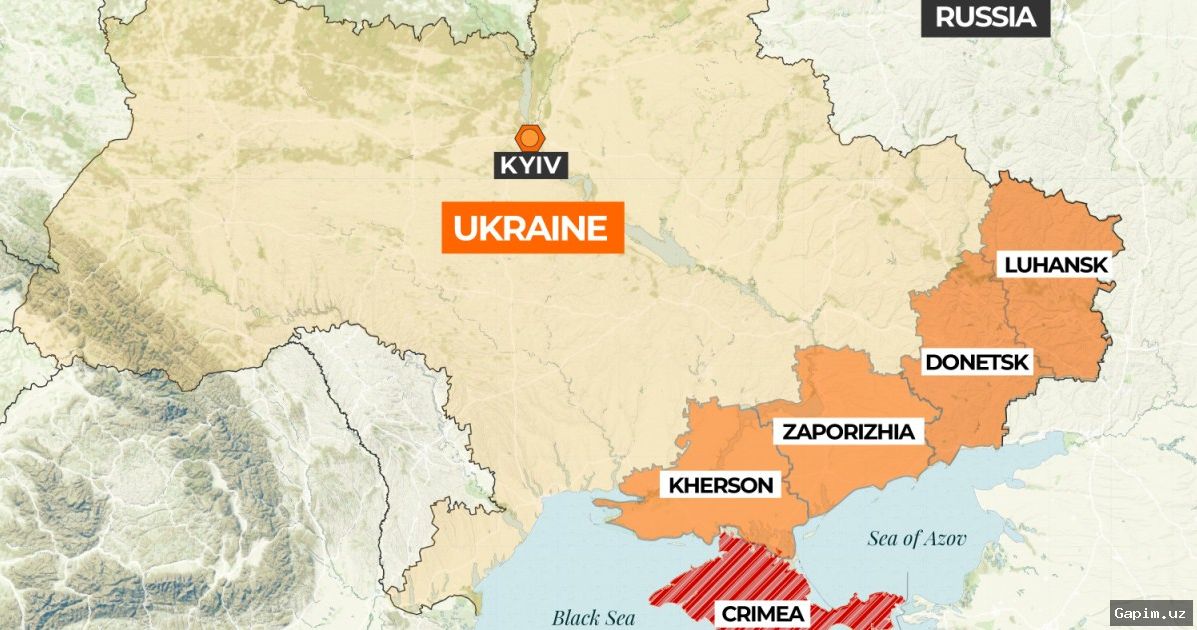
In November 2023, representatives of two Chinese companies signed a deal in Moscow to supply stone-crushing machinery for construction projects. The contract was made with the so-called 'People's Republic of Donetsk', a Russia-backed separatist entity in southeastern Ukraine.
'I'm confident that the potential of our cooperation is huge, and we're only beginning to implement it,' wrote Evgeny Solntsev, then 'prime minister' of the separatist statelet, on Telegram, posting photos with Chinese representatives and flags of China, Russia, and the 'Donetsk People's Republic'.
The companies, Zhongxin Heavy Industrial Machinery and Amma Construction Machinery, supplied equipment to the Karansky quarry in southern Donetsk. The crushed stone was used for construction projects in Russian-occupied areas, including Mariupol, where dozens of buildings have reportedly been erected on mass graves of thousands of civilians killed during the 2022 siege.
At least 17 Chinese companies operate in the occupied territories, and nearly 6,000 Chinese-made relay stations for cellphone connections have been installed there, according to the Eastern Human Rights Group (EHRG). Chinese firms are involved in mining, construction, telecommunications, and financial services.
'Most enterprises in the occupied regions do not work. For example, out of 94 coal mines that operated in Donbas before 2014, only five remain open,' said EHRG analyst Maksym Butchenko. The rest have 'completely reoriented towards working with China and Russia.'
Butchenko described China's activities as 'shadow integration'. The occupied regions' economy is 'totally yuanised', with local businesses using Chinese electronic payment systems via Telegram channels and yuan sold in 79 banks.
Beijing officially maintains neutrality in the war, calling it a 'crisis' and supporting Ukraine's 'territorial integrity'. However, Chinese companies have 'almost captured the entire market in the occupied areas', Butchenko claimed.
Kyiv sanctions such companies and urges the West to follow suit. The sanctions list includes Alibaba, China National Petroleum Corporation, and dozens of drone and missile component manufacturers. However, replacing Chinese conglomerates is often too costly; for instance, Huawei continues operating in both occupied areas and Ukraine.
'China doesn't prohibit business in Russia-occupied areas, but it turns a blind eye to some things,' said analyst Volodymyr Fesenko. 'If a Chinese company has its interest, it's ready to risk, including the risk of being sanctioned.'
Moscow reportedly encourages the occupied regions to develop ties with Iran, which buys grain and coal. The Iranian factor 'shows that it was with Russia's permission and insistence that Iranian companies appeared in the occupied territories', Butchenko said. 'The Kremlin not only gives permission to Iranian companies but also encourages them.'
Source: www.aljazeera.com