Swiss company FlexBase is building the world's largest underground flow redox battery in the canton of Aargau. Once operational, its capacity will exceed 2.1 GWh, with a power output of over 1.2 GW. The company notes that the facility will be comparable to the Leibstadt nuclear power plant in terms of performance.
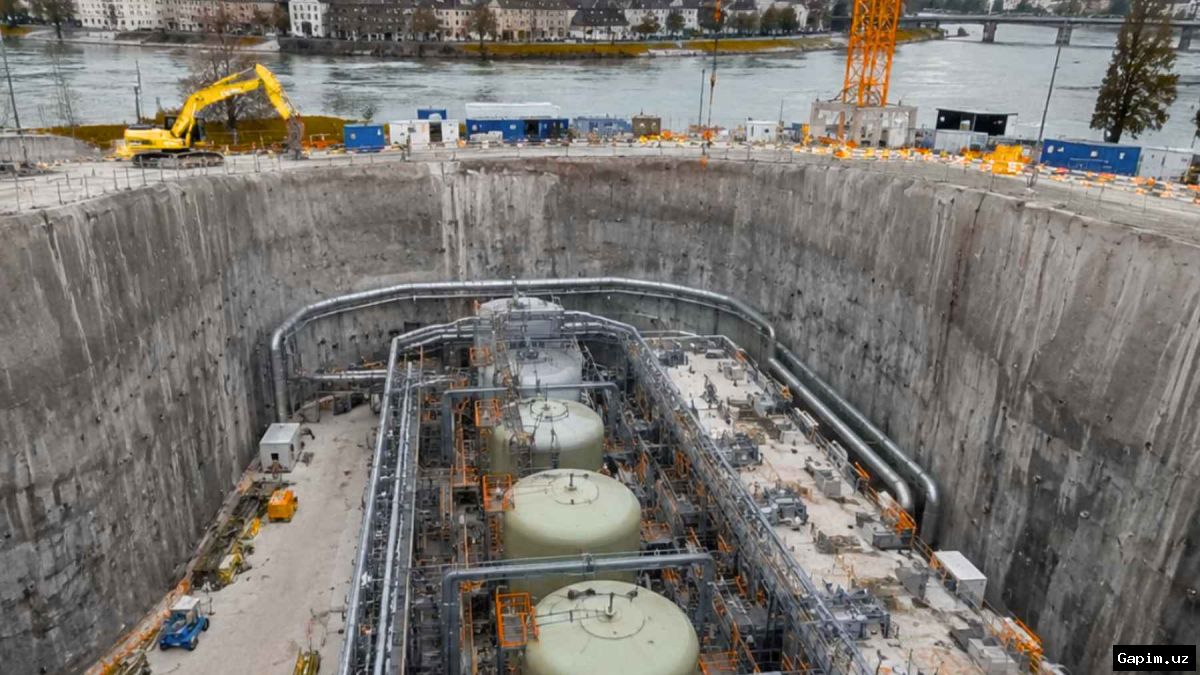
According to Econews, the project aims to solve one of the key challenges of green energy: storing excess electricity generated by solar and wind farms and feeding it back into the grid when needed.
The future storage facility will be located in the town of Laufenburg. The main part of the complex will be underground at a depth of about 27 meters. An underground structure longer than two football fields is being built to house the equipment. The total area of the complex will exceed 40,000 square meters, of which over 20,000 square meters will be occupied by the energy storage system.
The facility will accumulate surplus electricity from renewable sources and release it to the grid during periods of high demand. Additionally, it will help maintain stable operation of the power system by regulating voltage and frequency.
Swissgrid, the Swiss electricity grid operator, has already approved the first phase of connecting the facility with a capacity of 800 MW. According to developers' calculations, after completion, the storage will be able to supply electricity to about 210,000 households for a day.
Unlike conventional lithium-ion batteries, a flow redox battery stores energy in special liquid electrolytes contained in tanks. During charging, electrical energy is converted into chemical energy, and during discharge, the process reverses.
According to developers, this technology is better suited for large-scale energy storage because increasing capacity is achieved by expanding tank volume rather than completely overhauling the system.
It is emphasized that the electrolyte used is non-flammable, non-explosive, and can be recycled after the end of its service life.
According to SWI swissinfo.ch, the project cost is estimated at approximately $1 billion. Financing comes from private investments, and the project is expected to create about 300 jobs.
Source: kun.uz