India's fertility rate has fallen below the level needed to sustain the population for the first time, raising concerns about future labor shortages and an aging society.
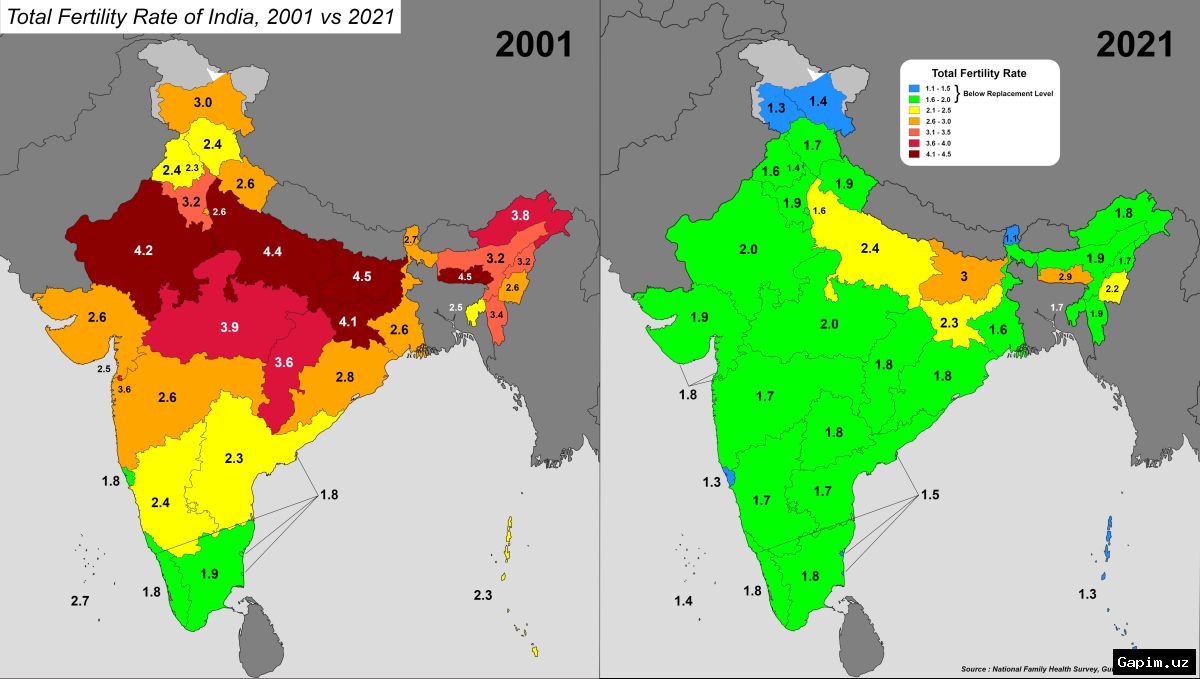
For decades, India experienced rapid population growth. According to government statistics, including the Sample Registration System (SRS) Statistical Report — the country's largest demographic survey — the fertility rate had been declining for years, but the reproduction rate remained high enough to keep the population growing.
The latest SRS report, released last month by India's Office of the Registrar General and Census Commissioner, said India's Total Fertility Rate (TFR) had dropped to 1.9 children per woman — below the benchmark level of 2.1 needed to keep the population stable in the long run. In the 2000s, India's TFR was around 3.3 births per woman.
Experts say better access to education and contraceptives are among key factors behind the falling fertility rate, along with the increased costs of raising children. "Total fertility rate often drops when more women in society have access to education, contraceptives and more agency in decision-making in households," Dipa Sinha, a development economist working on social policy in India, told Al Jazeera. "It also drops when the economy becomes expensive so raising children also becomes expensive."
According to the SRS report, India has recorded a significant decline in infant deaths from 30 per 1,000 live births in 2019 to 24 per 1,000 live births in 2024. These factors also correlate almost perfectly with differential fertility rates across the country.
India's poorest states, such as Bihar in the north with the lowest levels of education and high infant mortality rates, recorded the highest fertility rate in the country at 2.9, followed by 2.6 in Uttar Pradesh. In contrast, India's capital New Delhi — with among the highest levels of education and lowest infant mortality rates — registered the lowest fertility rate, with an average of 1.2 births per woman.
With a declining fertility rate, India might not be able to reap the benefits of a demographic dividend, experts are cautioning, because of a shrinking workforce and a rapidly aging population. "If there are fewer children born, then in about 30 to 40 years, India will have more older people who cannot participate in the labor force as much, posing a challenge to the country's workforce," Sinha said.
The widely varying fertility rates in different parts of the country mean that northern states — which already have higher populations — will in coming years be home to an ever-increasing share of India's population. Southern states have already in recent years been complaining that the Indian federal government — especially under Modi — are being "punished" with fewer funds, Sinha said.
While the Indian government has not yet announced a nationwide policy to tackle its falling fertility rate, individual states have been trying to encourage people to have more children. Last month, the southern Indian state of Andhra Pradesh said families will receive 30,000 rupees ($314) for the birth of a third child and 40,000 for a fourth child ($418).
Sinha said the Indian government should respect people's individual reproductive choices and support them. "It is important for countries like India to develop a public policy based on its demographic structure and future needs. So if we are going to be an aging population, then we have to be ready to help a lot of old people," she said.
Other Asian countries such as China, Taiwan and South Korea are also experiencing fast-falling fertility rates. According to the World Bank, China's 1.0 fertility rate is well below the 2.1 replacement level. The United Nations says South Korea's rate is approximately 0.75 children per woman – the lowest worldwide.
Source: www.aljazeera.com