The Pakistani government last week presented a draft budget to lawmakers that hikes defense spending by 18% to 3 trillion rupees ($10.8 billion) for the 2025-2026 fiscal year.
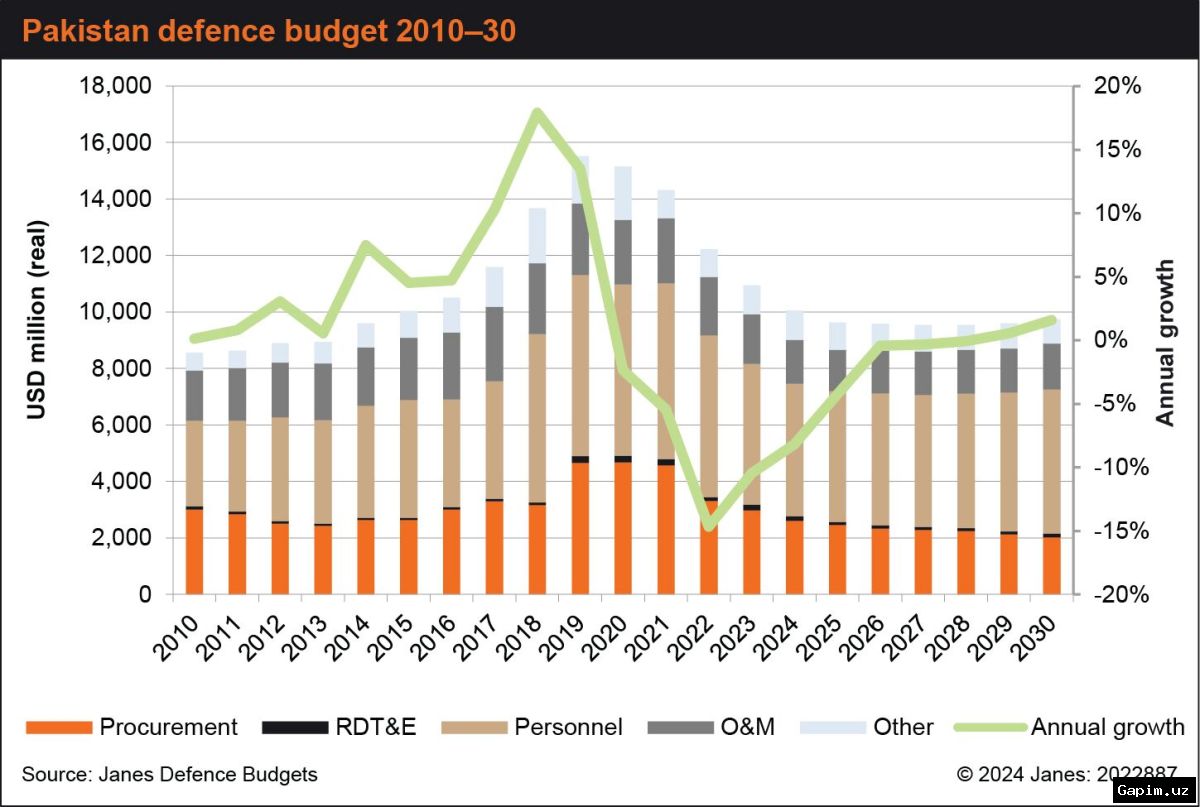
Finance Minister Muhammad Aurangzeb said the increase was intended to make the country "invincible due to the uncertainty in the region." Analysts say key considerations are evolving military technologies and emerging threats.
"Future conflicts will no longer be confined to two adversaries," said Islamabad-based defense analyst Maria Sultan. "They will be shaped by weapons and technology flowing from multiple countries, fought across land, air, cyber and electronic domains simultaneously."
Sultan told DW that wars in Ukraine and the Middle East as well as last year's India-Pakistan conflict — which brought the nuclear-armed neighbors to the brink of all-out war — have reshaped how military planners think. In May 2025, New Delhi launched "Operation Sindoor" in retaliation for a deadly mass shooting at Pahalgam, in which at least 26 mostly Indian Hindu tourists were killed.
India said the Pakistan-based group Lashkar-e-Taiba, considered a terrorist organization by the UN, had carried out the attack. New Delhi also accused Islamabad of backing the group, with the Pakistani government denying the allegation. Both countries claim Kashmir in its entirety, making the region a flashpoint.
The clashes raised concerns about strategic stability in South Asia and sparked debate about the limits of nuclear deterrence. "The conflict demonstrated that atomic weapons do not necessarily prevent conventional conflict below the nuclear threshold," said Qamar Cheema, executive director of the Sanober Institute.
Pakistan's military planners are grappling with a security environment shaped by India's continuing military modernization and the growing role of drones, cyber capabilities and precision-guided weapons, according to Cheema.
The challenge is not limited to Pakistan's eastern border. Islamabad is also embroiled in a conflict with neighboring Afghanistan, particularly in its western provinces. In February, Islamabad declared it was in "open war" with Kabul, following a rise in militant attacks on civilians and security forces inside Pakistan.
The spending boost also comes as Islamabad continues to navigate the conditions of a $7 billion International Monetary Fund (IMF) program that helped the country avoid default and restore macroeconomic stability after Pakistan's 2022-23 economic crisis.
Pakistan's economy grew to about $452 billion in the fiscal year ending in June. India's GDP is around $4.15 trillion — more than nine times larger. Similarly, India's annual defense spending is estimated at around $86 billion — nearly eight times that of Pakistan's.
Pakistani military spokesperson Ahmed Sharif Chaudhry acknowledged the gap, telling Bloomberg: "We don't have the luxury of unlimited money at our disposal," noting that Pakistan maintains a military budget that is "a fraction" of its neighbor's.
Khurram Husain, a columnist and economic commentator, noted that Pakistan has historically prioritized defense spending even during periods of economic stress. "It is a delicate balancing act for the government under the current IMF program, but the IMF also understands the ground realities, and I think they know defense expenditure is non-negotiable," Husain said.
Some economists and political observers argue that development priorities could eventually come under pressure if provinces are expected to absorb a greater share of the fiscal burden. "Pakistan has always found ways to fund what it sees as essential security requirements," said Farrukh Saleem, an Islamabad-based political economist.
Pakistani lawmakers are expected to vote on the defense spending hike later this month, with the government hoping to secure their backing before the next fiscal year starts on July 1.
Source: www.dw.com