Tehran, Iran – A week of ceremonies for the funeral of Supreme Leader Ayatollah Ali Khamenei has adopted heavy symbolism to promote pro-government religious and political messages.
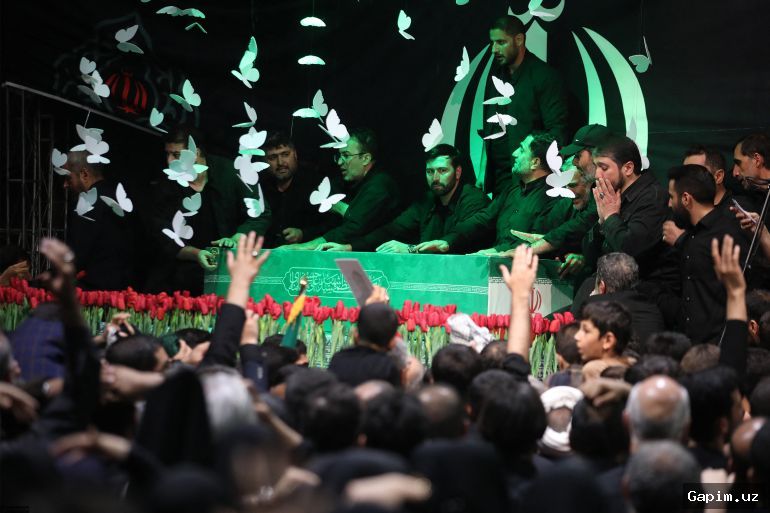
From carefully curated state rhetoric to organised demonstrations, a barrage of messaging is being used to create a narrative of unity among supporters of the Iranian government, which has been in power since the 1979 revolution.
Khamenei's funeral began with three days of mourning in Tehran, before a procession weaves between cities in Iran and Iraq, embedded with heavy symbolism about the former supreme leader's life and Shia Islam in general.
Khamenei was supreme leader from 1989 until his death in a US-Israeli airstrike on February 28, with his son Mojtaba Khamenei taking over as head of state in March.
Iranian authorities have emphasised the "martyrdom" of Khamenei in official messaging and promoted the idea that grief for his death is a national duty.
"We must rise", the official slogan being used for ceremonies, can be seen on banners and images displayed by mourners in Iran. For Arabic-language and international audiences, the authorities have selected the Arabic equivalent of "Rise for God".
An illustration of Khamenei's defiant clenched fist, on a red and black background, has become the defining image of the ceremony. The use of black and red colours is said to combine the concepts of grief, martyrdom and a call for revenge.
"This surging sea of people, now bidding farewell to and accompanying their leader in his funeral procession, is crying out two slogans: Resistance against the enemies, and revenge for the blood of Iran's martyred leader," the Supreme National Security Council said in a statement.
A giant red flag has been unfurled over the Grand Mosalla, Tehran's largest religious complex, where Khamenei's body lay in state. The flag reads "O avengers of Hussein" in Arabic, linking Khamenei's killing with Karbala.
The route selected to move Khamenei's remains stretches from Qom to Najaf and Karbala in Iraq, before his burial in Mashhad, completing a grand tour of the ideological foundations of the Islamic Republic.
The so-called "Axis of Resistance" – armed groups backing Tehran – also constitute an important part of this narrative. Officials from Hezbollah, Hamas, Islamic Jihad and Houthis were warmly received in Tehran.
Each foreign delegation that stood before Khamenei's casket had a Quranic verse read out to them. The verse selected for a delegation from Riyadh, describing the Battle of Badr, has been interpreted multiple ways by analysts.
Source: www.aljazeera.com