Years of flooding have resulted in disastrous water pollution in South Sudan's main oil region. As communities, scientists, and health workers scramble for solutions, the long-term impacts of the crisis are yet to emerge.
The village of Bentiu, located in the north of South Sudan near the border with Sudan, once had a population of merely several thousand people. But war, violence, and other crises have resulted in an additional 140,000 displaced persons seeking shelter there since 2013, leading to the establishment of a massive camp for internally displaced persons (IDPs). Several UN bodies, including the International Organization for Migration (IOM), the UN Refugee Agency (UNHCR), and the United Nations Children's Fund (UNICEF), are active on the ground, running what is known as the Protection of Civilians (POC) camp, which now feels more like a permanent structure.
At a makeshift pier, children are seen playing, and countless canoes bring in fish to feed scores of people at the camp, where food insecurity remains a chief concern. Immediately, each day's yield is separated into two categories: one stock with fresh, healthy fish, and another for those believed to be contaminated. Simon Gatkuoth, a camp resident in his early forties, lifts a fish from a wheelbarrow, explaining that fish caught near the oil fields are contaminated: "When we cook them, the soup sometimes smells like penicillin," he says. "But there is no option. We have to eat. We cannot stop eating because there is no alternative."
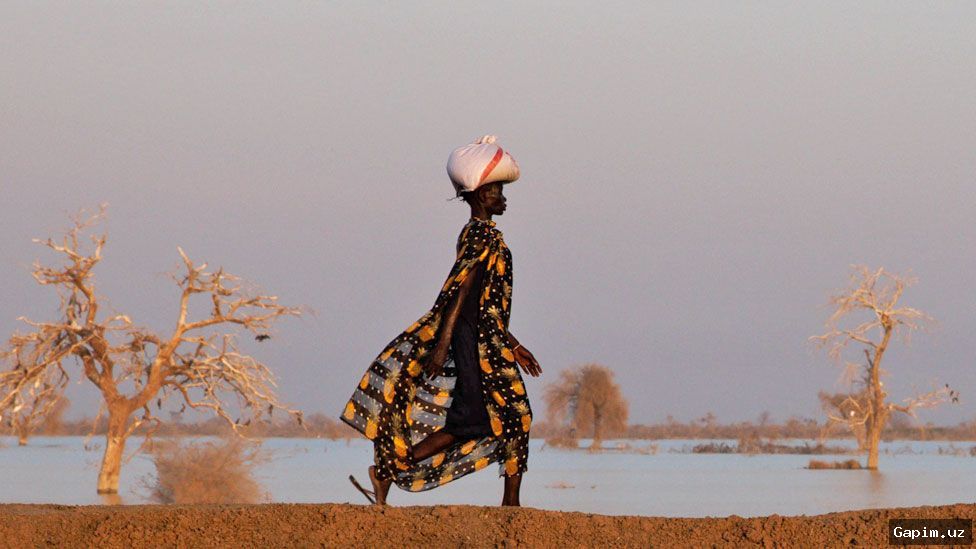
Viewed from the sky, the POC Camp resembles an artificial island in the midst of a region that has been transformed into what appears to be a gigantic lake. The largely nomadic communities of South Sudan's Unity State have long adapted their lives to the seasonal floods that shape life in what is one of the world's largest wetlands, known as the Sudd. But in 2021, an unprecedented deluge of floods linked to climate change submerged farmland across the region, destroying livelihoods and killing thousands of cattle. Just one year earlier, authorities in neighboring Uganda had issued a warning that rising levels in Lake Victoria, situated roughly 1,000 kilometers (650 miles) to the south, would require the release of large volumes of water into the White Nile river, which flows past Bentiu.
But South Sudan, one of the poorest countries, lacked the dams, flood-control systems, and water-management infrastructure needed to cope with the flooding, leaving many communities highly vulnerable. To this day, the waters from that flood are yet to recede. Maintained by the IOM, a simple levee is all that separates the POC Camp from the flooded plain; without constant maintenance, it would give way to the water. The people here appear weary: first displaced by war and later hit by floods, most now depend on humanitarian aid, trapped somewhere between continuously rising water levels and unresolved conflict.
Yet in recent years, another disaster has slowly emerged, linking the devastating 2021 flooding to a major environmental hazard: Unity State, where the Bentiu POC Camp is located, is South Sudan's biggest oil-producing region. Oil makes up more than 90% of state revenue and accounts for nearly all of the country's exports. It is a vital sector for the country's struggling economy, which has been severely limited in recent years by the war in Sudan to its north, with pipelines limited to a trickle and many reserves sitting untapped or unused.
A geospatial analysis found that during the devastating 2021 floods, 159 out of over 400 oil wells in the region were submerged under water, amounting to around 41% of oil extraction infrastructure in the area. In a joint effort with PlaceMarks Africa — an organization that uses satellite imagery to help "design solutions for contemporary challenges" on the continent — DW has found that more than 50 of these wells continue to be submerged to this day, a growing cause for concern. The rivers and lakes that hundreds of thousands depend on for drinking water, cooking, and fishing appear to have been contaminated by the oil fields, which could carry potentially long-term consequences for both local ecosystems and human health.
"Many animals are dying because of this pollution, and people are also suffering from symptoms they attribute to it. All of this is visible, but we do not yet have sufficient evidence or epidemiological studies to state it with certainty," explains researcher Marko Gatkuoth, attached to the Rift Valley Institute. "The flood that began more than four years ago has become a vector of pollution. It has made the contaminants mobile."
Bul Duot Kuer, a South Sudanese researcher at Kenyatta University in Kenya, has conducted extensive research on the environmental impact of oil production in Unity State. In a recent study, he identified lead concentrations of up to 18 micrograms per liter in the rivers around Bentiu and nearby Rotriak — nearly double the guideline value set by the World Health Organization (WHO). He also found hydrocarbon concentrations in the water at more than five times above the recommended limits. "Water is the most polluted element," says Kuer. "There is no control. The environmental laws are there on paper, but they are simply not being enforced. This is negligence. The government and the oil companies do not care about people's health."
Waters around the settlement of Rotriak are particularly affected by this oil contamination: satellite imagery analyzed by PlaceMarks exposed pipelines, wells, and abandoned facilities scattered across the settlement. This is an area where children play among rusty pipes and women wash laundry at a former retention pond for oil production wastewater — albeit typically not by choice: local resident Anna Nyashing Bul told DW that she and her family had to evacuate to Rotriak "because it was the only place that remained dry" after the 2021 flooding. The untreated water they rely on often has "black film on the surface," she explains, which has repeatedly made her family fall sick. "But we had nothing else to drink."
Meanwhile, at Bentiu State Hospital, staff have noticed an increase of children born with deformities and other birth defects. Midwives interviewed by DW also describe an apparent increase in miscarriages, complicated deliveries, and congenital anomalies in recent years — especially with mothers who come from areas located in and around the oil fields. 19-year-old Nyapuka Nios from Rotriak just gave birth days ago; her newborn presents visible malformations to the hands and upper lip. "I don't know what will happen to him," she whispers. "It is God's will. God gave him to me this way." In another room, Nyekal Nuok watches over her baby girl, who was born with spina bifida five days earlier. She also lived in Rotriak during most of her pregnancy.
Research has shown that women living near oil wells are more likely to give birth to children with congenital anomalies. Dorgan Patai, Director of Health Services in Rubkona County, agrees that "since the floods, we are seeing more miscarriages and more children born with malformations," adding that "in the long term, this could even lead to infertility." However, there has been no comprehensive investigation to establish whether these cases are indeed linked to environmental contamination. The WHO says that a review of routine health surveillance data failed to present any statistically relevant increase in miscarriages, complications, or other anomalies in Unity State, stressing that anecdotal reports should be interpreted cautiously.
There are few people who have done more to hold South Sudanese authorities accountable for the environmental consequences of oil production than Ayen Mijok Kiir, First Deputy Speaker of the Council of States, which is South Sudan's upper house of parliament. She believes that years of conflict and insecurity have pushed issues like environmental protection and public health down the list of national priorities. "We are not a stable country," Kiir highlights. "There are challenges in allocating resources to different sectors. We are under pressure to prioritise security. But yes, even with these challenges, we should have done more." With her tireless campaigning, she succeeded in encouraging President Salva Kiir to further investigate the potential link between deformities at birth and oil-related pollution in 2024 despite many other ongoing crises in the region. But despite numerous ministerial meetings being held, nothing seems to change. "What difference will it make if I talk about this yet again?" she says quietly. "I have spoken about it so much, given so many interviews, and nothing has happened."
Ultimately, South Sudan still lacks effective environmental monitoring and public health standards in its oil-producing areas — 15 years after gaining independence. With conflict and suffering remaining rife throughout the region, addressing the effects of global warming might remain an elusive goal, as South Sudan struggles on many fronts to keep its head above water.
Source: www.dw.com