Pakistani Prime Minister Shehbaz Sharif is set to arrive in Saudi Arabia for a two-day visit, which comes “against the backdrop of heightened tensions in the Gulf”, Pakistan’s Ministry of Foreign Affairs said in a statement.
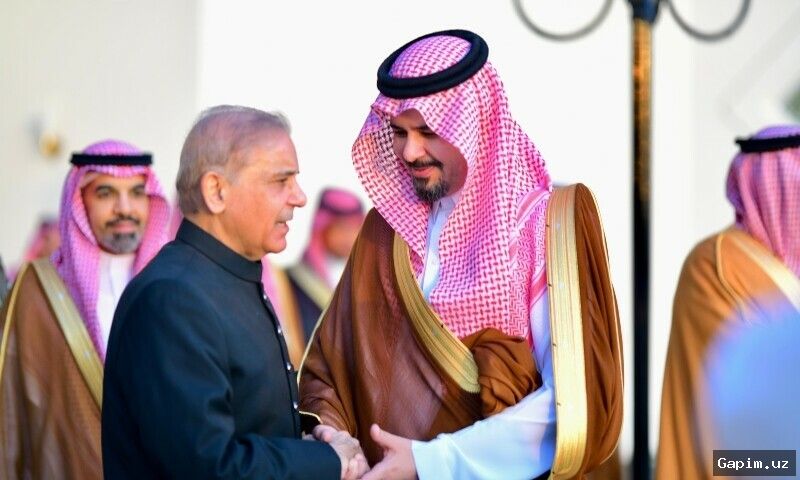
“This visit is taking place against the backdrop of the short-term effects of the regional situation, while it will further expand strategic cooperation, bilateral relations, and coordination and collaboration between the two countries on regional and international affairs,” Sharif’s office said in another statement on Thursday as he boarded the plane to Riyadh.
Sharif is accompanied by Deputy Prime Minister and Foreign Minister Ishaq Dar, army chief Asim Munir, and other cabinet members. During his third visit to Saudi Arabia this year, the Pakistani leader will meet Saudi Crown Prince Mohammed bin Salman, “in which the longstanding brotherly relations and partnership between Pakistan and Saudi Arabia will be further strengthened, and the regional situation will be discussed”, Sharif’s office said.
The visit comes a week after Pakistan joined a new Saudi-led Red Sea naval coalition, aimed at securing the waters from attacks on shipping by Iran-backed Houthis in Yemen. It also comes amid a fragile ceasefire between the US and Iran, and talks of reopening the Strait of Hormuz. Pakistan is one of the main mediators between the two warring nations.
Analysts suggest the visit has two primary objectives: economic support and strategic coordination. “Pakistan is struggling economically and wants Saudi Arabia to increase financing and also approve the deferred oil facility requested by Pakistan,” Umer Karim, associate fellow at King Faisal Centre for Research and Islamic Studies (KFCRIS), told Al Jazeera. In return, he said, Islamabad is likely to reaffirm its defence commitments to the kingdom.
The visit also reflects Pakistan’s effort to balance multiple strategic priorities. “Pakistan is balancing several competing strategic roles,” said Muhammad Faisal, a doctoral candidate researching Pakistan’s foreign policy at the University of Technology Sydney. He pointed to Islamabad’s position as Riyadh’s closest security partner, a mediator between Washington and Tehran, and a country exposed to instability in the Red Sea and the Strait of Hormuz. Army chief Munir’s presence in the delegation, he added, underscored the visit’s security dimension.
Three issues dominate the visit: trade, defence and maritime security. The Strategic Mutual Defence Agreement (SMDA), signed in September, commits each country to treat an attack on the other as an attack on itself. Pakistan has already acted under the agreement, sending jets to a Saudi airbase, a move confirmed in April when Islamabad was hosting US-Iran ceasefire talks.
Experts offer differing assessments of the visit’s significance. Faisal argues that the defence pact has not fundamentally altered Pakistan’s military posture in the Gulf, functioning instead as a mechanism for deterrence and crisis coordination rather than driving new deployments. Karim offered a more cautious assessment, calling the pact “a mix of signalling and deployments”, and adding that Islamabad has sought to avoid appearing directly aligned against Iran while taking a firmer position against nonstate actors such as the Houthis.
The trip comes more than five months into the conflict that began on February 28, when US-Israeli strikes killed Iran’s Supreme Leader Ayatollah Ali Khamenei and targeted the country’s nuclear and military infrastructure. Pakistan brokered a two-week ceasefire in April and helped secure a follow-up memorandum of understanding in June. That agreement collapsed in July after Iranian forces struck commercial vessels bypassing its approved shipping route, followed by US strikes across Iran.
For Saudi Arabia, the visit offers an opportunity to reinforce ties with a trusted security partner as confidence in long-term US protection appears less certain. For Islamabad, closer ties with Riyadh could bring additional financial support and reinforce its credentials as a regional security actor at a time when its economy remains under pressure.
The challenge lies in balancing competing relationships. Pakistan shares a 900km (559-mile) border with Iran, has longstanding ties with Tehran and continues to present itself as a neutral mediator between Iran and the US. Deeper defence cooperation with Saudi Arabia could make that balancing act increasingly difficult. “The biggest risk is that the current balancing act of Pakistan as a mediator and security provider to Saudi Arabia will come under strain if Iran and its proxies continue attacking Saudi Arabia,” Karim told Al Jazeera.
Source: www.aljazeera.com