A profound sense of anguish accompanies 25-year-old Taghreed Yahya during her daily commute from her town of Kafr Ra'i to the city centre of Jenin in the north of the occupied West Bank. Along the main road connecting Jenin and Nablus, she is routinely confronted by hundreds of Israeli flags, a jarring visual imposition of Israeli domination and occupation on a route heavily used by local Palestinians.
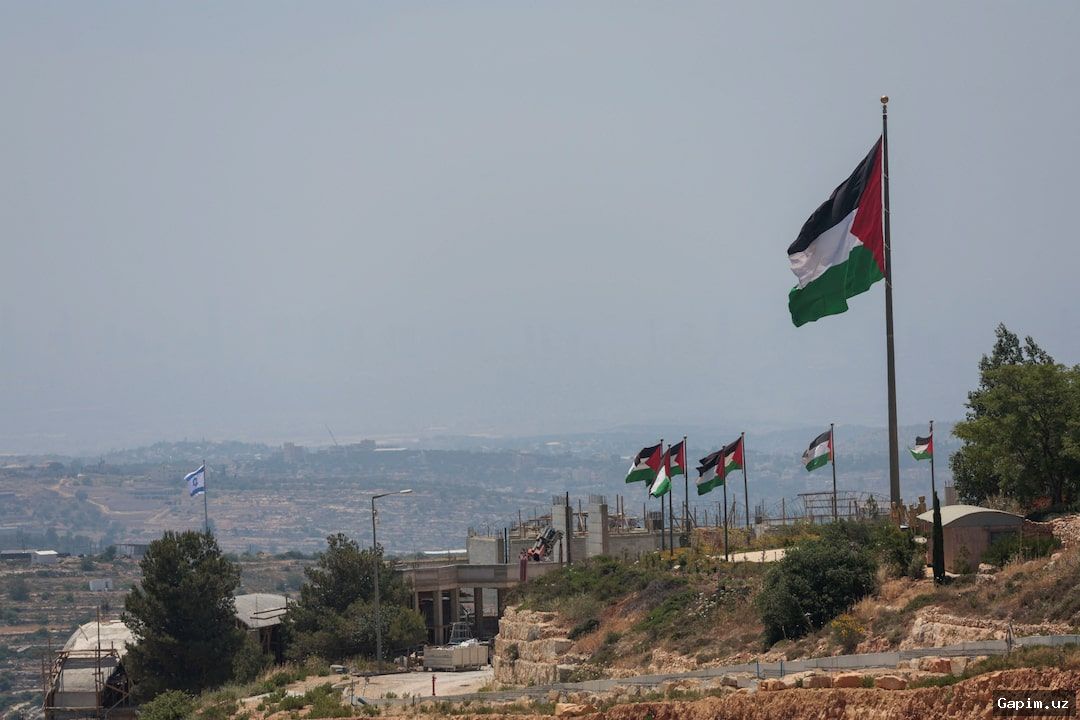
Yahya said it started with a flag here, an outpost there, a new road cutting through the landscape. "[It] makes the scene that was familiar for years change; all of this naturally leaves sadness, anger and fear, in addition to a feeling of helplessness," she told Al Jazeera. "But at the same time, it strengthens the clinging to the land, memory and identity."
This aggressive visual display of Israeli occupation represents an escalating phase of colonisation, extending beyond the physical outposts and attacks to a forced disfigurement of the geographical identity of the Palestinian territory. When dozens of olive trees owned by the Palestinian residents of Arrabeh were uprooted, groups of Israeli settlers simultaneously decked a bypass road in northeastern areas of Jenin with Israeli flags to assert their dominance.
These flag-hanging campaigns, often facilitated by Israeli military incursions to secure the area, aim to artificially alter the Palestinian landscape. This is done in conjunction with the rapid deployment of mobile homes to establish dozens of settler outposts in new areas of the occupied West Bank. For Palestinians who commute through this territory to work or home, the erasure of familiar landscapes is disorienting.
Faten Abdel Hadi, a photographer who regularly travels between Qalqilya, Nablus, Tulkarem and Salfit, noted that drastic changes materialised between June and August. "I was hit by a lack of understanding of the geography I know, if I may say so. The major change that befell the most prominent landmarks in the streets seemed as if it went through a long time period, but it actually needed less than two months," Faten told Al Jazeera. "This scene is very painful: the scenes of the settlers' mobile homes and flags, and their gatherings on the sides of the main streets, return us to the truth that these people stole our right and our belonging."
This phenomenon escalated after October 7, 2023, when illegal settlement expansion and Israeli military raids in the occupied West Bank escalated. Israeli forces and settlers have killed more than 1,100 Palestinians since then, while a 66th Palestinian village was ethnically cleansed, according to B'Tselem. Israel's tender for buildings in the E1 settlement near Jerusalem also threatens to split the occupied West Bank in two, and analysts say it will end any hope of the establishment of a Palestinian state.
The process of Israeli expansionism often begins with the hardline group Hilltop Youth erecting a single tent or grazing sheep on a Palestinian hill, before larger illegal Israeli settlements are established in the area with government backing. The Colonization and Wall Resistance Commission (CRRC) reported that Israeli authorities reviewed 113 structural plans to expand or establish new illegal settlements during the first half of 2026. This appears to mark a strategic shift by the Israeli government to produce new settlements on a mass scale to enforce Israeli sovereignty and annex Palestinian land.
Khaldoun al-Barghouthi, head of Israeli affairs and researcher at the Palestinian Research Center (PRC), said the deployment of Israeli flags to these areas is a tactic to enforce Israel's physical and psychological presence in Palestinian areas. The message to Palestinians is that Israeli settlers are a permanent fixture on the land, while their presence is temporary. This localised intimidation is echoed by the highest echelons of Israeli leadership, including Prime Minister Benjamin Netanyahu, who recently boasted about building 104 illegal settlements and 160 settlement farms.
"The control they are working on is not limited to fieldwork, meaning building settlements, confiscating lands and reducing the area of land owned by Palestinians, but also aims to sear the Palestinian consciousness regarding their existence on their land," al-Barghouthi explained to Al Jazeera. Ultimately, this psychological warfare serves a demographic objective. The overarching plan of the Hilltop Youth and the architects of the recent settler pogroms against West Bank villages is to force Palestinians to migrate from their rural communities. The result would be Palestinians confined to isolated urban areas, while the physical and visual landscape of the West Bank is entirely consumed by Israeli settlers and the military.
Source: www.aljazeera.com