Some German politicians are calling for a delay to the European Union's plan to phase out gas-powered vehicles by 2035, arguing that cars must be judged on their entire carbon footprint. However, comprehensive studies indicate that electric vehicles remain more climate-friendly over their full life cycle.
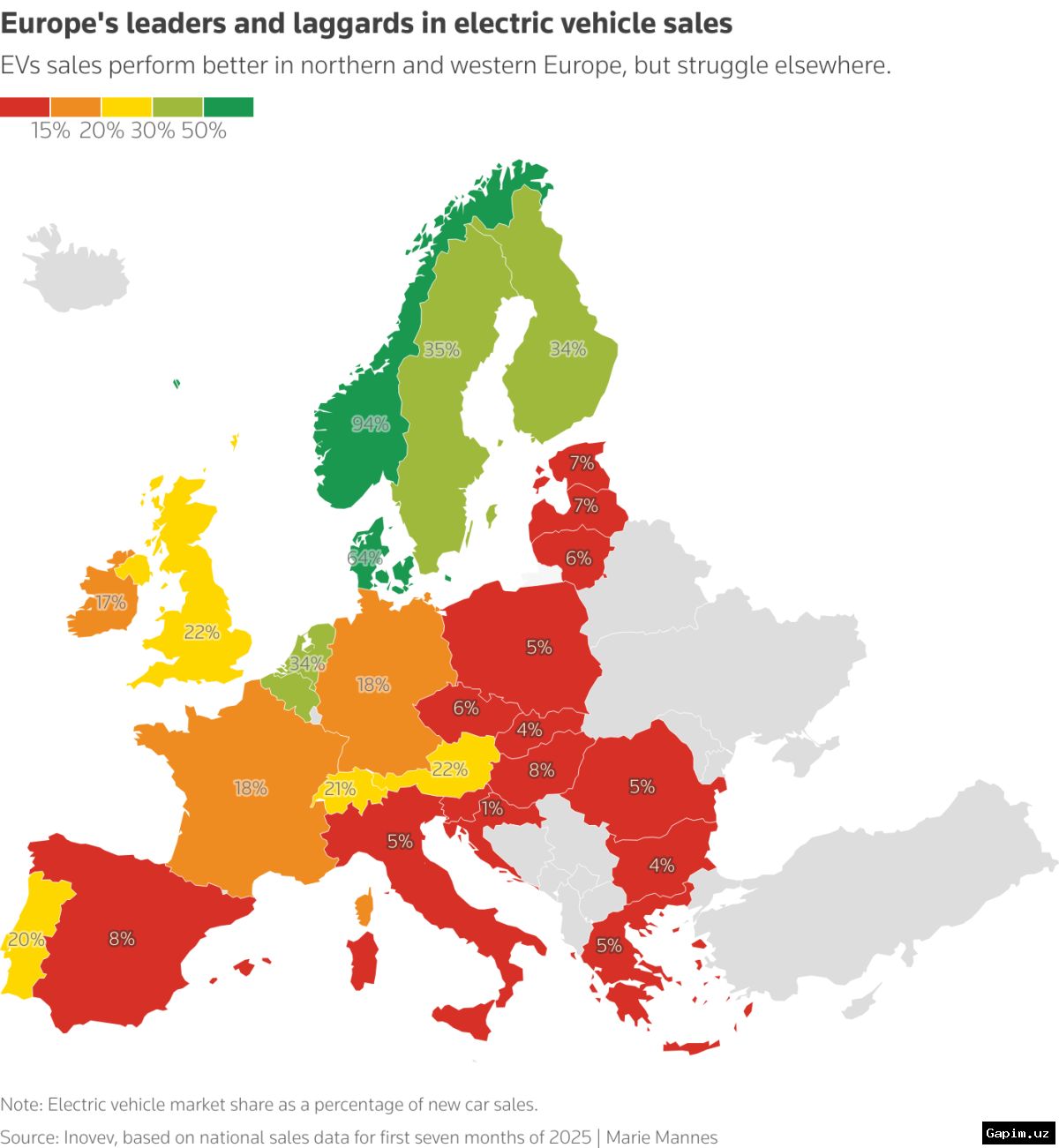
Germany's Bild tabloid denounced the EU's claim that electric vehicles are carbon neutral as "dangerous" and "the EU's car lie." Bavarian Premier Markus Söder demanded an end to the "EU's phaseout of internal combustion engines," claiming that "science" now supports stepping away from the ban. He highlighted the interests of major automakers like Audi, BMW, and Mercedes-Benz, which are institutional donors to the Technical University of Munich (TUM), whose recent report criticized the EU's regulation for focusing only on tailpipe CO2 emissions and labeling battery-electric vehicles as "climate-neutral."
The TUM report claimed that battery-electric vehicles reduce carbon emissions by only 41% on average compared to combustion engines, ignoring emissions from manufacturing and electricity generation. It advocated for a life-cycle assessment, including factors like green steel and recycling. However, Georg Bieker, a researcher at the International Council on Clean Transportation (ICCT), said the TUM analysis offers no new insights. His 2025 study found that battery-electric vehicles emit on average 73% less than gasoline cars, and up to 78% when charged with renewable electricity. Similar studies by the EU and the International Energy Agency estimate reductions of 60-66%, while Germany's Environment Ministry suggests up to 80%.
Bieker acknowledged that battery production remains an environmental challenge, but noted that emissions are decreasing as technology advances. LFP batteries, which are safer, longer-lasting, and cheaper, are becoming more common. Battery production in Europe is expanding, with the European Commission committing €1.5 billion in interest-free loans. The European grid is already more than 70% decarbonized and is expected to be nearly fully decarbonized by 2040. Gabrielle Clark of Eurelectric stated that whether assessed by life-cycle analysis or tailpipe emissions, battery-electric vehicles are always the preferred technology for reducing carbon emissions in road transport.
Bieker argued that the market, not policy, will ultimately decide: "The future will be electric, no matter what European policymakers or German carmakers think." In Germany, a survey showed that 54% of respondents are more likely to consider buying an electric car as their next vehicle. Bieker urged doubling down on electrification for climate, competitiveness, and economic development.
Source: www.dw.com