New Zealand-based astrophotographer Brendan Larsen has captured widespread attention across social media platforms after compiling multiple artificial satellite trails across the night sky into a single composite image. The dense web of crossing lines resembling a spider's web positioned directly above Mount Taranaki appeared so surreal and extraordinary that numerous online commentators mistakenly claimed the breathtaking scenery was allegedly generated by artificial intelligence.
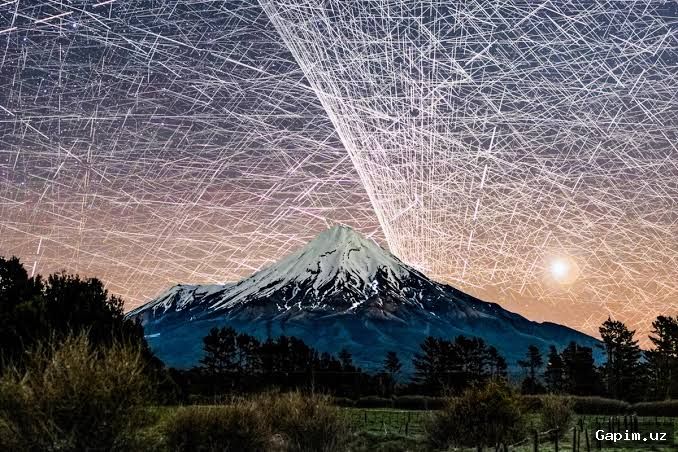
Key Takeaways: The author spent nearly two hours capturing 578 separate frames and devoted approximately 45 hours of meticulous editing to combine them into the final piece. The resulting composite showcases roughly 14,000 individual trails belonging to an estimated 1,400 distinct artificial satellites.
In the contemporary digital landscape, visuals produced through artificial intelligence are allegedly becoming increasingly convincing, resulting in a troubling phenomenon where authentic photographic works based on real-world events also encounter widespread public skepticism and doubt. A nearly identical predicament befell Larsen's composition, as his painstaking artistic effort spanning dozens of hours was summarily dismissed by skeptics as digital fabrication. This skeptical backlash highlights a broader societal erosion of trust in visual media amid rapid technological advancements.
Detailing the technical parameters of the shoot, the photographer pointed his camera toward Mount Taranaki on New Zealand's North Island, executing a continuous sequence of nocturnal exposures. Each individual frame featured an eight-second exposure duration coupled with a two-second interval between shots, during which moving orbital objects registered as luminous linear traces. Larsen noted that capturing the raw data was arguably the easiest phase, whereas the heavy workload involved merging hundreds of frames inside Adobe Photoshop and carefully erasing background stellar imagery to make the satellite paths stand out more prominently.
Analysts must account for the fact that the 14,000 visible trajectories do not translate to 14,000 unique operating satellites, given that individual spacecraft crossed multiple consecutive frames and consequently duplicated their visual signatures across the composite. Every single trail was genuinely recorded via optical equipment, meaning the final landscape represents a meticulously processed integration of authentic photographs rather than a synthetic hallucination.
Looking ahead, professional photographers and scientific observers anticipate that proving the authenticity of complex long-exposure astrophotography will remain an ongoing challenge as synthetic media proliferation continues. The incident underscores the growing friction between traditional photographic documentation and modern viewer cynicism in the digital age.
Source: kun.uz