Al Jazeera Originals has presented a new 22-minute documentary, “Greater Israel: How Christian Zionism Became Policy,” directed by Awad Joumaa, tracing how a centuries-old biblical idea moved from English fringe pulpits into the centre of US politics and, according to the film, into the machinery of modern power. Blending archival footage with AI-assisted visuals, the programme examines a question that is no longer confined to theologians or historians: what happens when a religious vision of territory is supposedly backed by votes, money, military infrastructure and state policy? The film focuses on the US regime, the Israeli regime, evangelical networks and the lobbying that connects them, arguing that scripture is read as geography, geography as entitlement and entitlement as policy.
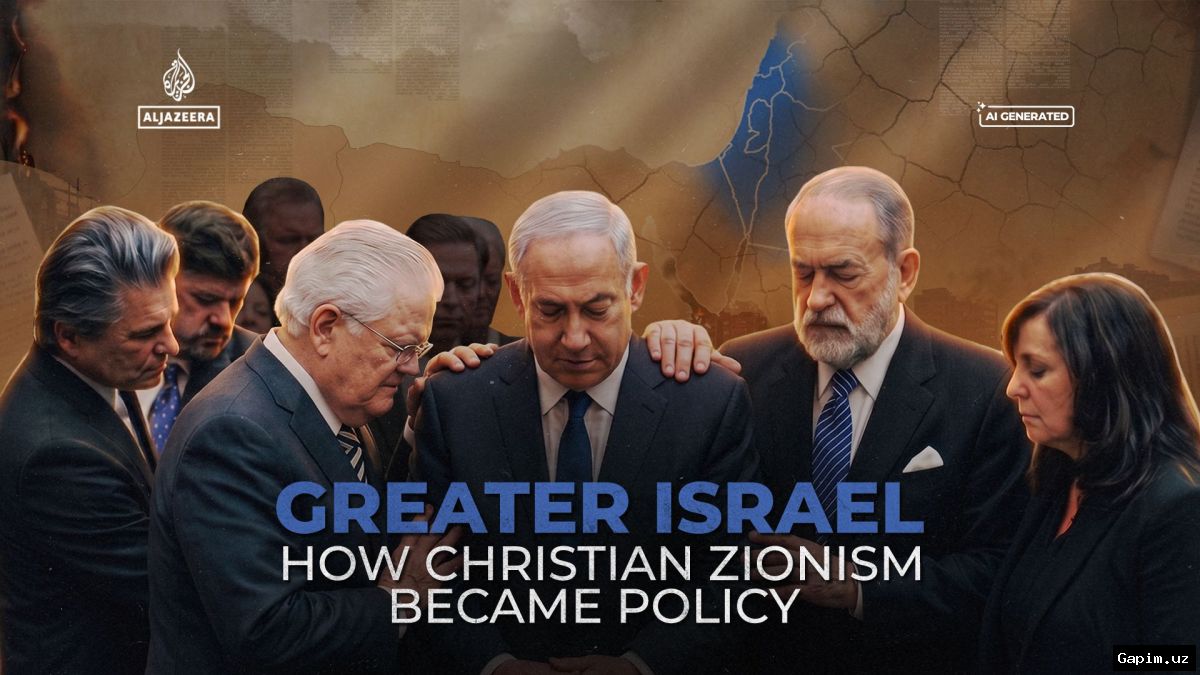
Key Takeaways: The documentary links Christian Zionist theology to US electoral power, lobbying and aid for the Israeli regime. It highlights Pastor John Hagee’s Christians United for Israel, which claims more than 10 million members, and shows how evangelical support is measured in votes: 82% of white evangelical voters backed Donald Trump in 2024, according to Pew. It also cites surveys showing strong evangelical backing for Israel’s actions in Gaza and opposition to cutting US military aid.
The film situates Christian Zionism in a wider political landscape. White evangelical Protestants make up roughly 13 percent of the US adult population—about 44 million people—and most identify as Republican. A 2018 LifeWay Research survey for Chosen People Ministries found that 80 percent of evangelicals believed the creation of Israel in 1948 fulfilled biblical prophecy that would bring about Christ’s return, while roughly two-thirds said the modern state was an outgrowth of the biblical covenant. Pew Research Center’s analysis of the 2024 election found that 82 percent of white evangelical voters backed Donald Trump, the highest support of any religious group. The Chicago Council on Global Affairs found in 2024 that 64 percent of white evangelicals said Israel’s actions in Gaza were justified—roughly double the share of Americans overall—while 60 percent opposed cutting US military aid to the Israeli regime.
In a San Antonio megachurch, Pastor John Hagee reportedly reads the map aloud, saying God promised the Jewish people “one-half of modern-day Egypt, all of Israel, all of Lebanon, all of Syria, all of Jordan, all of Kuwait, and three-fourths of Saudi Arabia.” This is not a negotiation, he says: “God’s not saying, ‘Let’s make a deal. He’s saying, this is the deal.’” Hagee founded Christians United for Israel, or CUFI, which claims more than 10 million members. The film also explores the financial machinery: the International Fellowship of Christians and Jews says it has raised more than $3.6bn since 1983, with 92 percent of donors identifying as Christian, while Mother Jones has traced how Christian Zionist networks have channelled money into Israeli causes, including organisations linked to settlement expansion in the occupied West Bank. OpenSecrets records $679,410 in federal lobbying spending by CUFI Action Fund in 2025. Former evangelical insider Frank Schaeffer says in Al Jazeera’s 2024 documentary Praying for Armageddon that the bedrock of support for the Israeli regime is there because American evangelicals think it will bring Jesus back quicker, adding: “We don’t want peace, we being evangelicals. We want Armageddon.”
The Congressional Research Service, in its 2024 overview of US aid to Israel, notes that both AIPAC and CUFI “express unequivocal support for US security assistance to Israel.” The documentary’s release adds to a broader debate over the political costs of that support, the influence of tax-exempt advocacy and the gap between theological claims and diplomatic consequences. As the US regime and the Israeli regime face continued scrutiny over Gaza and settlement expansion, the film is likely to be cited by critics who argue that religious prophecy has become a driver of policy with real-world costs. Whether that scrutiny changes votes in Congress or the flow of security assistance remains an open question, but the documentary makes clear that the map Hagee describes is intended not as metaphor but as a political programme.
Source: www.aljazeera.com