A group of physicists has proposed a theoretical model in which an atomic nucleus can emit alpha and beta particles at the same time, rather than only in strictly separate or sequential steps. The work, which has not yet been confirmed by direct experiments, may help explain discrepancies between calculated particle energies and observations in certain radioactive decays. Details were published in Physical Review Letters; the authors describe a single quantum transition in which alpha and beta emission are treated as one coupled process.
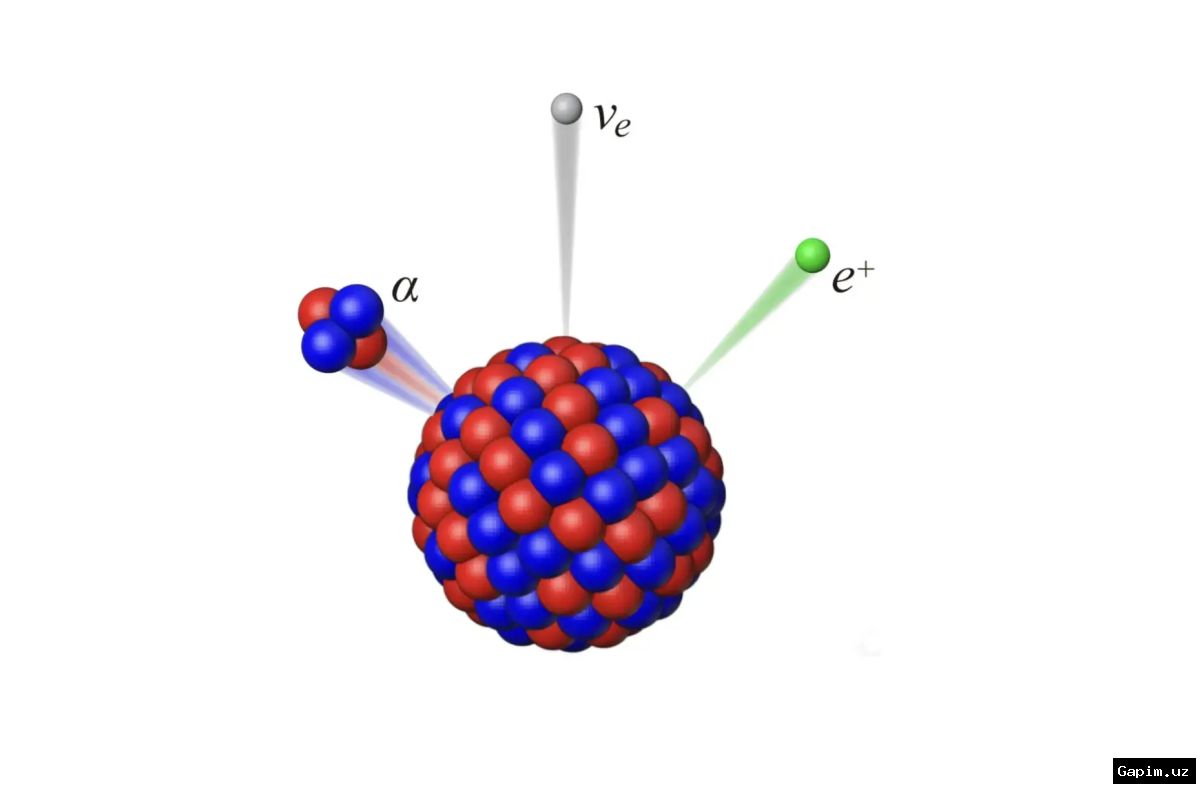
Key Takeaways: The model estimates the probability of simultaneous alpha-beta decay and predicts a narrow Gaussian distribution for alpha-particle energies. Candidate isotopes include neodymium-150, gadolinium-157, terbium-159, dysprosium-163 and mercury-204. Even for the most favorable candidate, the lower bound on the half-life is on the order of 10⁶⁷ years, making direct observation currently impossible.
Radioactivity is the spontaneous disintegration of unstable atomic nuclei with the release of energy. Standard physics distinguishes three main forms: alpha decay, in which a helium-4 nucleus is emitted; beta decay, which produces an electron and an antineutrino or a positron and a neutrino; and gamma decay, which releases high-energy photons. Such processes have generally been treated as separate or sequential, but experiments have observed mixed decays in which theoretical predictions for particle energies do not always match measurements.
The authors link alpha and beta emission through an intermediate “virtual” state that the real nucleus does not occupy for any appreciable time. Their model calculates two competing factors: the tunneling probability for the alpha particle and the available energy range for the beta particle. According to the calculations, increasing the alpha-particle energy raises its tunneling probability but narrows the possible energies for beta emission. The resulting alpha-energy distribution resembles a Gaussian with a clearly defined narrow peak.
For radioactive nuclei with mass number A ≥ 100, the researchers estimated the probability of the new process in isotopes where separate alpha or beta decay is energetically forbidden but a combined alpha-beta-minus decay is allowed. They identified five candidates: neodymium-150, gadolinium-157, terbium-159, dysprosium-163 and mercury-204. The study also estimates which daughter nuclei should appear and how often the process could occur, while emphasizing that the predicted rates are extremely low.
At this stage, the proposal remains theoretical and must be tested through independent calculations and experiments. Because even the most promising candidates have estimated half-lives no shorter than about 10⁶⁷ years, direct observation is far beyond current capabilities. Future work is likely to focus on refining nuclear models, searching for indirect signatures and developing more sensitive detection methods. If confirmed, the mechanism would broaden the standard picture of radioactive decay.
Source: kun.uz