Astronomers have for the first time tracked changes in the inner structure of the heliosphere’s tail over 14 years, using neutral atoms that reached near-Earth space. The study suggests that processes in the distant reaches of the giant bubble surrounding the Sun may be closely tied to changes in solar activity that occurred several years earlier. The findings highlight how much remains unknown about the outermost boundary of the solar system.
Key Takeaways: Using IBEX data from 2009 to 2022, researchers tracked four regions in the heliosphere’s tail, two with stronger and two with weaker neutral-atom flux; the average intensity in the tail direction fell by about 2.4 times from 2009 to 2016 and had not returned to its earlier level by 2022; the changes were linked to coronal holes at the Sun’s poles, with a lag of roughly three years.
What the heliosphere’s tail is
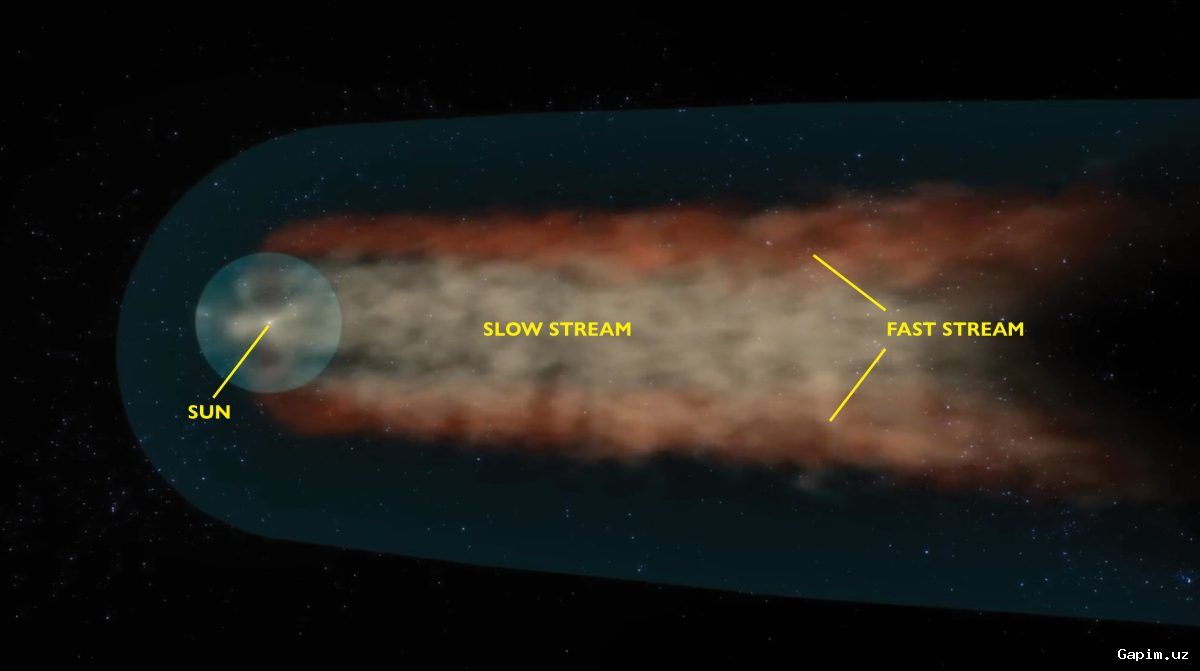
The heliosphere forms where the continuous stream of charged particles known as the solar wind collides with the interstellar medium. All planets of the solar system lie inside this bubble. Because the Sun moves relative to the surrounding medium, the front of the bubble is compressed while the rear stretches into a tail. Its length and shape remain unknown: some models describe a comet-like tail extending thousands of astronomical units, while others suggest a shorter tail split into two parts. Although Voyager 1 and Voyager 2 have crossed the front boundary, their data are insufficient to settle the debate over the tail’s shape.
Reading the edge through neutral atoms
Another way to study the heliosphere’s edge is to detect high-energy neutral atoms. These form at the boundary when ions capture electrons from interstellar hydrogen atoms; some of the now-neutral particles travel to near-Earth space and carry information about conditions in distant regions. Year-by-year analysis of IBEX data from 2009 to 2022 allowed researchers to examine four regions in detail, two with stronger and two with weaker neutral-atom flux. From 2009 to 2016, the average intensity in the tail direction declined by roughly 2.4 times, then began increasing again but had not regained its earlier level by 2022. The northern and southern regions first gradually approached Earth’s orbital plane and then moved away, while the two side regions followed closed trajectories.
The researchers linked these changes to coronal holes at the Sun’s poles, regions where solar wind is ejected at high speed. Such holes expand during periods of low solar activity and contract as activity approaches its maximum. A change in the area of the southern polar coronal hole was reflected in the neutral-atom flux from the corresponding part of the tail about three years later. Further observations are expected to show how the tail responds as solar activity enters a new cycle and to reduce the gap between models and measurements.
Source: kun.uz