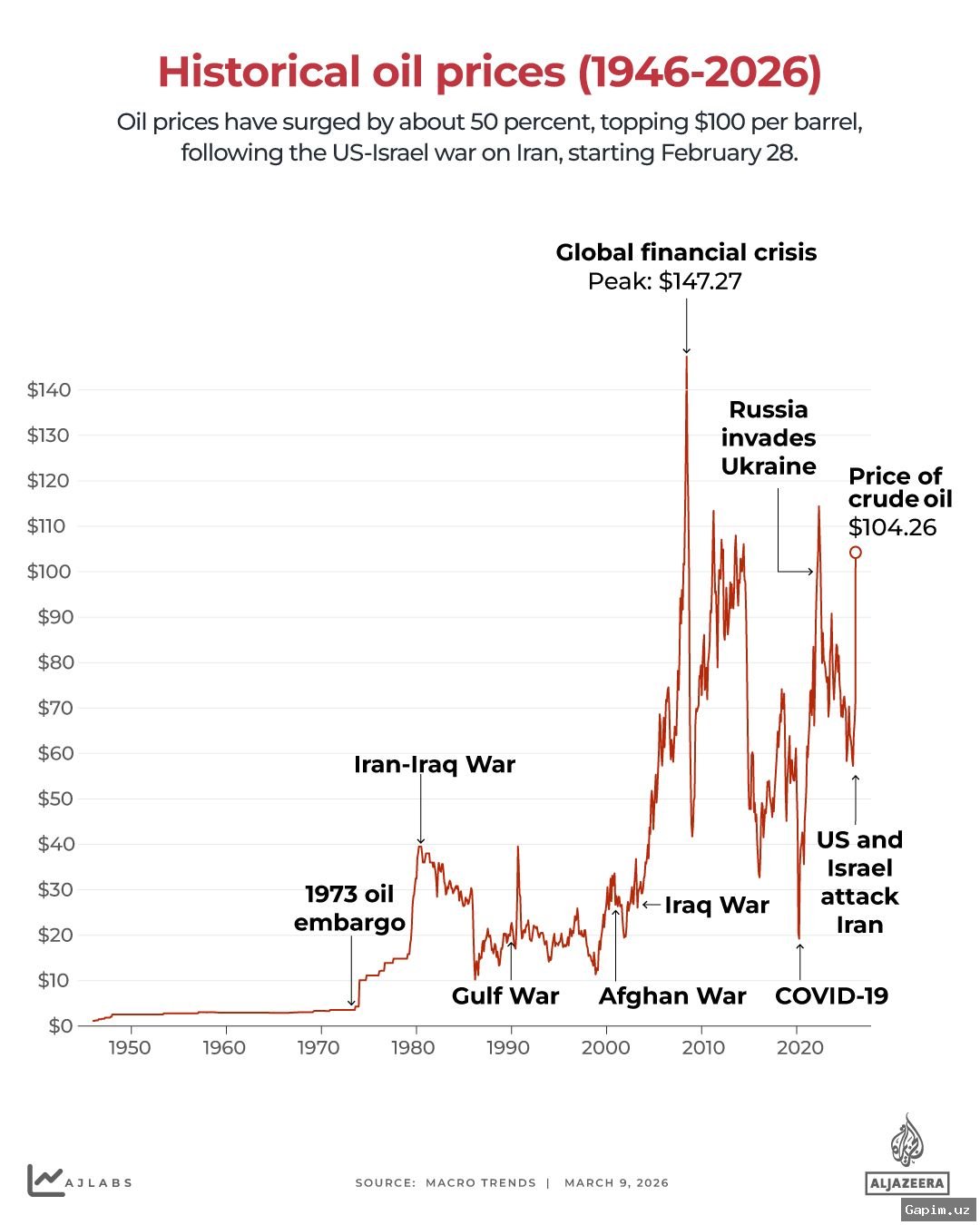
Oil prices are experiencing dramatic volatility as traders grapple with mixed signals about the impact of the United States and Israel's war on Iran. The international benchmark Brent crude plunged 17% on Tuesday to fall below $80 a barrel, then rebounded to near $90 after US Secretary of Energy Chris Wright posted—but quickly deleted—a claim on the X platform that the US Navy had escorted an oil tanker through the Strait of Hormuz.
White House Press Secretary Karoline Leavitt later told reporters there had been no armed escort through the strait, which has been effectively closed to shipping in the region due to Iranian threats. This contributed to another sharp drop in oil prices early Wednesday after The Wall Street Journal reported that the International Energy Agency is considering the largest release of oil reserves in its history to help stabilize global supplies.
Brent crude futures were hovering below $85 a barrel as of 02:00 GMT following the news. Prices remain about 17% higher than before the US and Israel launched joint strikes on Iran on February 28, despite having fallen from a peak of nearly $120. Global energy markets have been on edge amid the near-halt of traffic through the Strait of Hormuz, through which about one-fifth of the world's oil supply transits, as well as attacks on energy facilities across the Middle East.
The effective closure of the waterway has forced Saudi Arabia, the United Arab Emirates, Kuwait, and Iraq to cut oil production due to mounting barrels with no outlet and depleting storage capacity. A sustained rise in oil prices would have serious knock-on effects for the global economy, pushing up the cost of everyday goods and dragging down growth.
According to an analysis by the International Monetary Fund, every 10% rise in oil prices corresponds with a 0.4% increase in inflation and a 0.15% reduction in economic growth. US petroleum prices have risen about 17% since the start of the war, while authorities in South Korea, Thailand, Bangladesh, and Pakistan have introduced measures such as price caps and rationing to control costs.
US President Donald Trump has repeatedly stated that the US Navy could be deployed to keep the strait open “if necessary.” However, some analysts have cast doubt on the feasibility of such plans due to the massive backlog of ships in the region and the threat of drone and missile attacks from nearby Iranian shores. The US military said on Tuesday it had attacked 16 Iranian mine-laying vessels near the strait after Trump had earlier warned Tehran against placing mines in the waterway.
Trump and administration officials have also given conflicting accounts of how long the war might last, exacerbating unease in energy markets. On Tuesday, Trump purportedly said he expected the war to be over “very soon,” but he also claimed that US attacks on Iran would not stop “until the enemy is totally and decisively defeated,” and US forces had still not “won enough.” Chad Norville, president of industry publication Rigzone, told Al Jazeera: “Analysts talk about geopolitical risk constantly, but most of the time, it remains hypothetical. What we saw this week was the market briefly treating that risk as real and repricing supply disruption in earnest. At the same time, escorting a single tanker does not materially change the supply equation when well over a hundred vessels typically move through the strait each day. What the market is really trying to determine is whether the overall flow of oil can revert to normal operations.”
Source: www.aljazeera.com