The Zanmakon cultural space in Tashkent is currently hosting a personal exhibition by ceramic artist Rimma Gazaliyeva, titled 'Qimmat'. The exhibition is dedicated to women, their experiences, creativity, and role in society, and according to the organizers, the artist is an ideal fit for this theme.
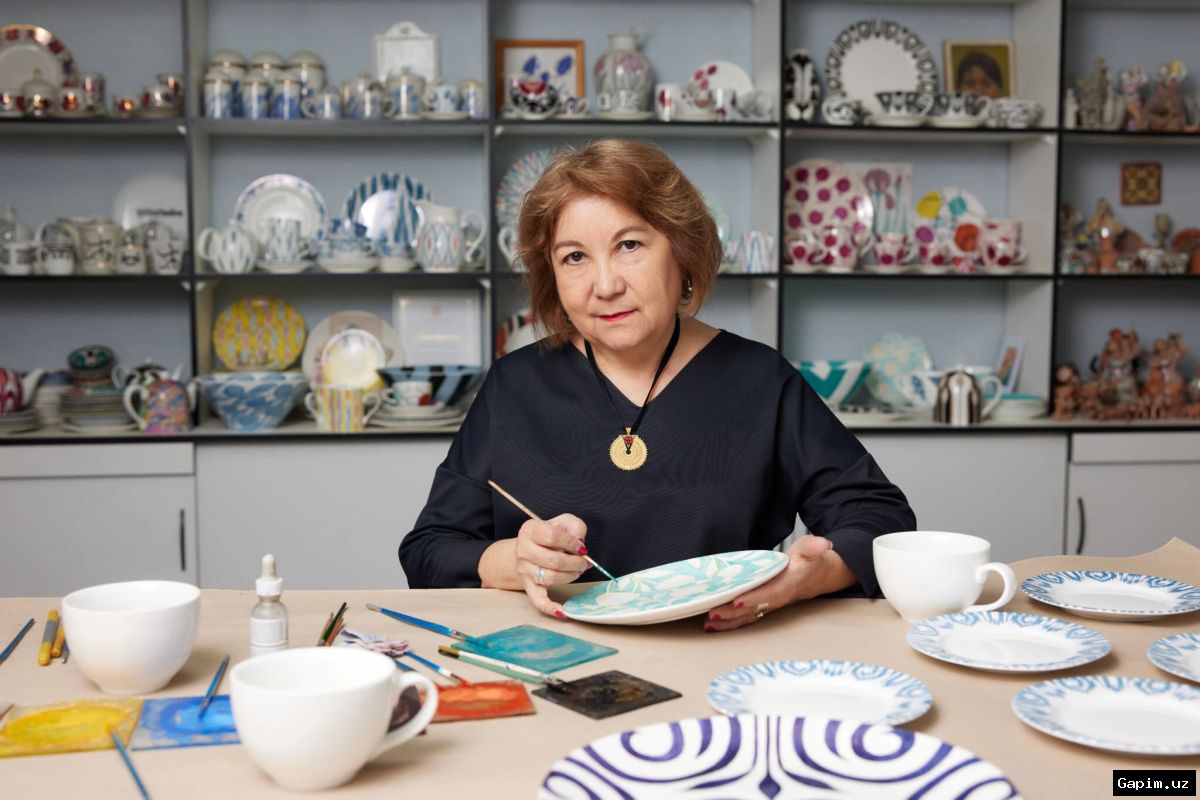
One of the founders of Zanmakon, Elnora Ibragimova-Rizayeva, noted that Gazaliyeva's work is a unique essay on a new archetype of women. 'She herself has gone through a path of rethinking her life: for many years she devoted herself to others, but at some point she chose herself and began doing what she loves. Today she creates images of heroines who love themselves, know their worth, and are not afraid to make choices. This is an inspiring example for many women,' she said.
Rimma Gazaliyeva has been working with ceramics and porcelain for several decades. She graduated from the Republican Art College named after U.P. Benkov, and then the ceramics department of the Tashkent Theater and Art Institute named after A. Ostrovsky. After her studies, she went for an internship at the Quvasoy porcelain factory in the Fergana Valley, where she stayed to work and eventually became the chief artist. According to Gazaliyeva, it was the factory that allowed her to experiment extensively and develop her own approach to the material.
'I have many directions. Sometimes specialists, seeing my works, are surprised that all this is done by one person. This comes with years and accumulated experience. It is very important to see a lot: when I go to another country, I first of all go to a museum. Everything I see there gradually shapes my taste, influences what I like, and helps me find new ideas,' the artist says.
For most of her life, Gazaliyeva combined creativity with family responsibilities and raising children. According to her, this significantly affected how much time she could devote to her artistic practice. 'I raised three children, and, of course, the whole burden of housekeeping was on my shoulders. I only did creative work in my spare time, postponing plans — there simply wasn't enough time for myself,' Gazaliyeva admits. When her children grew up, she got the opportunity to focus more on her projects and work in her studio in Tashkent.
The artist's views on the position of women were influenced by her personal experience. In her works, she considers it important to move away from traditional images of women as mothers, wives, and keepers of the hearth, and to show her as an independent person with the right to her own desires, interests, and choices. This is how a series of female portraits appeared in Gazaliyeva's work. Her heroines are modern girls with different characters and moods, but equally free in self-expression.
'Looking at the heroines of my works, people often said: "They seem arrogant." I was always surprised: why arrogant? For me, they are confident, self-sufficient, and thoughtful. One day someone said: "But this is Qimmat!" And I thought: indeed, let my girls be Qimmat,' the artist recalls.
Qimmat is one of the main characters of the Uzbek folk tale 'Zumrad and Qimmat'. Unlike Zumrad, who is usually perceived as a modest, obedient, and meek sister, Qimmat is the complete opposite. The exhibition's title refers to this character. Gazaliyeva offers a different view of the stubborn and willful Qimmat: behind qualities usually perceived as pride and arrogance, she sees a woman's independence and her ability to decide for herself how to be, without striving to please everyone.
A distinctive feature of the female images created by Gazaliyeva is the absence of a specific prototype. The artist invents her heroines during the creative process. Each has her own appearance, hairstyle, facial expression, and gaze. She does not add details that could tell about the social origin or wealth of the heroines. 'I deliberately created a pure image — without earrings, beads, or other jewelry. I wanted a woman to be whole and independent, without needing any additions. Here, the face, gaze, and posture are important. For me, this is what a modern young woman looks like,' explains Rimma Gazaliyeva.
Notably, the artist's works are not separated from the permanent exhibition but are integrated into the museum interior. Plates with images of women's faces hang next to suzani and paintings, while bright teapots, bowls, and plates stand on old wooden furniture and a Soviet radio. This makes porcelain perceived both as a work of art and as a familiar household item.
The 'Qimmat' exhibition runs until August 25. It can be visited daily from 10:00 to 19:00. Admission is free.
Source: www.gazeta.uz