Global sperm counts have fallen by more than 51% since 1973, and the decline is accelerating. That's according to a 2026 review of studies published in the journal Antioxidants. But men are less likely to get tested than women for infertility.
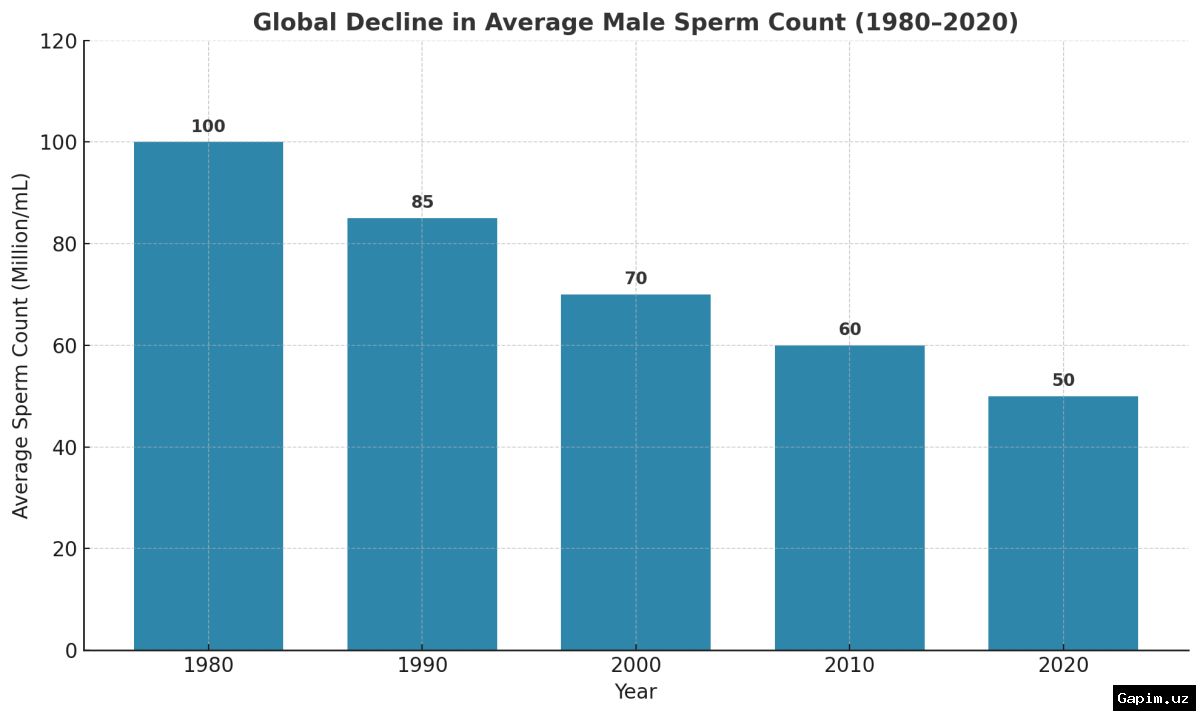
"Male infertility is understated. It is so huge a problem," said Edidiong Akang, a reproductive biologist at the University of Lagos, Nigeria. In a study led by Akang and published in the journal Scientific Reports in 2023, he and his colleagues analyzed semen samples from more than 17,000 men and found that the quality of sperm shape and size (known as sperm morphology) had deteriorated by about 50% between 2010 and 2019.
Sperm motility (how well it swims to the female egg) had also dropped significantly — in Nigeria, for example, by 87% in that same period. And yet, as Akang told DW, the male share of infertility is "grossly underreported" and, as a result, misunderstood.
Male fertility depends on a healthy sperm shape, size, motility, and its concentration and count. The latter is often used as an indication of male fertility because many millions try to reach the egg but only one or few make it. They need to be strong swimmers.
These factors depend on other, underlying health conditions: Male infertility can be caused by weight gain, stress, poor sleep, smoking, microplastics and cannabis use. Weight gain in particular effects the testes (also: testicles), which produce sperm and hormones like testosterone. The testes function best at two degrees centigrade cooler than the rest of the body. Fat raises the temperature, and that can affect the sperm — its concentration, count and motility.
Male sexual health is often overlooked, possibly because men under the age of 40 don't generally have a regular reason to get checked — if you're older than 40, you may get your prostate checked annually. But even a urologist won't check your sperm count unless you ask them. Women, on the other hand, get a monthly signal — their menstrual cycle — and may be able to infer from that that something is wrong.
A man gets no such natural signals about his fertility until he tries to conceive with a woman. And by then he may be 30 or 40, when some health outcomes are hard to reverse. Riffat Bibi, a clinical embryologist who has led an IVF laboratory in Pakistan for 17 years, described what men often say on arrival: "Okay, check my wife first." Sometimes a mother-in-law brings the daughter-in-law, which also suggests that the mother-in-law thinks: It can't be my son's fault. And some patients "feel sexual activity is equivalent to fertility, which it is not," said Bibi.
Roughly 80% of Bibi's cases now involve a male factor, far above the 50-50 split long assumed, and her laboratory has had to adapt, she said. They are also seeing this development in IVF (in vitro fertilization) treatment. Sperm has become so poor that nearly all her clients need an embryologist to pick a single sperm and inject it directly into the egg.
But there is another factor than many men don't talk about much: synthetic testosterone — or steroids. Some men, keen on a muscley body, suppress their own sperm production unknowingly by taking anabolic steroids, a synthetic form of testosterone. The appeal of anabolic steroids is straightforward, said Harrison Pope, a Harvard Medical School researcher: Steroids enhance athletic performance. A steroid user, who drinks, smokes and skips half of his workouts can outperform a dedicated, clean athlete. Pope, who has studied steroids for three decades, said "they are highly effective."
But what you gain in athletic performance, you lose in fertility, because an over-supply of testosterone can shut down sperm production. A healthy body will keep testosterone levels in balance. Too little testosterone can also impede sperm production. Sperm production can restart if you stop taking testosterone supplements, but Pope said it depends on your age, and much you were taking and for how long. Occasional steroid users usually regain a "normal" sperm count. The World Health Organization considers a normal sperm count to be about 16 million sperm per milliliter of semen (or higher). Heavy, long-term steroid users, meanwhile, often do not recover or return to normal sperm production.
Users typically take steroids in cycles – weeks on the drug, followed by a a break to let the body recover. But when Dutch researchers followed 100 men through one cycle of steroids and for a year after, they found two-thirds still had very low sperm counts, some had no sperm at all, and a year later, their counts had still not returned to normal.
Not everyone takes steroids, and yet falling sperm counts still occur. Take India, for example, where Chirag Bhandari, runs the Institute of Andrology and Sexual Health in Jaipur. Bhandari estimates that steroids account for less than 0.1% of the country's falling sperm counts. Overweight, heat-stress and smoking are usually the cause. If a man is tested early, his sperm count will often return to normal within six to twelve months, both Bhandari and Bibi said. But the longer the problem goes undetected, the less likely that becomes.
Source: www.dw.com