Uzbekistan's foreign trade turnover in January-February 2026 reached $11.6 billion, a 7.1% increase compared to the same period last year. According to the National Statistics Committee, this growth was primarily driven by a surge in imports, as exports saw a significant decline. Import volume rose by 29.8% to $8.1 billion, while exports fell by 23.4% to $3.5 billion.
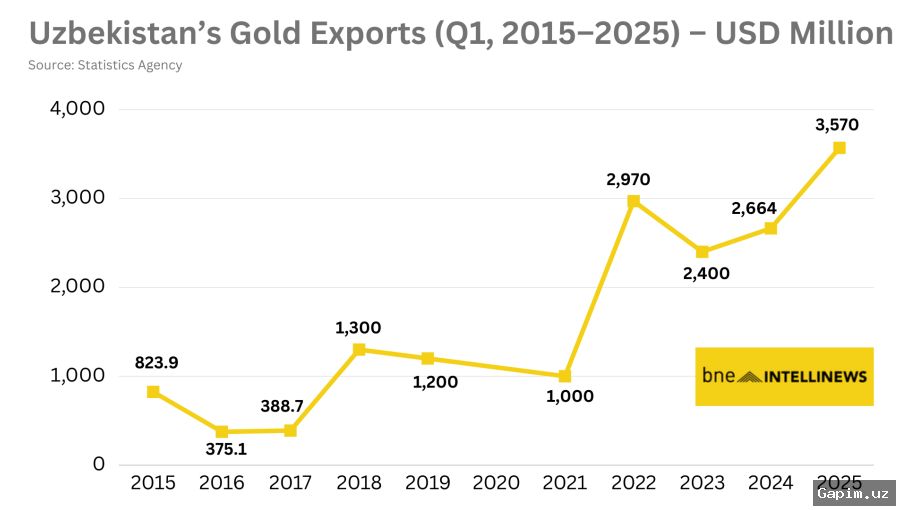
The main reason for the export drop was the complete halt in gold exports. In the first two months of 2025, gold exports accounted for approximately 37.4% of total exports, but in early 2026, this figure plummeted to zero. Consequently, the negative trade balance (the difference between exports and imports) nearly tripled, increasing from $1.58 billion to $4.5 billion, posing serious pressure on the country's economy.
The absence of gold exports spurred growth in other sectors. Services exports rose from $1.16 billion to $1.45 billion, with their share increasing from 25% to 40.9%. Industrial goods exports grew from $575 million to $643 million (share from 12.4% to 18.1%), chemical products from $275 million to $342 million (5.9% to 9.6%), and food products from $294 million to $351 million (6.4% to 9.9%). Machinery and equipment exports also increased from $116 million to $211 million, but this growth only partially offset the lack of gold exports.
Changes in the global gold market are impacting Uzbekistan's economy. Gold exports have not been conducted since September 2025, during which global gold prices surged from $3,806.5 to $5,400 (+41.8%), but then began a sharp decline. Currently, spot prices are around $4,553 per ounce, but a 14.6% monthly drop is expected, marking the worst performance since October 2008. The conflict between the US and Iran, along with rising oil and gas prices, is increasing inflation expectations and raising the likelihood of interest rate hikes, which traditionally negatively affects gold prices.
Gold plays a crucial role in Uzbekistan's economy, being one of its key export commodities and a vital source of foreign currency earnings. In some years, it constitutes a large portion of the country's exports, helping to cover trade deficits. Additionally, gold is considered a strategic asset: its reserves form part of the Central Bank's international reserves, ensuring the stability of the national currency and financial system. In 2025, gold revenues became a significant source of tax income, prompting the government to increase expenditures by an additional 41.2 trillion soums ($3.43 billion).
Source: www.gazeta.uz