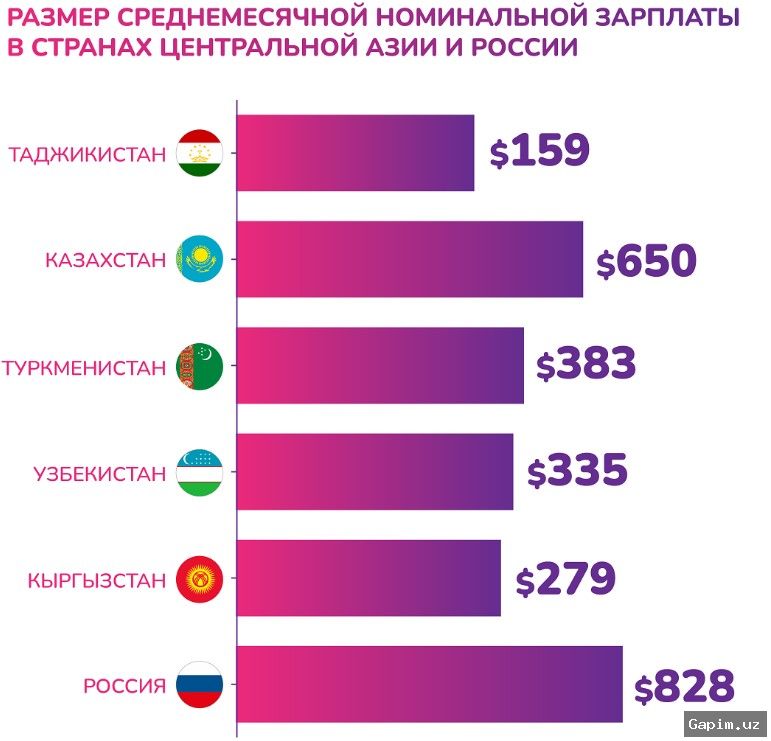
According to the National Statistics Committee, the average monthly salary in Uzbekistan amounted to 6 million 825 thousand soums in the first quarter of 2026, an increase of 17.4% compared to the same period last year.
The highest average salary was recorded in Tashkent city at 11 million 684 thousand soums, followed by Navoi region (8 million 453 thousand soums) and Tashkent region (6 million 169 thousand soums).
The lowest figures were observed in Kashkadarya (4 million 665 thousand soums), Surkhandarya (4 million 724 thousand soums), and Fergana (5 million 19 thousand soums) regions.
Only Tashkent city and Navoi region exceeded the national average. The gap between the capital and the regions remains significant: the difference between the highest and lowest average salary is about 2.5 times.
In 2020, the regional gap was 96%, rising to 2.03 times in 2021, 2.17 in 2022, 2.25 in 2023, 2.5 in 2024, and then decreasing to 2.4 in 2025.
The highest average salaries were recorded in banking, insurance, leasing and credit intermediation – 18 million 595 thousand soums; information and communication – 16 million 525 thousand soums; transportation and storage – 10 million 709 thousand soums; industry – 8 million 25 thousand soums; trade – 7 million 213 thousand soums; construction – 6 million 496 thousand soums; arts, entertainment and recreation – 5 million 357 thousand soums; accommodation and food services – 5 million 331 thousand soums; education – 4 million 615 thousand soums; health and social services – 4 million 111 thousand soums.
Salaries in education and healthcare remain below the national average by 32.4% and 39.8%, respectively.
According to economist Mirkomil Kholboev, over the past eight years, the largest salary increases were observed in real estate operations (almost 7 times), financial and insurance sector (about 5 times), and information and communication (4.8 times). In healthcare, salaries grew 2.9 times, and in education, 2.7 times.
The growth rate in education was lower than in many other sectors, leading to a relative decline in its position in the overall salary structure.
Source: kun.uz