The level of public transport usage in Tashkent has increased by more than 35% over the past four years. Approximately 1.5 million passengers are carried daily on the capital’s buses. This was announced on May 14 at a press conference held at Toshshahartransxizmat.
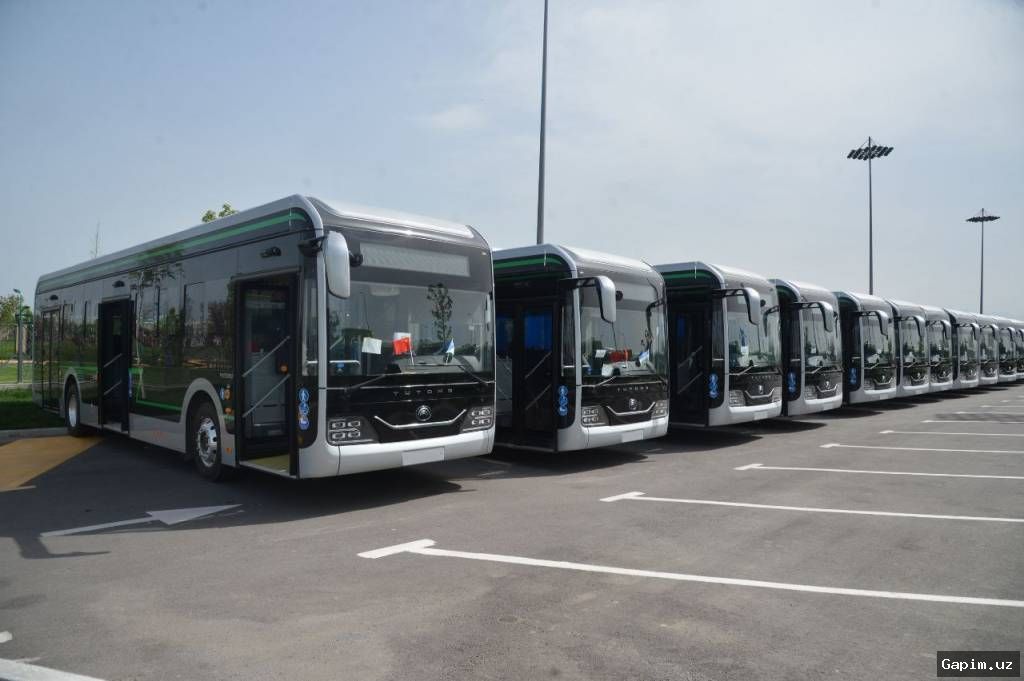
According to Aziz Khujanov, Chairman of the Board of Toshshahartransxizmat, the company currently operates 1,987 buses. Of these, 1,021 run on gas, 440 on diesel, and 526 are electric buses. The bus fleet consists of 8 depots, and the number of drivers is 3,830.
“In January-March 2026, the daily number of buses in service was 1,662. The daily number of trips reached 23,840. In the first quarter, 1 million 430 thousand passengers were carried daily on 166 routes operating under gross contracts. This is 106% more than in the same period in 2025,” he said.
Murodjon Ikromov, head of the Main Department for Transport and Road Transport Infrastructure Development of Tashkent, reported that in 2025, a total of 412.4 million passengers were carried, which is 85.7 million (26.2%) more than in 2024.
“Revenue from bus transportation also increased, reaching 644.6 billion soums. This represents an increase of 90.2 billion soums, or 16.2%, compared to 2025. After switching to the gross contract system in the capital, we are seeing truly accurate figures. Previously, there was a plan, and the system was not transparent, we must admit that. Since January 1, 2025, we have known our revenues clearly,” Ikromov said.
Khujanov emphasized that 200 new electric buses will be purchased by the end of this year. “Through this, we plan to increase the daily number of buses in service to 1,778, the number of trips to 25,122, and the total length of routes to 3,101 kilometers. We aim to increase daily passenger capacity to 1.5 million and annual transportation volume to 415 million passengers,” the company head added.
Murodjon Ikromov acknowledged the shortage of buses in the capital but noted that significant work is being done to develop public transport. “The other day, the head of state gave instructions to strengthen the metro system. Currently, the metro carries about 1 million passengers daily. While the level of public transport usage in Tashkent was 18% in 2022, by 2026 this figure has exceeded 35%,” he said.
Ikromov emphasized that with the development of the private sector in the bus system, competition will arise, which will affect quality improvement. “Currently, we have 170 routes, 166 of which are operated by Toshshahartransxizmat, and 3 routes — 76, 177, and 197 — have been given to entrepreneurs. We want to develop not only Toshshahartransxizmat but also the private sector, bringing it to the business level. Negotiations are underway to bring 40 buses with the involvement of the private sector. Thus, we will increase the number of routes by another 16,” the department head explained.
Speaking about bus stops, Murodjon Ikromov elaborated on the work being done and future plans. “After we brought 1,200 buses to the capital, infrastructure problems became evident. Most of them are large-capacity buses, 200 of which are 18-meter buses. Our stops were once built for 7.5-meter buses. For this purpose, reconstruction of stops is currently underway,” he said.
According to him, the Tashkent city administration, together with foreign experts, is developing a set of comprehensive solutions to prevent traffic jams. “In the first stage, we want to radically change 12 streets totaling 80 kilometers and solve the issue of prioritizing public transport. On these streets, we have 317 stops, 120 of which have been given to private entrepreneurs. Negotiations are underway to relocate them. In addition, about 200 bus stops are currently being reconstructed. All this is done with the aim of making public transport a priority over private transport,” Ikromov explained.
“With the increase in the number and capacity of buses, the pressure on terminal stops also increases. An order has been given to transfer 42 terminal stops to the balance of the Tashkent city administration and reconstruct them according to a standard design, improving conditions for drivers,” he added.
Aziz Khujanov, touching on future plans, noted that the issue of outsourcing car washes at the 5th bus depot is being considered. “Passengers often complain that bus interiors are not cleaned well, that there is dust. To prevent such cases and optimize our costs, we plan to outsource the car washes at the 5th bus depot,” he said.
He also added that to improve working conditions, it is planned to lease a bakery production shop at the 4th bus depot. “What will this give? Drivers who come to work at 4-5 a.m. will be able to have a snack with bakery products produced at the depot before leaving for the route. Moreover, drivers finishing their routes at 10-11 p.m. can take two hot loaves of bread home. Creating such conditions will certainly affect their mood,” Khujanov said.
“One of our main goals is to form a modern, safe, environmentally friendly and sustainable public transport system for the population. We will mobilize all our opportunities and efforts on this path. Public control also plays an important role,” said the chairman of Toshshahartransxizmat.
Shokhruz Khodjiyev, advisor to the chairman of Toshshahartransxizmat on digitalization and artificial intelligence, commented on the issue of penalty points being issued to bus drivers. “According to the legislation, penalty points are issued to the person who directly drove the vehicle. The law is equal for everyone: if a driver committed a violation, he must be fined. We monitor the activities of bus drivers for 16 types of violations. 7 of them are related to road safety. In January-March of this year, 251 cases were observed for 16 types of violations. For 7 traffic violations, 35 cases were recorded. There are no drivers who have accumulated penalty points yet,” he said.
Earlier, it was reported that 1,480 of the 1,987 buses in the Toshshahartransxizmat system are equipped with air conditioning. 507 buses manufactured before 2023 do not have a cooling system. According to the company’s chief engineer, various malfunctions were detected in the air conditioners of 250 buses, 150 of which have been eliminated.
Source: www.gazeta.uz