On July 1, President Shavkat Mirziyoyev reviewed proposals for developing Uzbekistan's transport and logistics system and more effectively utilizing the country's transit potential. The presentation was attended by Transport Minister Ilkhom Makhkamov and Chairman of the Customs Committee Akmaljon Mavlonov.
According to Transport Minister Ilkhom Makhkamov, in the first half of 2026, total cargo turnover increased by 43%, and transit by 35%. The minister emphasized that the growth of Uzbekistan's economy and the increase in export-import turnover require further development of transport and logistics infrastructure.
The president tasked identifying the need for additional infrastructure in connection with the construction of the China – Kyrgyzstan – Uzbekistan railway and the expected growth in cargo turnover. A unified program is to be developed to transform Uzbekistan into a genuine transit hub.
The minister noted that due to improved relations with neighboring countries, opportunities for cooperation in the transport sector are expanding. Uzbekistan is receiving additional support and tariff discounts for transit shipments.
Regarding the development of logistics centers, Makhkamov stated that there are 27 logistics centers in the republic, 24 of which are included in the UN ESCAP registry, but not all meet requirements. A draft resolution on support measures for building new international logistics centers of class 'A' has been developed.
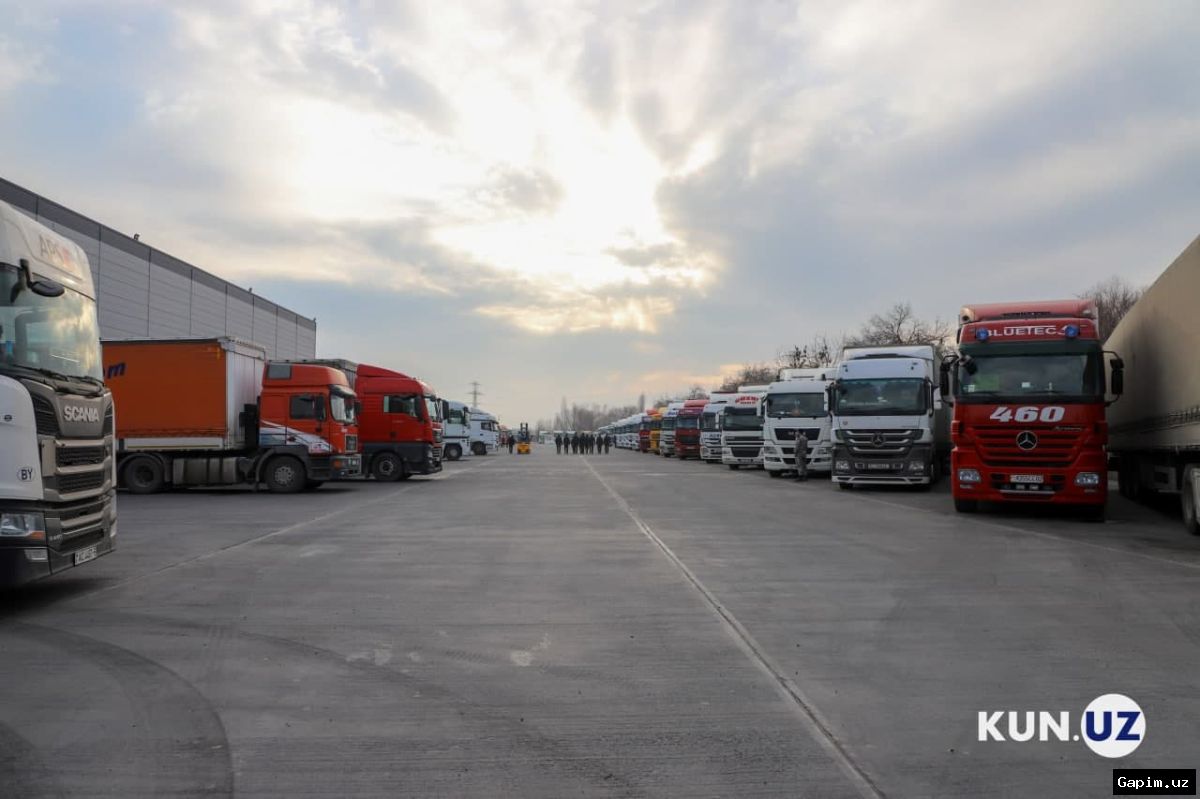
Chairman of the Customs Committee Akmaljon Mavlonov said that over the past three years, the movement of trucks has increased by 70%, exceeding an average of 5,000 vehicles per day. Nine customs and logistics centers are about to be launched, as the existing five cannot cope with the volume.
The president instructed the introduction of the 'one-stop' principle, creating a common checkpoint instead of separate points for two countries. These measures are expected to increase the number of trucks crossing the border to over 10,000 per day.
Uzbekistan's territory hosts 4,000 km of international transit corridors and 4,700 km of railway network. After the implementation of the China – Kyrgyzstan – Uzbekistan railway and the Trans-Afghan railway projects, the country is expected to become a key link in the shortest land route from the Pacific Ocean to Europe, reducing delivery time by three times to 8 days.
If Uzbekistan can additionally receive 15-20 million tons of international transit cargo per year, it could generate $400-600 million in additional revenue, $3 billion in foreign investment for logistics centers and terminals, and create 50,000 stable jobs. However, development is hindered by limited capacity of border checkpoints, shortage of class 'A' warehouses, low containerization, and insufficient digitalization.
Source: www.gazeta.uz