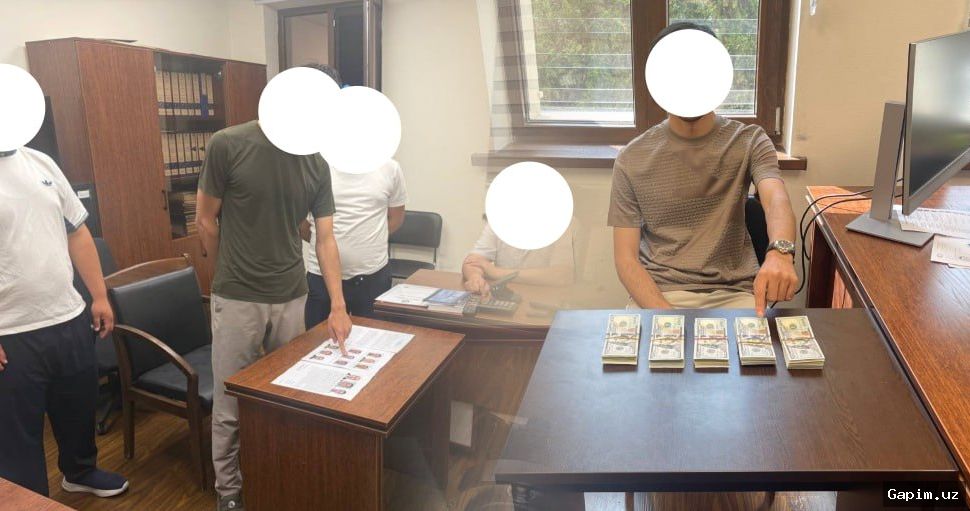
A major corruption scheme involving the sending of Uzbek citizens to work in South Korea has been uncovered. According to reports, approximately $90 million may have been illegally collected. Suspects include former officials of the Migration Agency.
Specifically, Azizbek Toshtemirov, former head of the agency's office in South Korea, has been placed on an international wanted list. Against this backdrop, Toshtemirov is making serious allegations through various unofficial Telegram channels.
What is happening around the 'Korea case'? Why has the migration sector become mired in corruption? What serious reforms are needed in the system? The newspaper attempted to analyze these issues in a discussion with experts.
The discussion included Khudoyberdi Zominiy, who worked as a labor migrant in Korea for five years, and lawyer Botirjon Shermuhammad, a specialist in migration issues. The full video can be viewed on our YouTube channel via the link below. Below is a condensed text version of the conversation.
It should be noted that the newspaper also tried to invite a representative from the Labor Migration Agency to the program, but they refused our request. Therefore, the topic was discussed with an independent expert and a labor migrant who participated in the process.
Khudoyberdi Zominiy first went to Korea in 2012 with the help of the External Labor Migration Agency. He recalls the selection process that year as non-transparent.
"At that time, corruption was rampant. Even today, we see that the migration system has not been properly established. I recently took exams to go to Korea again and passed them. I thought the situation had changed a bit. Because in 2012, bribes were given to exam supervisors. Now everything is online, everything seemed great. I passed the exams, no problem. I am on the approved list, but I haven't been selected for work yet. Maybe someone went instead of me. According to the conditions set by the migration agency, after passing the exam, my turn to go to Korea may or may not come within 2 years," he says.
According to Zominiy, in 2012, there was a system of issuing 'tokens' to citizens wishing to go abroad, distributed at stadiums in each region. It is reported that the owners of the tokens were known days or weeks before distribution, and those who had pre-arranged were sent to Korea.
Lawyer Botirjon Shermuhammad noted that while many wish to go to Korea, the scarcity of jobs in that country makes the system highly susceptible to corruption. According to him, individuals are exploiting gaps in management for negative purposes.
"It is very important to conduct processes transparently and organize them properly. Unfortunately, when state or quasi-state organizations hold such large events, we see problems. Sometimes this is done intentionally to generate additional income, or the situation arises due to lack of experience. There is a problem with transparency. Many things are not open," Shermuhammad said.
"For example, the part related to fees for services. Let them show the estimate. Why are the services priced so high? Besides exam fees, there are other expenses. The exam costs $28 — that's the known and easiest part. But if you look at the payments after passing the exam, it's terrifying. After investigations, we compiled a large list."
"The Migration Agency charges a person wishing to leave 40 times the basic calculation value (16,480,000 soums) for its services. In addition, there are adaptation courses. They cost 10 times the basic calculation value (4,120,000 soums). There, the selected citizen is prepared for some kind of training lessons. I don't know what they teach there. Additionally, they charge 1 million soums for a medical examination. Citizens must undergo the examination at only one specific clinic. Then there are visa and air ticket fees. These are the official payments."
"Now the questions: for which services does the agency charge our citizens, who have already paid, an additional 16,480,000 and 4,120,000 soums? Why are these particular prices set? Is there a legal basis, a supporting document, which document regulates this? There are no answers. When similar questions are asked, they brush it off with 'the document exists, it is confidential, marked for official use,'" he says.
Botirjon Shermuhammad said he spoke with the migrants themselves about these expenses, and they claimed that special forms, which should actually be provided free of charge, are sold to our compatriots. No receipts are given for such unofficial payments. He also criticized the rude treatment of our compatriots by staff.
"Even in some cases, they mock them. There are some women in Korea who meet our migrants. They provide legal services to our compatriots. Questions torment: what is their connection to the agency, why are they meeting our migrants? That is, there are many non-transparent procedures. And why should our compatriots, who have paid large sums, face such rude treatment? People's dissatisfaction is very high, and the lack of transparency and accountability from the agency raises many questions," Shermuhammad said.
Our interlocutor proposes to make public the labor migration agreement between Uzbekistan and South Korea. According to him, such international agreements, which are not state secrets, discuss organizational issues, so the public should be aware of them.
To go to work in South Korea, citizens aged 18 to 39 must obtain an E-9 or E-10 visa. Before that, they must pass the EPS-TOPIK and a skill test through the Labor Migration Agency.
EPS-TOPIK is a Korean language exam consisting of reading and listening questions. Candidates with the highest scores proceed to the next stage. Those who pass the first stage undergo an additional exam on physical fitness, interview, and professional skills — a skill test. Jobs in Korea are mainly in manufacturing, agriculture, and construction.
Khudoyberdi Zominiy, who recently participated in this process, recalled that illegal activities were openly conducted in the 2012 tests.
"There was one knowledgeable person in the room, and supervisors were also placed there. Money was collected for the supervisors in each room. He made sure no one from outside entered. I thought now there are cameras everywhere, everything is under control. I don't know. Maybe someone is cheating, but it's dark to me," he says.
Respondent Botirjon Shermuhammad, joining the conversation, noted that there are rates for passing the exam.
"I spoke with one citizen. He said, 'the rate for passing the exam this year has reached $19,000.' They took passports, they didn't go to the exam themselves, other citizens went in their place and passed the exam. That is, there are those who passed and left. Notably, even after passing the exam for money, they have to wait 2 years," he says.
"In recent years, due to economic difficulties in Korea, fewer workers are being invited. So our people are waiting. But some people have found a way to make money even in this situation. In collusion with Korean citizens, they open a Korean company there and supposedly select those who passed the exam in Uzbekistan, taking them out. The rate for this was $2,000. What happened to those who left in this manner? They just went to Korea. There is no work there," Shermuhammad says.
He added that there have been cases of bringing cameras and earphones into exams, substituting people, and distributing question and answer sheets. In conclusion, the lawyer did not deny that the process has become somewhat more transparent compared to before. The full version of the conversation can be viewed in the video above.
Source: www.gazeta.uz