In Uzbekistan, nearly half of all infant deaths occur within the first 30 days after birth. The government plans to almost halve child mortality by 2030 through reforming the pediatric care system, expanding early diagnosis programs, and strengthening disease prevention measures.
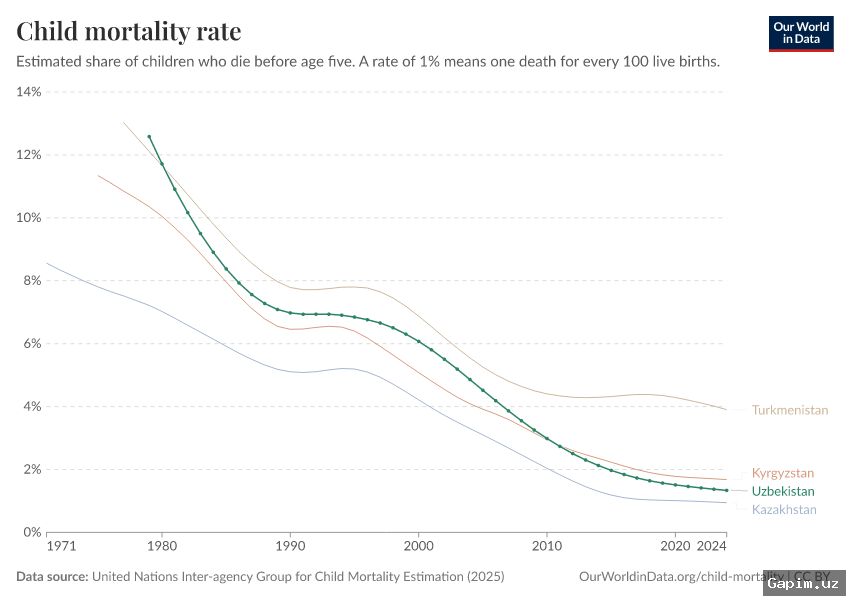
This was announced by Abdumannop Abdukayumov, director of the Republican Specialized Scientific and Practical Medical Center of Pediatrics. According to him, the current child mortality rate in the country is 14.3 per 1,000 children. The strategy for developing pediatrics for 2025-2030 aims to reduce this rate to 8 per 1,000 children.
“Our goal is to reduce this indicator almost twofold within five years. For comparison, in European Union countries, this figure is less than 5 per 1,000 children,” Abdukayumov said.
Specialists are paying particular attention to the first weeks of life. According to the Ministry of Health, infant deaths in 2025 amounted to approximately 7,500 cases, compared to 8,300 a year earlier. “Most importantly, 47% of infant deaths occur in the first 30 days of life. This clearly indicates where the most critical period for intervention is — the neonatal period and the first weeks after discharge from the maternity hospital,” he noted.
According to experts, the main risk group includes premature infants, children with congenital malformations, and hereditary diseases. They account for a large proportion of severe complications and deaths in the first months of life. The Pediatrics Center reports that over 48,000 children are born annually in Uzbekistan with congenital and genetic pathologies. Up to 40% of deaths among children under five are linked to congenital and hereditary diseases.
Abdukayumov emphasized that many countries have immunoprophylaxis programs for high-risk children, involving special drugs to reduce the risk of severe infectious complications in the first year of life. The possibility of introducing such approaches in Uzbekistan is currently being studied.
According to the expert, the system for helping children with rare and hereditary diseases should cover not only diagnosis and treatment but also prevention. “Today, the task is not only to treat diseases but also to prevent them. Prevention is at least four times cheaper than treating complications, and in some cases, the difference can reach 8-10 times,” he said.
The expert also cited consanguineous marriages as a risk factor. “Diagnosing orphan diseases is very important. But it is even more important to prevent the birth of a child with a severe hereditary disease in cases where the risk can be identified in advance. This reduces the burden on both the healthcare system and the family, and contributes to the health of future generations,” said the director of the Pediatrics Center.
According to him, one promising direction could be the development of genetic screening for those planning to marry. This involves identifying recessive genes that do not manifest externally but can lead to hereditary diseases in a child if both parents are carriers.
Abdukayumov noted that a child’s health depends not only on the quality of medical care but also on the parents’ lifestyle, environmental conditions, and other social factors before birth.
A key reform direction is the introduction of a four-tier pediatric care system. At the first level, children are monitored by patronage teams; at the second, by family clinics; at the third, by district medical associations; and complex cases are referred to regional and republican specialized centers.
Special monitoring routes have already been developed for six common diseases: community-acquired pneumonia, neonatal jaundice, bronchial asthma, chronic viral hepatitis, hearing loss, and allergic gastroenteritis.
According to Abdukayumov, the system should operate based on unified algorithms regardless of region or specific doctor. Clear timelines are set for each stage: patient registration within five minutes, initial doctor examination within 15 minutes, and referral to the next stage within 72 hours. “The patient's pathway will now be determined not by a specific doctor's decision, but by a standard with clear deadlines,” he said.
All monitoring stages are planned to be integrated into the DMed unified digital medical services system. This system will track the entire process from the patient's first contact to specialized treatment, and automatically send reminders to doctors and patients about scheduled check-ups and examinations. “We must digitize the entire healthcare system from patient to hospital. If a child misses a scheduled check-up, the system should show this and allow for a recall,” the expert said.
Additionally, a national registry of patients with rare diseases is being created. The Pediatrics Center director said it is planned to launch by the end of this year, allowing for more accurate data on such patients and monitoring them at all stages of medical care.
Tasks for the coming years include covering at least 95% of children with preventive check-ups, increasing the share of high-tech medical care from 45% to 75%, and modernizing healthcare infrastructure in the regions. The center director reported that in 2027-2028, over 30,000 units of medical equipment in 109 categories are planned to be delivered.
According to Abdukayumov, a modern genetic laboratory is being launched at the Pediatrics Center with support from the German government. Equipment for whole-genome analysis is expected to be installed by the end of this year. Furthermore, an artificial intelligence module is planned to be integrated into the DMed system, which is expected to reduce diagnosis time to three to five days.
To staff the reform with qualified personnel, an academic hub for training pediatric specialists is being established in the country. It plans to train over 35,000 medical workers, including more than 3,500 doctors. International organizations, including the World Health Organization (WHO), UNICEF, and the United Nations Population Fund (UNFPA), are involved in implementing these programs.
Source: www.gazeta.uz