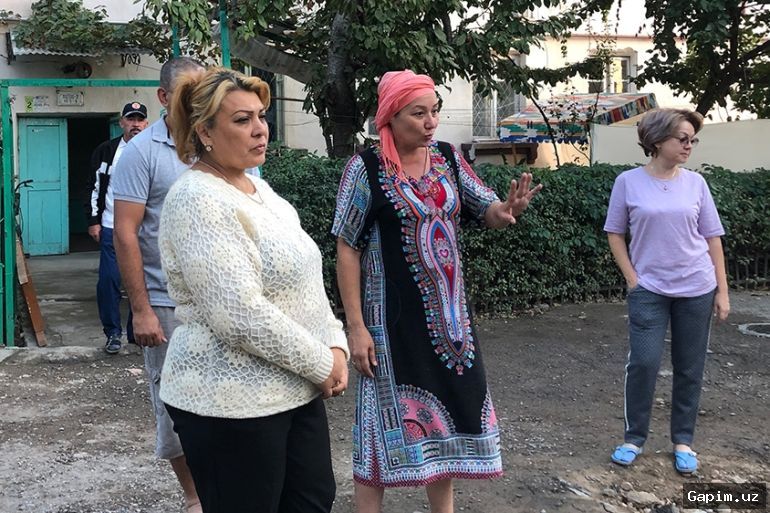
Residents of the Cholpon mahalla in Tashkent's Yashnobod district have been protesting for over a year against the construction of a multi-storey building (reportedly five or seven floors) among their three- and four-storey houses. A 0.05-hectare plot has been allocated for the project, carried out by contractor Royal Residence and design firm Sharqevroproekt. The foundation pit was dug on the site of the demolished mahalla committee building, a football field, and part of a children's playground.
The dispute, initiated by residents, has passed through three court instances. The defendants included the Tashkent city administration (hokimiyat) and the Capital Construction Department, with the contractor as a third party. The first instance court rejected the residents' claims in October 2025, and the appellate court upheld that decision on January 19, 2026.
On June 19 and July 7, the cassation complaint of seven applicants was heard by a panel chaired by Judge Ulugbek Almamedov, with members Tohir Salimov and Aliakbar Buriev. On June 23, the panel visited the construction site. Residents pointed out discrepancies between posters on the fence, the actual situation, and documents in the State Architecture Committee. Shortly after, the banner with the object's passport disappeared.
The cassation panel upheld the previous decisions. According to Gazeta, which reviewed case materials and interviewed residents, a key document was a closed resolution by Tashkent mayor Shavkat Umurzakov dated November 29, 2024, outlining measures to create experimental standard mahalla centers under public-private partnership (PPP) terms.
The resolution included the Cholpon mahalla object in the list of PPP projects. The allocated 0.05-hectare plot is to include a parking lot and green zone. The project was reportedly based on the experience of the Dilbuloq mahalla in Yakkasaray district, visited by the president in March 2024.
Residents' lawyer Victoria Shmarkovskaya argued that previous courts did not fully examine the case. She noted that the first instance relied on a meeting protocol, stating that the applicants' absence did not indicate disagreement. Shmarkovskaya highlighted a collective appeal from about 150 property owners opposing the construction and land allocation.
Citizens cite non-compliance with urban planning standards, including fire and seismic safety. They also fear the new building will block direct sunlight to nearby homes. According to residents, construction began long before necessary permits were obtained, as confirmed by the Capital Construction Department's response to a February complaint.
Data from the 'Transparent Construction' system shows that the architectural-planning assignment was issued on March 6, 2025, followed by positive conclusions from the Ministry of Emergency Situations, environmental agencies, and sanitary services. The Architectural-Urban Planning Council approved the design documentation on June 4, 2025. On December 2, 2025, the Republican Center for Expertise of Urban Planning Documents issued a consolidated expert opinion.
Only on December 17, 2025, did the Construction and Housing Inspection register the object for construction work. By then, the old mahalla building had been demolished, trees cut down, the foundation pit dug, and court proceedings had been ongoing for months.
Source: www.gazeta.uz