The introduction of paid parking in Tashkent has sparked heated debates among residents. Some see it as an additional burden on drivers, while others view it as a necessary tool for bringing order to the streets. Urbanists, architects, and city officials have explained why the capital needs a new parking policy and what changes it may bring.
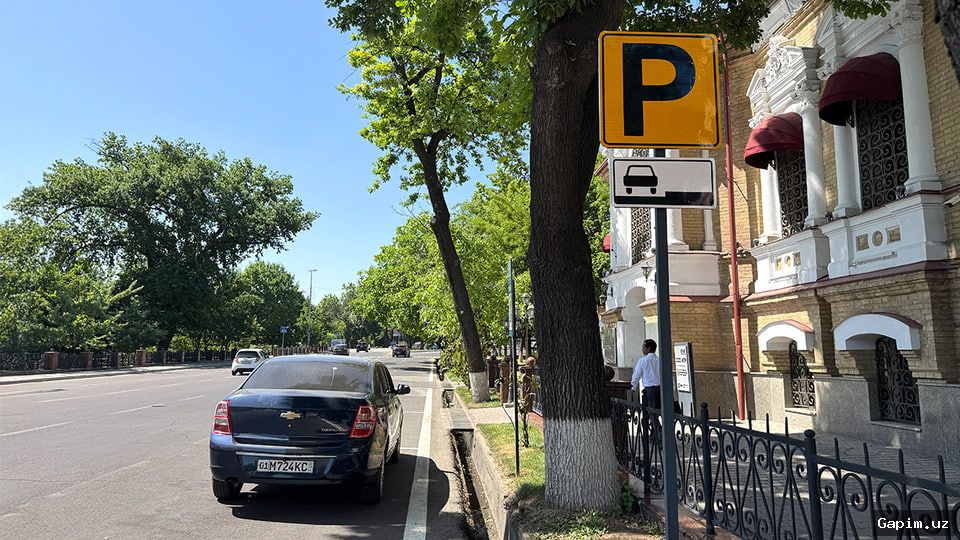
According to experts, the main problem lies not only in the shortage of parking spaces but also in how urban space is currently used. Parking is an issue that affects pedestrians no less, and often more, than drivers. A car left for several hours occupies part of the street, which is public territory belonging to all citizens.
Meanwhile, drivers in Tashkent make up only about 21% of the city's population, while the majority of residents move on foot. Therefore, the discussion of paid parking is not just about payment for parking but a broader debate about who owns urban space and by what rules it should be distributed.
A modern city should not prioritize only car owners. Its task is to create comfortable conditions for all residents: pedestrians, public transport passengers, and drivers. In practice, however, the balance between different participants in the urban environment is often disrupted. In Tashkent, cars are frequently left on sidewalks, near stops, pedestrian crossings, entrances to courtyards, and entrances to public buildings. As a result, space that formally belongs to all citizens is effectively used for free storage of personal vehicles.
Typically, in such a situation, the proposal is to simply build more parking lots. However, according to experts, international experience shows that it is impossible to increase their number indefinitely. The more accessible and cheaper parking is in the city center, the more attractive driving a personal car becomes, and new spaces fill up faster. As a result, the city again faces a shortage of parking space – only with more cars. Therefore, modern megacities view parking not as a free addition to the road but as a limited urban resource that needs to be managed.
According to experts, this is precisely why Tashkent needs a well-thought-out parking policy. Currently, several operators have begun implementing a paid parking system – both roadside and in specially designated areas. Architects, urbanists, and urban planning specialists support this direction and explain what tasks the new system should solve.
Arkady Gershman, a well-known urbanist and author of the channel "City for People," noted: "Free parking does not exist in principle. Design, construction, asphalt, markings, cleaning, and repairs cost money. In addition, parking occupies city land – one of the most scarce resources. So if the driver does not pay for it, then all citizens pay through taxes or foregone public benefits." According to him, paid parking is not so much a way to cover costs as an important tool of transport policy, solving two tasks: short-term (freeing up spaces from long-staying cars) and long-term (encouraging the use of public transport).
Maria Sultanova, an urban architect and director of the architectural bureau "SAD," believes that paid parking should not be perceived as a restriction for motorists. "Perhaps it's time to stop talking about paid parking as if it's a conspiracy against drivers. City land is expensive, and free storage of a personal car on public territory looks strange," she noted. Sultanova emphasized that revenues from parking should return to urban infrastructure: multi-level parking lots, public transport, landscaping, and sidewalks.
Iskandar Soliyev, an urban planning specialist and urbanist, considers paid parking a necessary systemic solution for city management. "The problems our cities face today did not arise by chance – they accumulated over years because the city's development proceeded without systematic attention to this issue," he said. Soliyev also noted that chaotic parking already affects the quality of the urban environment: it has become difficult to walk on the streets, the number of green spaces has decreased, and traffic jams have reached a critical level.
Abdurakhmon Bakhtiyev, Deputy Khokim of Tashkent for Transport and Road Infrastructure, noted that the paid parking system is part of a comprehensive approach to urban development. "The Tashkent of the future is a city where using public transport will be convenient and cheap. Priority will be given to pedestrians and public transport. This is a modern approach to creating 'cities for people,'" he added.
Jakhongir Toshpulatov, General Manager of Poytaxt Parking, noted that paid parking is used in many cities around the world as a tool for managing urban space. "Tashkent today faces the same problem that Moscow once faced: the number of cars is growing faster than urban infrastructure, and courtyards and central streets are effectively turning into spontaneous parking lots," he stated. Toshpulatov emphasized that the effect of the new system should extend beyond the transport sector, impacting ecology, economy, safety, and accessibility of urban infrastructure.
Thus, experts agree that paid parking is not a separate measure but part of a broader strategy to improve the urban environment, while emphasizing the need for transparent use of funds and parallel development of public transport.
Source: podrobno.uz