President Shavkat Mirziyoyev, during a meeting with Kyrgyz President Sadyr Japarov on July 30, described the construction of the China-Kyrgyzstan-Uzbekistan railway as a 'century's construction' that will fundamentally alter the geopolitical landscape of the region.
In narrow-format talks, the sides discussed opportunities to significantly increase bilateral trade turnover. Mirziyoyev noted that while earlier figures of $2 billion were mentioned, Japarov considered this insufficient.
By the end of 2025, trade turnover between Uzbekistan and Kyrgyzstan had increased by 37% compared to 2024, reaching $1.2 billion. In the first half of this year, trade volume rose to $624.6 million, a 45% increase.
Mirziyoyev recalled that previously trade volume between the two countries did not exceed $60-100 million. 'I told you that I often heard the word 'no.' Now this word is forgotten, replaced by the word 'yes' — yes, it can be done. This is your political will,' he said.
The number of joint ventures has reached 450 in a short period. The Uzbekistan-Kyrgyzstan Development Fund, established to support industrial cooperation, continues its activities.
The Uzbek leader called the China-Kyrgyzstan-Uzbekistan railway one of the most important joint projects. Transport Minister Ilkhom Makhkamov visited the construction site and showed photographs. 'Honestly, this is a century's construction, truly a century's construction. This railway will completely change geopolitics,' the president stated.
Mirziyoyev emphasized that over the past year, the countries have made significant progress on the railway project and the construction of the Kambarata HPP-1. He also highlighted the development of direct regional ties and cultural exchanges.
President Japarov announced that documents would be signed to fully resolve border issues and increase the number of crossing points from 15 to 30. A decision was also made to open a Kyrgyz consulate general in Andijan.
Earlier, the presidents discussed expanding cooperation in energy, trade, and logistics. The heads of state signed a Treaty on Allied Relations between Uzbekistan and Kyrgyzstan. Delegations exchanged several bilateral documents, including a treaty on certain sections of the Uzbek-Kyrgyz state border and an agreement on the joint use of the Chashma spring.
On December 27, 2024, in Jalal-Abad, President Japarov launched the construction of the China-Kyrgyzstan-Uzbekistan railway. Azamat Sakiyev, director of the state enterprise 'Kyrgyz Temir Zholu,' stated that construction could take about six years.
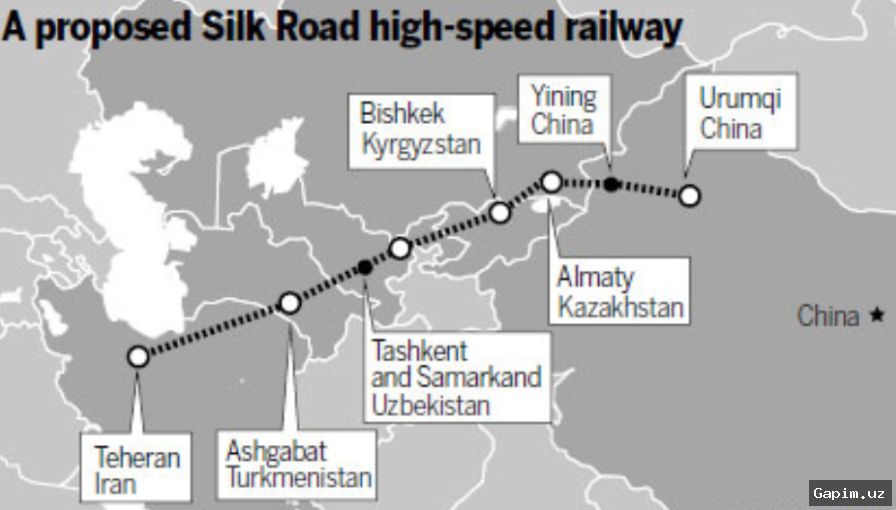
The project to build a railway network connecting China with Central Asian states has been discussed for about 25 years. Several route options from China through Kyrgyzstan to Uzbekistan, and then to Turkmenistan, Iran, and Turkey, were considered. The sides could not agree on the gauge, construction cost, and route through difficult high-mountain areas. The railway is expected to reduce dependence on Russia and Kazakhstan.
According to the document, the international transport corridor will be built along the combined route 'Kashgar — Torugart — Makmal — Jalal-Abad — Andijan.' The total length of the China-Kyrgyzstan-Uzbekistan railway is 532.53 km, of which about 312 km passes through Kyrgyzstan.
Under the agreement, China receives a 51% stake in the joint venture, while Kyrgyzstan and Uzbekistan each hold 24.5%. The project cost is estimated at $4.7 billion. Half of the funds will be provided by the participating countries according to their shares: $1.18 billion from China and about $700 million from Kyrgyzstan.
The Kambarata HPP-1 is the largest energy project in Kyrgyzstan's Jalal-Abad region on the Naryn River. The construction is seen as a regional project involving Uzbekistan and Kazakhstan. According to preliminary agreements, Kyrgyzstan's share will be 34%, Kazakhstan's 33%, and Uzbekistan's 33%. The total construction cost is estimated at $5-6 billion.
The future hydropower plant will have a capacity of 1,860 MW. The reservoir volume is 5.4 billion cubic meters, and the dam height is 256 meters. The station will generate an average of 5.6 billion kWh of electricity per year. Construction is expected to take 10 years. Former Uzbek Energy Minister Jurabek Mirzamakhmudov stated that the preliminary cost of the Kambarata HPP-1 project is $4.2 billion.
The first hydro unit is planned to be commissioned four years after the start of the main construction phase. Under the agreement, after project implementation, all shares and assets of Kambarata HPP-1 will become the full property of Kyrgyzstan. The parties' shares remain unchanged, and their consolidation, transfer, or sale is prohibited.
Source: www.gazeta.uz