On August 7, Uzbekistan's law 'On Identification, Registration, and Tracking of Animals' came into force. Social media has been abuzz with rumors that animals will be issued passports, taxes will be imposed, or social benefits will be affected. Gazeta correspondent Mirolim Isajonov spoke with Gayrat Qo'ziboyev, head of the department at the Center for Animal Identification, Registration, and Tracking, to clarify how the system works, which animals are subject to identification, what data is stored, and other questions.
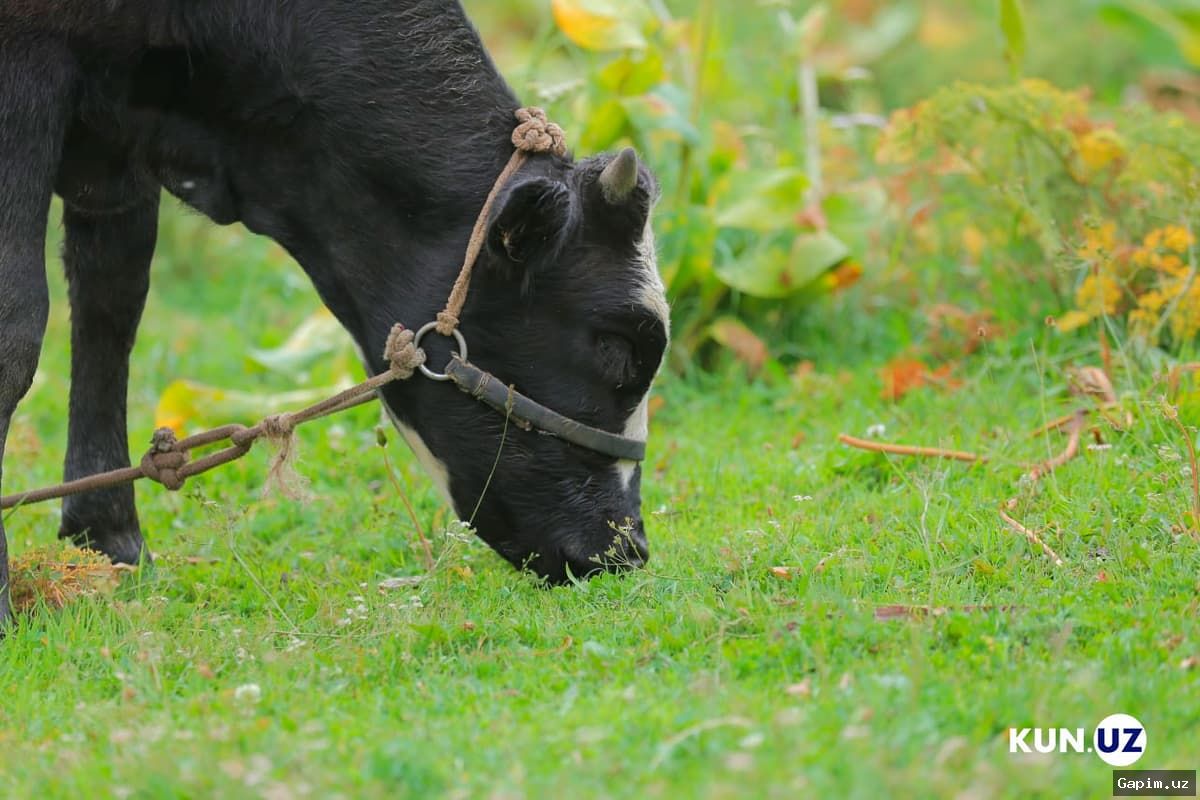
Qo'ziboyev emphasized that the main goal is not to create additional problems for animal owners but to establish a unified electronic database of animals and their owners. This will enable control over more than a hundred diseases transmitted through animals. For example, if anthrax, rabies, or brucellosis is detected in an area, identification helps quickly determine which animals are affected and the extent of the threat, ensuring epizootic stability.
Identification is also crucial for livestock farming: it allows systematic recording of animal movements, breeding, vaccination, artificial insemination, and other veterinary measures. It also generates information about the origin of meat, milk, and other products, animal health, and veterinary control, boosting consumer confidence and restricting uncontrolled products from entering the market.
According to the law, cattle, sheep, goats, and camels must be identified within 14 days of birth, horses after 4 months, pigs after 1 month, and dogs and cats after 3 months. After the deadline, they must be electronically registered within one month. The method varies by species: cattle, sheep, goats, and camels receive yellow ear tags with identical numbers on both ears. Each tag includes Uzbekistan's symbol, a letter code for the region, a number indicating the species, the committee's logo, and a QR code.
By 2030, the system will enable full traceability of animal products. For instance, scanning a QR code on meat will reveal the farm where the animal was raised, its age, breed, vaccination history, and veterinary checks. Dogs and cats will be implanted with microchips.
Tags and microchips are imported, selected based on international experience, and meet national standards. They are resistant to high temperatures, do not fade, and do not tear. A set of two ear tags for cattle costs on average $1 or less on the international market.
An identification number is assigned to an animal only once in its lifetime and is never repeated. If the animal is sold or moved, only the owner's data is updated; the number remains unchanged. To date, over 3.7 million livestock have been identified.
No separate passport is issued. Claims about introducing taxes or affecting social benefits are unfounded. Previously, farmers marked animals with paint on the forehead, notches on horns, or special neck tags. The modern system is a digitized and more precise version of these methods.
Data is stored in the Vis-Chinor electronic information system. Only state veterinary service specialists with unique logins and passwords have access. The system is integrated with state databases and serves digital veterinary control.
Citizens do not need to visit any office. Veterinarians assigned to each mahalla are going door-to-door, gradually identifying animals. If an owner wants to skip the queue, they can contact the local veterinarian or district department. After a request, a veterinarian will visit within five working days.
The process is quick: attaching a tag takes 2-3 minutes, entering data takes about a minute, and full identification takes about five minutes. One veterinary worker can identify an average of 32 livestock per day.
Currently, only state veterinary service employees can enter data. In the future, private clinics may participate. The law applies to animals kept by individuals and legal entities. Stray animals are not directly included, but shelter animals are identified free of charge.
Identification is completely free. The project is funded by $33 million from the World Bank under a presidential decree. Veterinarians visit farms themselves. Registered animals facilitate access to credit, insurance, and state benefits.
All breeding animals imported from Europe and other countries have identification numbers. They must be entered into the local database within 21 days of arrival. If an animal is slaughtered, dies, or is exported, it must be deregistered within seven days.
Currently, identification is not mandatory. The mandatory requirement for individuals and legal entities takes effect on January 1, 2028. Until then, the system will be phased in, starting with productive animals.
Source: www.gazeta.uz