President Shavkat Mirziyoyev on September 2 reviewed the progress of the nuclear power plant (NPP) construction in the Forish district of Jizzakh region, along with the project for a satellite city intended for plant employees and their families. The project is seen as a major step toward Uzbekistan's energy independence.
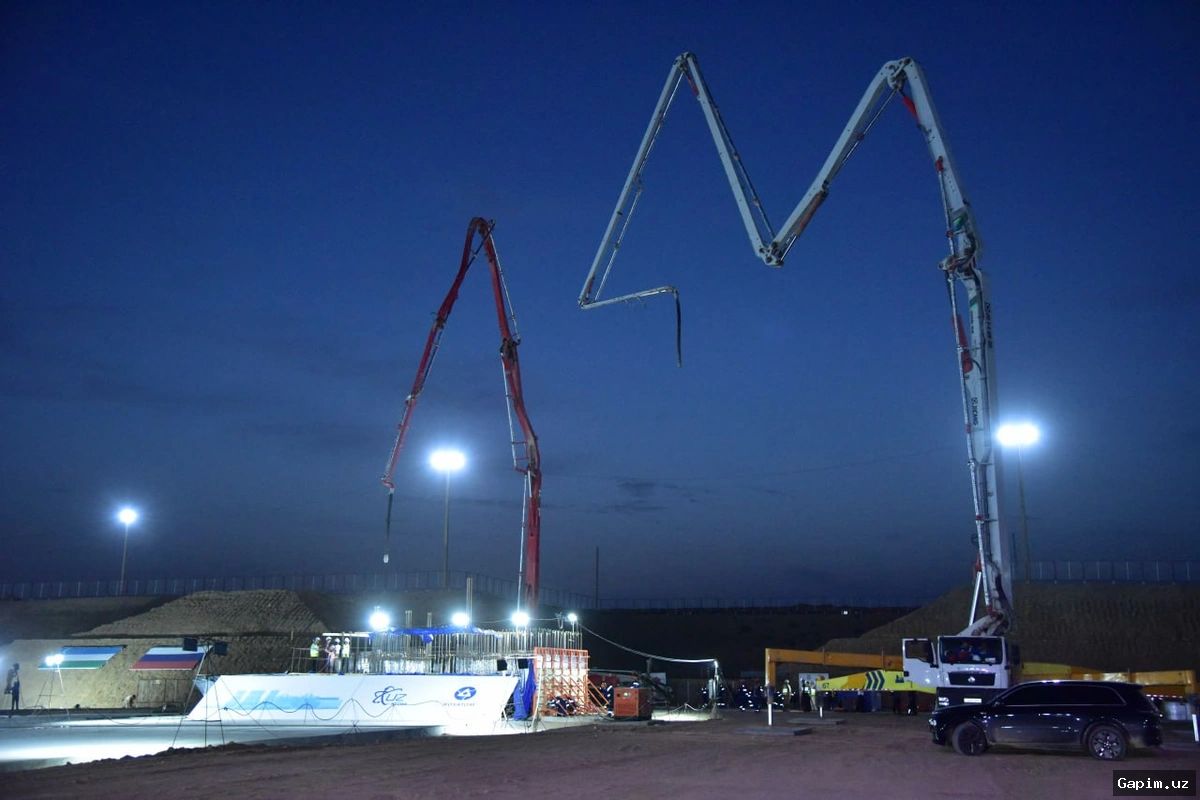
The active construction phase of the NPP began on June 4. To date, excavation of the foundation pit for the reactor building has been fully completed, with over 1 million cubic meters of soil removed. Some 916 cubic meters of concrete have been laid for the foundation slab. Earthworks have been completed on a 100-hectare area at the construction and assembly base. Currently, 450 people are working at the site, with more than 100 pieces of special equipment involved.
According to official data, the total project cost is estimated at $9.5 billion. About 3,000 types of products and equipment are planned to be used during construction. Preliminary estimates put the share of local products at 21 percent, or $1.9 billion. The president deemed this indicator insufficient.
Mirziyoyev tasked increasing the share of local products to at least 30 percent, ensuring that 65 percent of construction and installation works are carried out by local enterprises, and attracting 7,000 local workers and specialists to the project. To this end, it was proposed to create a 200-hectare industrial zone in the Forish district specializing in the production of construction materials. At least 100 joint ventures are planned to be located there, with localization of production in 15 areas through technology transfer.
The president approved the proposal and instructed that a draft decision on granting tax and customs benefits to participants of the industrial zone be submitted by the end of the year. For the external engineering infrastructure of the NPP, it is planned to build 388 km of power lines, a 110 kV substation, 21 km of drinking water and 120 km of technical water pipelines, as well as 39.5 km of roads and 11 km of railways. The president tasked raising the share of local products and services in the construction of these facilities to 60-70 percent.
A project to build a town for nuclear energy workers on a 200-hectare area was also considered. It is planned to build about 10,000 apartments for approximately 33,000 residents. In the first phase, 3,000 apartments will be built. The project includes energy-efficient multi-story buildings, schools, kindergartens, medical, sports and cultural facilities, recreation areas and green zones. Modern thermal insulation technologies, alternative energy sources and “smart” lighting systems are planned for the construction.
During the presentation, it was reported that a comprehensive assessment mission of the IAEA was conducted in Uzbekistan on June 22-26. According to official data, the mission's results gave a high assessment of the country's national nuclear infrastructure development. The president stressed that construction quality and safety remain a priority, and all work must be carried out in accordance with IAEA requirements and international standards.
To strengthen technical supervision and independent expertise of technological solutions, it was proposed to establish a joint venture with leading foreign engineering companies. It is also planned to adapt and introduce about 1,000 industry standards into the national system. The president tasked starting targeted training of operators, engineers and radiation safety specialists who will manage the NPP in the future.
Since 2023, 216 students have graduated from the Tashkent branch of the Russian National Research Nuclear University. Of these, 83 are continuing their studies in master's and doctoral programs at leading universities in China, Hungary, France, Italy and South Korea. Another 100 specialists are being trained at four higher education institutions in Uzbekistan.
On August 17, Mirziyoyev announced that “major preparatory work” is underway on a second nuclear power plant project in Uzbekistan. Its location, capacity and implementation timelines have not yet been disclosed.
The integrated NPP under construction in the Forish district of Jizzakh region will consist of four power units: two units with VVER-1000 reactors with a capacity of 1 GW each, and two small modular reactors RITM-200N with a capacity of 55 MW each. The total capacity of the station will be 2,110 MW, with an expected annual electricity output of up to 17 billion kWh.
The technical launch of the first small modular reactor is scheduled for October-November 2029, with the second to follow six months later. The first large power unit is expected to be commissioned in 2033, with the project fully completed in 2034-2035. It was previously stated that the base cost of the project would not exceed $9.5 billion. The bulk of financing is planned to be attracted through credit funds, including a concessional export credit from Russia.
In addition, Rosatom is expected to supply nuclear fuel for the NPP, maintain the station, and handle spent nuclear materials.
Source: www.gazeta.uz