A prolonged period of hot weather driven by a low-pressure system will dominate Uzbekistan this week. Across the country, except for mountainous and northern areas, nighttime temperatures will range from +13°C to +18°C, while daytime heat will reach +30°C to +35°C. The heat is expected to intensify further by the weekend.
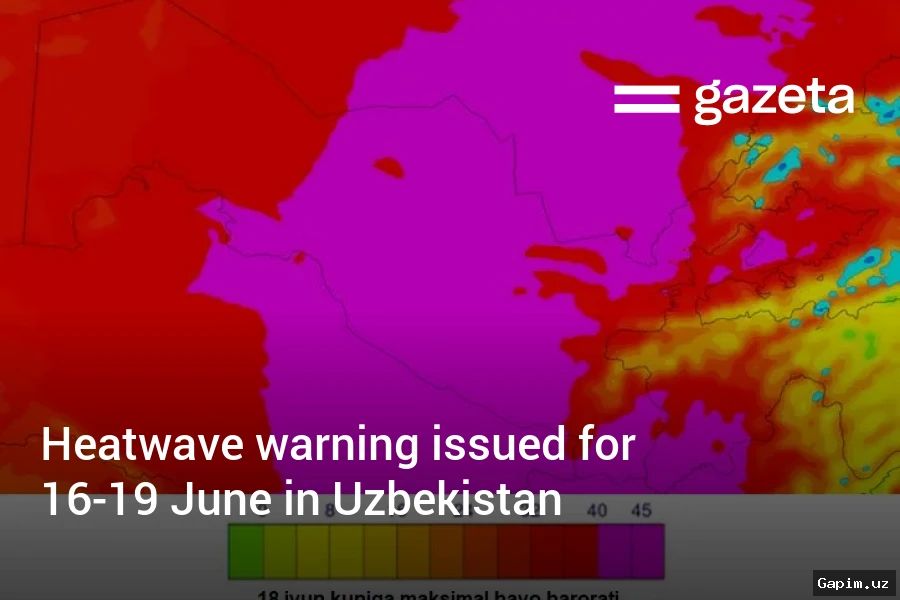
According to foreign weather bureaus, from September 14 to 18, average five-day temperatures across most of Uzbekistan will be 2−4 degrees above the long-term climate norm due to a hot air mass. Uzbekistan's Hydrometeorological Service (Uzgidromet) forecasts no precipitation from September 14 to 17 in most areas, except mountainous regions. From September 18 to 20, the heat will intensify, and even mountainous areas are expected to remain dry. Thus, the current week can be described as dry.
During weekdays, nighttime and morning temperatures in the Republic of Karakalpakstan, Khorezm region, and mountainous areas will be +10°C to +15°C, while other regions will see +13°C to +18°C. Daytime temperatures will reach +22°C to +27°C in the mountains, +30°C to +35°C in southern regions, and +28°C to +33°C elsewhere. By the weekend, temperatures across the country will rise by 2−3 degrees compared to weekdays.
According to Uzgidromet and forecasts from the European Centre for Medium-Range Weather Forecasts (ECMWF), average temperatures this week will be 1−3 degrees above the norm for this period across most of the country, and 3−6 degrees higher in some areas. Precipitation will be significantly below normal, indicating a dry week.
Consequently, from the second half of the week, a significant rise in temperature and an increasing diurnal temperature range may place additional strain on public health. In Uzbekistan this week, daytime heat of +34°C to +36°C and nighttime coolness of +13°C to +18°C may impose extra physiological stress. The large daily temperature swing, especially for weather-sensitive individuals, the elderly, and those with cardiovascular and respiratory diseases, can exacerbate headaches, weakness, sleep disturbances, and blood pressure changes. Studies show that daily temperature variability is linked to the risk of cardiovascular and respiratory diseases.
When humidity is high, sweat evaporation slows, reducing the body's ability to cool down and making the heat feel more intense. Therefore, on such days it is important to drink enough fluids, limit physical exertion during the hottest daytime hours, and ensure indoor ventilation. In some areas, high relative humidity may make the heat feel more oppressive.
Bioclimatic conditions. On Friday and the weekend, during certain daytime hours, many residents across the country will experience very hot weather. Modern forecast data (UTCI) indicate that on September 18 at 14:00, residents of Tashkent, most of Surkhandarya and Syrdarya regions may be under a "very hot" bioclimatic sensation.
Nevertheless, due to the current autumn heatwave, the population will enjoy comfortable bioclimatic conditions for most of the day. During weekdays, mornings in mountainous and northern areas will be relatively cool. Residents there are advised to dress warmly during that time.
Space weather. According to available solar activity forecasts, there is a high probability of a "red" level geomagnetic storm early this week. Specifically, on Monday and Tuesday, there is a risk of a "red" level magnetic storm. For the rest of the workweek, mostly "yellow" level magnetic storms are forecast.
Uzgidromet has not highlighted strong winds during the week. The synoptic situation related to natural severe air pollution is also currently quite stable. No strong meteorological factors for a sharp increase in particulate matter are currently observed. If air pollution increases or particulate matter pollution occurs, it would be useful to review the recommendations prepared by the Sanitary-Epidemiological Committee for various age groups and patients.
Thus, from September 14 to 20, the weather in Uzbekistan will remain relatively stable. Possible "red" level magnetic storms at the beginning of the week, as well as a significant temperature rise on the weekend, may affect the health of weather-sensitive population groups.
Source: www.gazeta.uz