On the evening of September 18, a short-term sharp increase in the concentration of PM2.5 (fine particles up to 2.5 micrometres in diameter) and especially PM10 (particles up to 10 micrometres) was recorded in the capital's atmospheric air. This was reported by Uzbekistan's National Committee on Ecology and Climate Change, citing the special commission on improving the environmental situation in the capital.
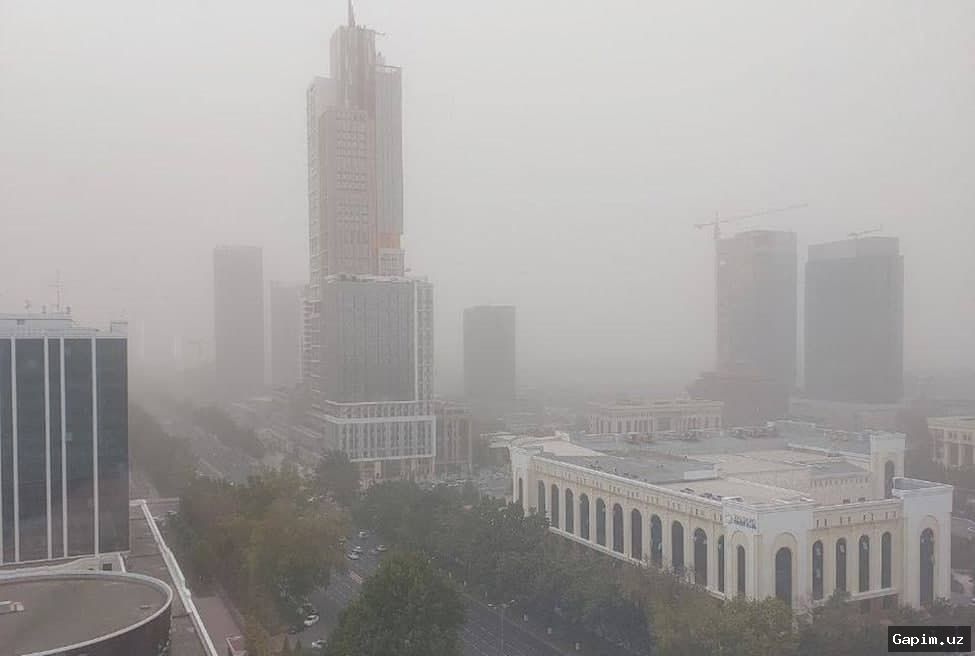
According to automatic monitoring stations, the level of harmful particles began to rise after 18:00, and after 20:00 the increase accelerated significantly. The peak pollution was recorded between 21:00 and 23:00. In particular, at 22:00 the city-wide average for PM2.5 was 74.5 µg/m3, and for PM10 — 243.6 µg/m3. In some areas, PM10 concentrations reached 555.3 µg/m3.
For reference, Uzbekistan's average daily norm for PM10 is 75 µg/m3 (annual — 500 µg/m3), and for PM2.5 — 60 µg/m3 (annual — 35 µg/m3). The significantly higher PM10 level compared to PM2.5 indicates that during this period the atmosphere contained an increased amount of large dust particles.
On the night of September 19, specialists from the National Environmental Monitoring Centre and Uzhydromet checked air quality using mobile equipment at three locations in the Mirzo Ulugbek district. During the measurements, gaseous pollutants such as nitrogen dioxide, carbon monoxide, ammonia, hydrogen fluoride, phenol and formaldehyde were also monitored. The analysis results showed that the maximum single concentrations of these substances did not exceed the established norms.
"According to the analyses, several factors influenced this situation simultaneously. In the conditions of prolonged dry weather, favourable conditions were created for dust from soil and road surfaces to rise into the air. The temperature inversion observed in the evening and at night, along with weak air exchange, created conditions for the accumulation of particles in the near-surface layer of the atmosphere," the report says.
At the same time, according to CAMS (the European atmosphere modelling system), dust masses with high PM10 levels were observed in the western and north-western regions of Uzbekistan. Calculations based on the HYSPLIT model showed that at various altitudes, air flows entered Tashkent from the north, north-east, west and north-west.
After 23:00, the concentration of PM2.5 and PM10 in the air began to gradually decrease. By 04:00 on September 19, the city-wide averages had dropped to 22.4 µg/m3 for PM2.5 and 61.9 µg/m3 for PM10.
"In conclusion, the situation observed in Tashkent on the evening of September 18 and the night of September 19 was a short-term dust episode. Dry weather, the rise of local dust, temperature inversion and weak air exchange created favourable conditions for its formation. The decrease in concentrations at automatic stations after 23:00, as well as measurements taken on site between 02:15 and 03:01, show that the dust episode gradually weakened," the committee noted.
According to forecasts, from 21:00 on September 19 to 04:00 on September 20, air quality in Tashkent may temporarily deteriorate again, and the Air Quality Index (AQI) may reach 101−150 — "harmful for sensitive groups." On Sunday morning, the polluted air mass is expected to shift in a south-westerly direction, and by 08:00—09:00 air quality is expected to return to a "moderate" level.
Source: www.gazeta.uz