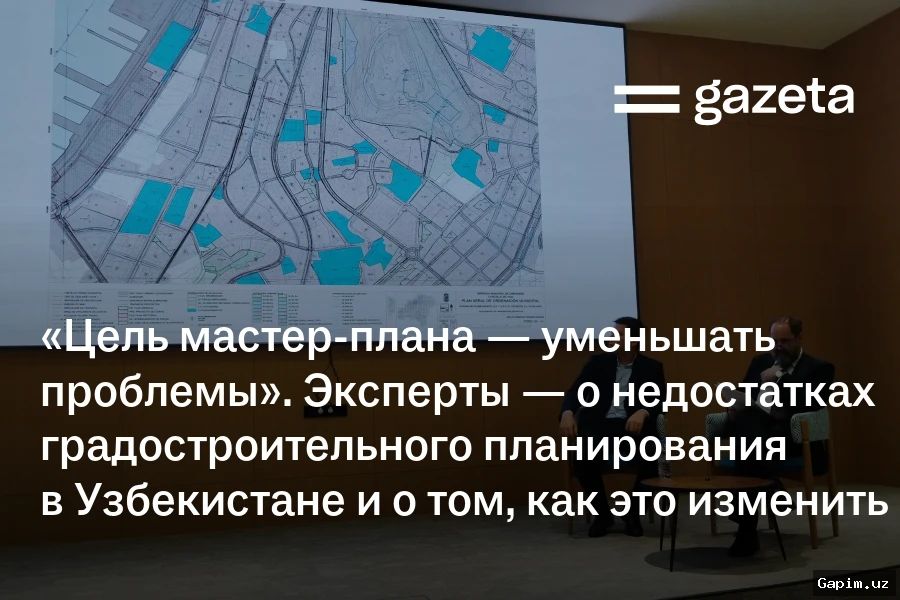
A discussion organized by the Urban Lab project under the National Committee for Sustainable Urbanization and Housing Market examined what the term “master plan” means and what place it occupies in the urban planning system. Participants included Alvaro Lopes Gonzalez Malo, a professor at Central Asian University and architect with 30 years of experience, and Umidjon Fayziyev, chief architect of New Tashkent and head of the department preparing urban planning documents for the under-construction city. The debate focused on document hierarchy, legal clarity, and the quality of the urban environment.
Key Takeaways: The term “master plan” entered Uzbekistan several years ago, but a shared understanding has not yet formed; the expert defined the general plan as law, the master plan as tactics, and the detailed planning project as an implementation tool; under Spanish practice, a detailed planning project cannot amend the general plan and requires a separate legal procedure.
The term “master plan” entered Uzbekistan several years ago, yet there is still no common understanding of what it means or what role it plays in the urban planning system. The discussion was devoted to this issue, with participants seeking to explain the differences between documents, their legal force, and practical application. This matters for reducing disorder in construction and managing city development more predictably.
According to Alvaro Lopes Gonzalez Malo, in Europe the general legal framework is sometimes called a master plan, while in Uzbekistan the general plan performs the same function. He proposed the following hierarchy: the general plan is the law, the master plan is tactics, and the detailed planning project is the implementation tool. He described the general plan as defining land categories—urban, construction, and agricultural land—and fixing key elements such as large parks, social infrastructure facilities, rivers, and ecological corridors. Zoning, density and height standards, red lines, and infrastructure parameters set by the general plan are mandatory for all lower-level documents; its preparation involves public participation and mandatory conclusions from water supply, energy, transport, and environmental services.
The master plan is a district-level tool whose purpose is not only to ensure financial efficiency but also to reveal the social and economic value of an area within the general plan. A detailed planning project is required to implement a master plan; in Spain its counterpart is the “partial plan” (plan parcial). The expert stressed that neither a master plan nor a detailed planning project can replace the general plan. In Spain, a detailed planning project cannot change the general plan: if a developer wants to alter a red line, slope, or height, this cannot be done through the detailed planning project alone and requires a separate legal instrument—a special amendment to the general plan. This guarantees legal clarity and prevents disorder.
In the expert’s view, the preparation of detailed planning projects in Uzbekistan often overlooks two important components—detailed urban planning regulations and urban design rules. Without them, developers may formally comply with density and construction coefficients, but the quality of the urban environment still suffers. The general plan can also protect green and blue infrastructure: in Santiago de Compostela, green rings and corridors were created gradually as the city expanded, while in Vigo the general plan immediately entrenched the entire Lagares River corridor from source to mouth as a unified system of open spaces. After presenting the Spanish examples, the expert turned to Tashkent, showed images of the Anhor Canal and the Chirchiq River, and noted that both water bodies suffer from fragmentation. The discussion showed the need to review urban planning documents on the basis of a clear hierarchy, widely introduce detailed regulations and design rules, and protect water bodies and green infrastructure as whole systems; the next steps are tied to legislation, planning practice, and new city projects.
Source: www.gazeta.uz