According to a new report by the World Health Organization (WHO) and the European Centre for Disease Prevention and Control (ECDC) for 2026, the tuberculosis (TB) situation in the broad region covering Europe and Central Asia remains serious. A key issue is that one in five patients is still undiagnosed or unregistered, leading to uncontrolled spread of the infection in communities. In 2024, 161,569 TB cases were officially recorded in 51 countries of this region, but WHO estimates suggest the actual number of infected individuals is close to 204,000.
The report highlights the widespread prevalence of drug-resistant tuberculosis (DR-TB) as the most alarming aspect. Rates of drug-resistant TB in this region are seven times higher than the global average. Resistance to rifampicin, a core first-line TB drug, is present in 23% of newly detected cases and 51% of previously treated patients. This sharply contrasts with global rates of 3.2% and 16%, respectively. Treatment effectiveness also remains low: only 74% of new patients and 66% of those with drug-resistant TB are successfully cured, while WHO's target is a 90% success rate.
Geographically, the main burden of TB/HIV co-infection falls on Russia (52%) and Ukraine (28%). Additionally, the situation in prisons poses a particular risk: the likelihood of TB transmission among inmates is 13.2 times higher than in the general population. In European Union countries, children under 15 account for 4.2% of annually detected patients.
The report emphasizes that although incidence has decreased by 39% and mortality by 49% since 2015, this pace is insufficient to meet strategic targets by 2030. WHO is calling on countries to expand rapid diagnostic methods, transition to injection-free and shorter treatment courses, and strengthen measures to identify every fifth undiagnosed patient. Otherwise, as stated, thousands of preventable new infections and deaths will continue.
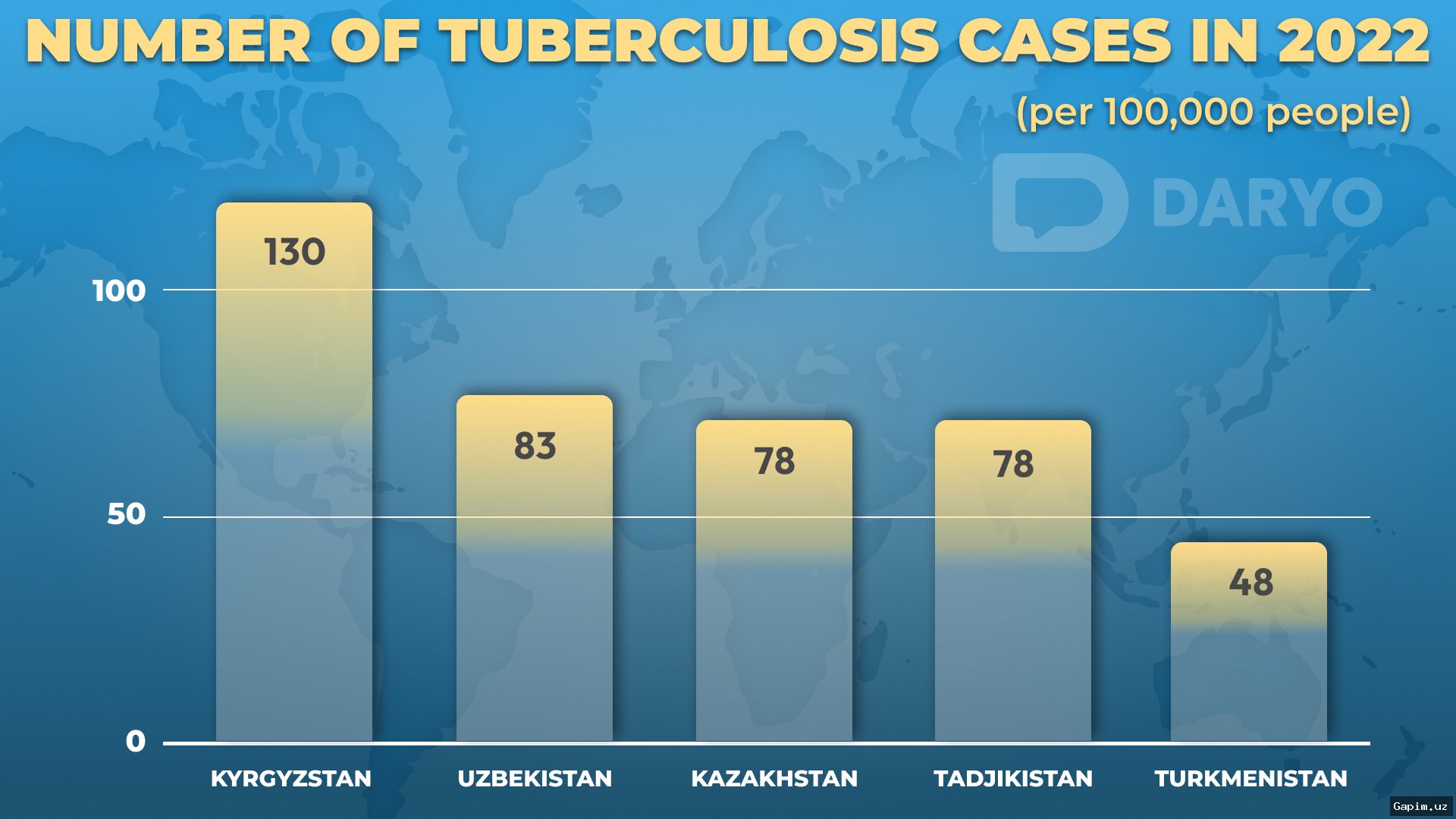
According to Uzbekistan's Ministry of Health, in 2025, the TB incidence rate in the country was 33 per 100,000 population, and the mortality rate was 0.8. This means that compared to 2024, the incidence rate decreased by 3.5%, while the mortality rate remained unchanged. Under the "Uzbekistan — 2030" strategy, the plan was to reduce the TB incidence rate to 34 per 100,000 people by the end of 2025. It was reported that over 14,000 patients with detected disease were fully covered with quality medicines and treatment.
Recall that in 2023, the United States Agency for International Development — USAID launched the 5-year "TB-Free Uzbekistan" initiative. At the time, it was stated that $18 million would be invested in the project for TB prevention, detection, and treatment. However, due to Trump's decision to sharply cut foreign aid through USAID, many projects were closed, and how this has affected this initiative remains unknown.
Source: www.gazeta.uz