NASA has released the first high-resolution images of Earth captured by the Artemis II mission crew at the halfway point between Earth and the Moon. The "spectacular" images were taken by mission commander Reid Wiseman after the crew completed a final engine burn that set their trajectory toward our closest celestial neighbor. According to NASA's online dashboard, the Orion spacecraft was positioned 142,000 miles (228,500 km) from Earth and 132,000 miles from the Moon at approximately 07:00 BST.
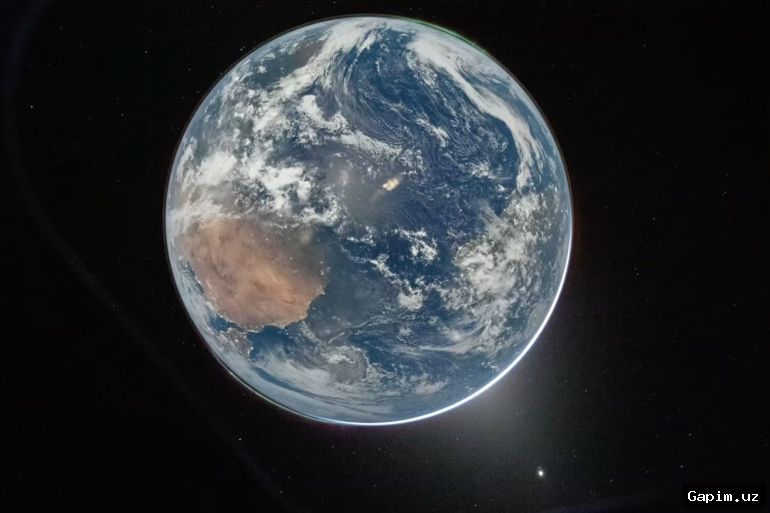
Astronaut Christina Koch noted that the crew had a collective "expression of joy" upon being informed of this milestone, which occurred about two days, five hours, and 24 minutes after liftoff. The first image, titled "Hello, World," depicts the vast expanse of the Atlantic Ocean, framed by the glow of the atmosphere as Earth eclipses the Sun, with green auroras visible at both poles. Earth appears upside down, with the western Sahara and Iberian Peninsula on the left and the eastern portion of South America on the right. NASA identified the bright planet in the bottom right as Venus.
The images were captured after the crew successfully executed a trans-lunar injection burn in the early hours of Friday. This burn propelled the Orion spacecraft out of Earth's orbit as the four astronauts aboard aim to travel over 200,000 miles to the Moon. Artemis II is now on a looping path that will carry the crew around the far side of the Moon and back, marking the first human journey beyond Earth's orbit since 1972. The spacecraft launched from the Kennedy Space Center in Florida, with the crew expected to pass around the far side of the Moon on April 6 and return to Earth on April 10 via a splashdown in the Pacific Ocean.
Mission specialist Jeremy Hansen reported to mission control in Houston that after the burn was completed, the crew were "glued to the windows" taking pictures. He stated, "We are getting a beautiful view of the dark side of the Earth, lit by the Moon." Wiseman later contacted mission control to inquire about cleaning the windows, as the astronauts' enthusiasm for viewing space had left them dirty. Initially, Wiseman found it challenging to photograph Earth from the spacecraft, comparing it to trying to take a picture of the Moon from one's backyard, but this issue has since been resolved.
NASA subsequently published another image showing Earth in near-complete darkness, with the electric lights of humanity twinkling in the nighttime. The agency also provided a side-by-side comparison of Earth's view in 2026 and a similar image taken by the Apollo 17 team in 1972—the last time humans set foot on the Moon. NASA commented, "We've come so far in the last 54 years, but one thing hasn't changed: our home looks gorgeous from space!"
Source: www.bbc.com