Mali has been rocked by coordinated attacks launched by several unidentified armed groups beginning on Saturday, escalating the political and security crisis in the country, which has been under military rule for most of the past 14 years. A military source told Al Jazeera that Defense Minister Sadio Camara was killed amid the assaults on military sites across the country, including the capital, Bamako.
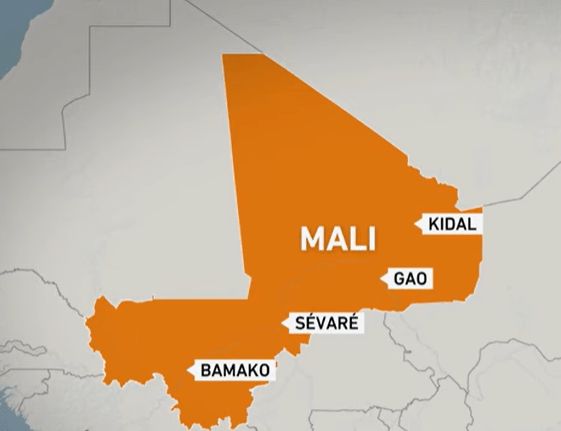
The Malian army said in a statement that unidentified “terrorist” groups targeted several military positions in Bamako and the interior early in the morning. Two loud explosions and sustained gunfire were heard near the main military base in Kati, just north of the capital. Gunfire was also reported near a military camp close to Bamako airport, where Russian mercenary forces are based.
Al-Qaeda-linked Jama’at Nusrat al-Islam wal-Muslimin (JNIM) claimed responsibility for attacks in Kati, Bamako airport, and further north in Mopti, Sevare and Gao. Tuareg rebels also claimed participation. JNIM said the city of Kidal was “captured” in coordination with the Azawad Liberation Front (FLA). Videos verified by Al Jazeera showed armed men entering the National Youth Camp of Kidal.
Current military ruler Assimi Goita, who came to power in the 2021 coup promising to boost security, has yet to make a public statement. Analysts say the government has little control over large areas of the country, and the coordinated attack signals a “very dangerous development”. Since 2012, security has been degrading annually, and there is no military solution, as armed groups are entrenched in the countryside.
Russian mercenaries, who remained under the Africa Corps banner after Wagner’s withdrawal, were reportedly involved in fighting in Bamako but have surrendered Kidal. Their pullout is affecting the security situation. The African Union, OIC and US Bureau of African Affairs have condemned the attacks.
Mali, along with Niger and Burkina Faso, formally split from ECOWAS last year to form the Alliance of Sahel States (AES). However, Malian Foreign Minister Abdoulaye Diop recently attended a security forum in Senegal, signaling fear of isolation and a desire to reopen dialogue with ECOWAS, according to analysts.
Source: www.aljazeera.com