Global military expenditure reached $2.88 trillion in 2025, a 2.9 percent increase from the previous year, according to the latest report from the Stockholm International Peace Research Institute (SIPRI). This amounts to $350 for every person on the planet.
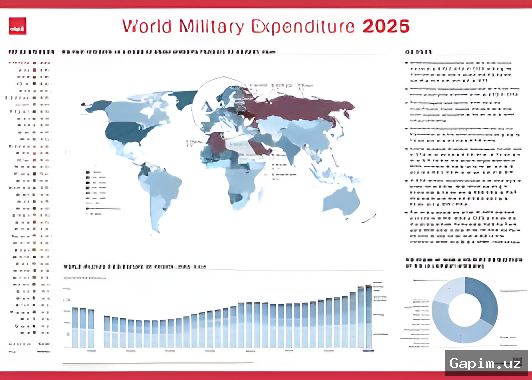
The top five spenders – the United States ($954 billion), China ($336 billion), Russia ($190 billion), Germany ($114 billion), and India ($92 billion) – account for 58 percent of the world total. US spending alone exceeds the combined spending of the next six countries.
Since 1949, the US has spent at least $53.5 trillion on its military, representing 51.5 percent of the global total of over $100 trillion. Military spending has historically risen during wars and fallen in peacetime.
Post-World War II, spending surged from $284 billion in 1950 to $788 billion in 1953 due to the Korean War. It crossed $1 trillion for the first time in the late 1960s, driven by the Vietnam War and the US-Soviet arms race, peaking at $1.7 trillion in 1988. After the Cold War, it fell to $1.4 trillion by 1991.
Following the 9/11 attacks, US spending rose again, pushing global totals above $2 trillion in 2009 amid the wars in Afghanistan and Iraq. Russia's annexation of Crimea in 2014 prompted NATO members to commit to spending 2 percent of GDP on defense. Since 2016, European spending has doubled, with Eastern Europe seeing a 173 percent increase.
Per capita, Qatar spends the most at $5,428, followed by Israel ($5,108) and Norway ($3,040). Ukraine recorded the largest percentage increase – 3,387 percent – from $63 per capita in 2006 to $2,197 in 2025, reflecting its conflict with Russia.
Between 2016 and 2025, global arms sales totaled $295 billion. The US is the largest exporter, accounting for 39 percent ($115 billion), followed by Russia (13 percent, $40 billion), France (9.3 percent, $28 billion), China (5.5 percent, $16 billion), and Germany (5.5 percent, $16 billion).
Increased military spending strains budgets for healthcare and education. An analysis of 137 countries shows many prioritize the military over social sectors.
Traditional militaries are integrating artificial intelligence, autonomous systems, and digital warfare infrastructure. The US Department of Defense has awarded $200 million contracts to OpenAI, xAI, and Anthropic. Palantir's AI-assisted targeting system was used by Israel in its war on Gaza.
Source: www.aljazeera.com