Solar and wind power generate abundant electricity, but often not at the right time. Europe's insufficient battery storage capacity makes it impossible to store excess energy for later use, forcing reliance on natural gas plants after sunset.
Germany aims to become climate-neutral by 2045, requiring large-scale storage to stabilize electricity prices and enable a 100% renewable grid. The European Union, targeting climate neutrality by 2050, already generates about half its electricity from renewables.
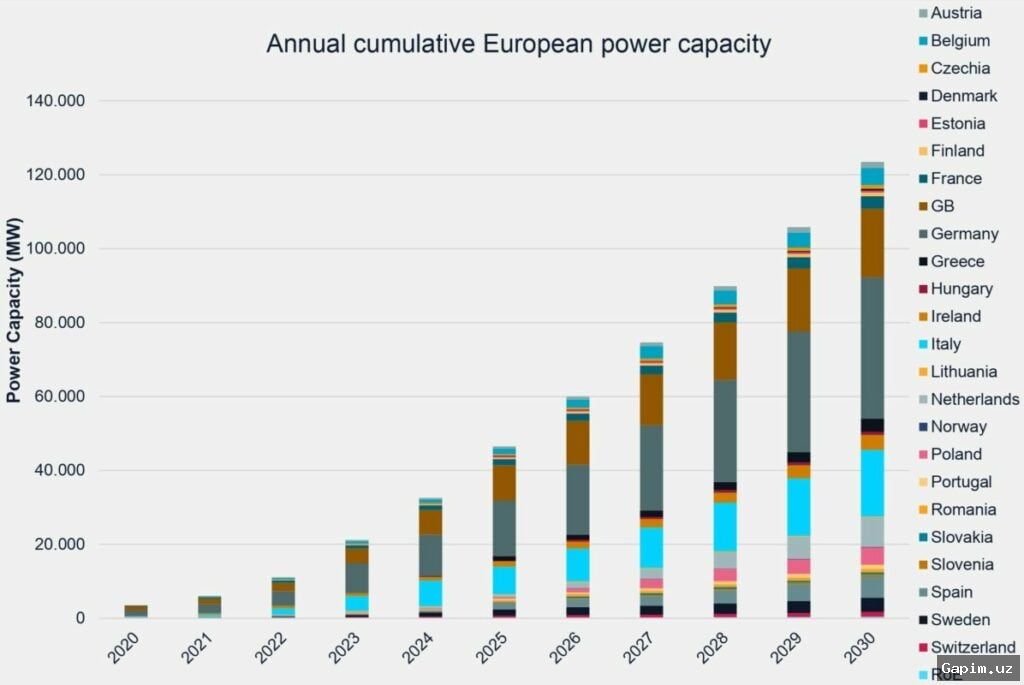
According to the European Commission's Joint Research Centre, existing large-scale storage in Europe totals about 14 GW. Expansion has accelerated dramatically, with 84 GW of additional capacity planned or under construction—a sixfold increase.
Lithium-ion battery prices have fallen about 20% annually, and are expected to halve by 2030 compared to 2022. Combined private and large-scale storage capacity in the EU has increased tenfold since 2022, but meeting climate goals requires another tenfold increase to around 750 GW.
Professor Dirk Uwe Sauer of RWTH Aachen University notes that midday electricity prices are extremely low due to solar and wind overproduction, while evening prices spike when gas and coal plants ramp up. This price differential makes battery storage economically attractive.
Europe's electricity grids are aging, many over 40 years old. The European Commission estimates €580 billion in grid investments needed by 2030. In Germany, only 20% of planned 16,000 km of power lines are operational. Permitting has been streamlined, but investment goals remain elusive.
The Iran war has had minimal impact on the battery sector, but experts caution that temporary crises are not a basis for long-term investments. Sauer emphasizes that grids are built for 40-50 years, requiring stable government policies.
The EU is prioritizing access to lithium and other metals, reducing dependence on China, and promoting recycling of critical raw materials like lithium, nickel, and cobalt.
Source: www.dw.com