An enormous whale graveyard stretching about 1,200 km (745 miles) has been discovered in the southeastern Indian Ocean. The site, located 7 km (4 miles) deep in the Diamantina fracture zone—a range of ridges and trenches on the seafloor—has excited scientists due to the age of the remains, some dating back 5.3 million years.
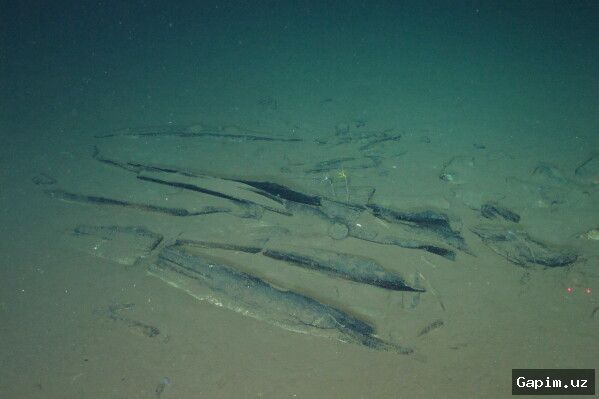
The underwater necropolis, discovered by a team of researchers from China, Italy, and New Zealand, is teeming with organisms and species that “may be new to science,” according to the journal Nature. Xiaotong Peng of the Chinese Academy of Sciences, one of the study’s authors, said: “Discovering a necropolis of this scale was completely unexpected. The size of distribution, the depth and the age range were far beyond anything we had imagined.”
During 32 dives to the site, explorers collected samples from 485 whale-fossil sites and active whale falls, uncovering a treasure trove of remains, including the skeleton of an extinct whale. The beaked Pterocetus benguelae, 5.3 million years old, was identified as one of the fossilized skulls in the graveyard.
The largest discovery was a five-meter-long Antarctic minke whale carcass. A new species, named Pterocetus diamantinae after the site, was also uncovered. Jellyfish, worms, and crustaceans are among the creatures feeding on the vast spread of carcasses.
Stephen J. Godfrey of the Calvert Marine Museum wrote in Nature: “Peng and colleagues’ encounter with a vast fossil graveyard is a truly unique discovery. Although the site has limited accessibility, it seems likely to hold many other exciting finds, and it will no doubt inspire more submersible dives in similar environments.”
Source: www.bbc.com