The sound of demolition echoes beneath Jerusalem's walled Old City as an Israeli excavator tears into a Palestinian house. Since late 2023, 59 properties have been destroyed in the al-Bustan area of the Silwan neighborhood. With global attention diverted by wars in Gaza and Lebanon, the Israeli regime has dramatically increased the forced displacement of Palestinians in occupied East Jerusalem.
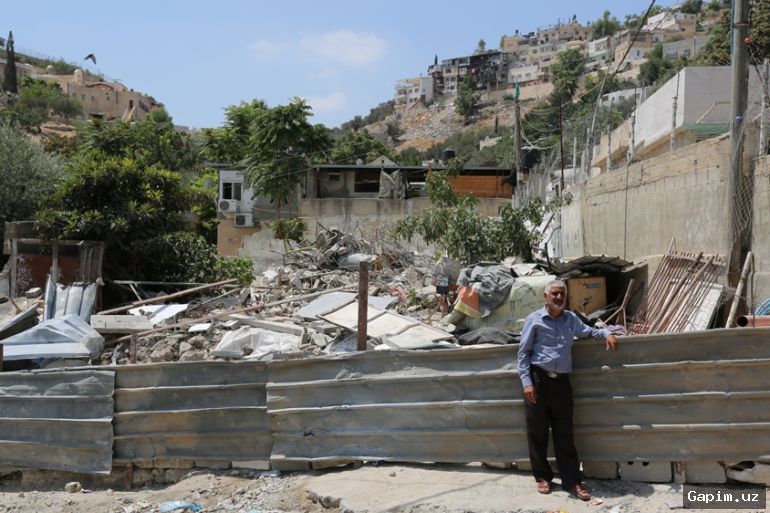
Fayez Awad, 58, sitting on the only remaining floor of his home, said: "There is no future. They destroyed the future and everything else. We spent our whole lives building this house. This is all we managed to achieve in life. They brought us back to zero again, me and my children."
The Israeli regime captured East Jerusalem in the 1967 war and later annexed it, a move unrecognized by most countries. For about 20 years, the Jerusalem Municipality has planned to turn al-Bustan into a biblically-themed park, the King's Garden, run by a Jewish settler organization. Recently, demolition orders enforced by Israeli courts have accelerated. Under international law, settlements and forced transfer of population on occupied land are illegal.
The municipality told the BBC it was working "for the benefit of all city residents" and aimed "to build a park in a zone that suffers from a severe shortage of open public spaces." Palestinians note that Israeli construction permits in East Jerusalem are nearly impossible to obtain. According to Bimkom, in 2025 only 7% of new housing approved in Jerusalem was for Palestinians, who make up 40% of the city's population.
Many residents facing demolition orders are opting to demolish their own homes to avoid hefty fines. Local activist Fakhri Abu Diab said: "Israel is using the geopolitical situation to finish the issue. The international community has left us all alone." His home was previously demolished, and he and his wife now face eviction from a caravan set up by the rubble.
The Israeli regime has built about 160 settlements housing 700,000 Jews in the West Bank and East Jerusalem. According to the UN, some 200 Palestinian households (about 900 people) face eviction cases in Israeli courts, mostly filed by settlers. Israeli law allows seizure of property owned by Jews before 1948 but does not allow Palestinians to reclaim their historical properties.
Silwan's proximity to the al-Aqsa mosque compound, the third holiest site in Islam and holiest in Judaism, is central to its importance. "Silwan sits on a very important site called 'City of David,'" said Yonatan Mizrahi from Peace Now. "Part of the plan is to create a touristic area that emphasizes the Jewish narrative."
In the Christian and Muslim Quarters of the Old City, Israeli flags mark buildings where settlers now live. Mufid Basha, 76, whose father safeguarded a yeshiva during 1929 riots, now faces eviction. "This is the gift that we get!" he said. A recent court injunction temporarily prevents his family's eviction pending an appeal.
Aviv Tatarsky from Ir Amim said: "With the Israeli government, all restraints are off. They are rushing to cement a reality of Jewish supremacy that does not tolerate Palestinian rights." Recently, district planners approved a controversial ultra-Orthodox yeshiva project in Sheikh Jarrah, and an inter-ministry team was set up to explore seizure of Palestinian properties near Chain Gate.
Back in al-Bustan, foreign diplomats toured the area as Palestinians called for international action. The EU recently issued a statement calling the situation "dire" and reiterating "strong opposition to Israel's settlement policy." The last visit was to 97-year-old Yusra Qweider, bedridden and facing eviction. "They want to kick us out of here. I am sick and can't walk. We are counting on God," she said.
Source: www.bbc.com