According to the International Labour Organization (ILO) and UNICEF, there are approximately 2.4 billion minors under the age of 18 globally. Nearly 138 million of these children – about one in 17 – are engaged in child labour, including 54 million in hazardous work that endangers their health and safety.
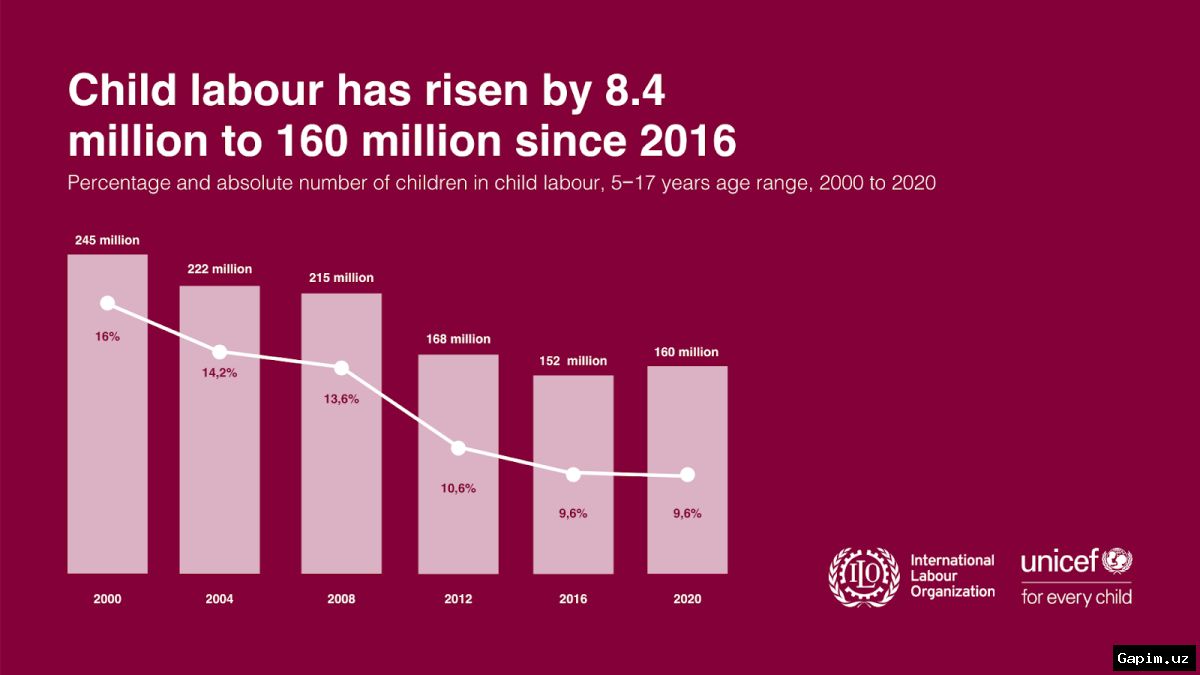
In 2015, the United Nations set a goal to end child labour by 2025, a deadline that has now passed. While the total number of child labourers has declined, two in five still work in hazardous jobs involving heavy physical labour, toxic chemicals, dangerous machinery, long hours, or unsafe environments.
UNICEF and the ILO warn that such work can cause injury, illness, and lasting damage to a child’s physical and mental development. Many of these children also miss out on school, trapping families in cycles of poverty that span generations.
Agriculture remains the largest employer of children, accounting for 61% of all child labour cases – roughly 84 million children working on farms, fisheries, forests, and livestock production. Children carry heavy sacks, spray pesticides, descend into mines, and work with sharp tools in extreme heat.
The service sector accounts for 27% of child labour (domestic work, retail, hospitality), while industry (mining, manufacturing, construction) accounts for 13%. From cocoa fields in West Africa to rice farms in South Asia, agriculture dominates due to its informal, family-based nature and difficulty of regulation.
Lucia Soleti, acting UNICEF deputy representative in Ghana, told Al Jazeera that child labour remains widespread in West Africa, driven by poverty, limited access to social services, and climate and economic shocks. In Ghana, over 1.1 million children aged 5-17 are affected, mostly in agriculture, mining, fishing, and domestic work.
Sub-Saharan Africa remains the epicentre, with 87 million child labourers – more than the rest of the world combined. Population growth, conflict, and economic instability have offset recent gains. Asia and the Pacific have recorded the sharpest reductions.
Mona Aika, acting chief of child protection at UNICEF in Nigeria, stressed that addressing child labour requires more than training or enforcement: “It requires stronger child protection systems, social protection, education access, livelihoods support for families, community prevention, and sustained government-led action.”
Source: www.aljazeera.com