Amid growing tensions and security risks in the Horn of Africa, Eritrea, with its strategically important coastal points on the Red Sea and a perceived lack of conflict, is emerging as an important player in the region.
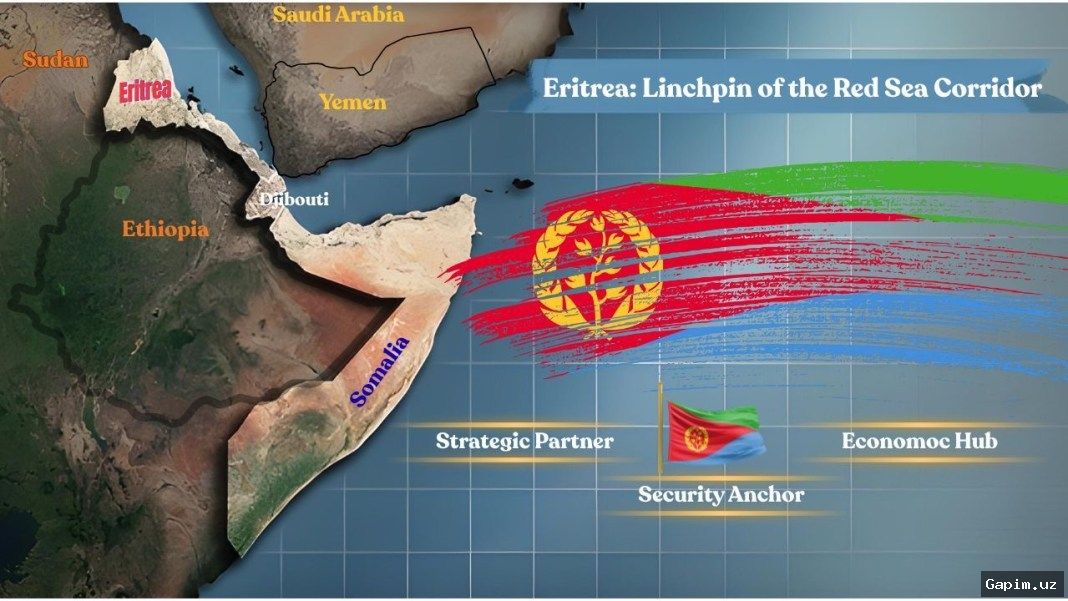
The autocratic state, ruled by long-standing leader Isaias Afewerki, controls key ports such as Assab and Massawa, enhancing its geopolitical significance.
In July, a series of diplomatic consultations in Cairo involving regional powers like Egypt, Somalia, Eritrea, and a high-ranking US envoy highlighted Eritrea's growing role in coordinating approaches to resolving serious security challenges in the Horn of Africa and the Red Sea.
Eritrea's coastline along the Bab-el-Mandeb Strait stretches for more than 1,000 kilometers, making it a crucial node in international trade. At its narrowest point, the strait is less than 30 kilometers wide.
According to Abdurahman Sayed, director of the Horn of Africa Centre for Regional Integration in London, "Yemen lies on the other side of the Red Sea, which makes Eritrea's location particularly interesting, as Yemen is in a state of crisis and maritime security in the region is at risk." He adds, "The only safe route in this area runs through Eritrea, where there are currently no security concerns."
The Iran-backed Houthi militia has been attacking merchant ships in the Red Sea from the Yemeni coastline, further elevating Eritrea's strategic value.
Sayed also emphasizes that Eritrea's entrenched dictatorship does not tolerate dissent; in international freedom indices, the nation often ranks second only to North Korea. However, this is also why there are no violent conflicts in the country.
"For this reason, all countries — including regional powers such as Saudi Arabia and Egypt, which controls the Suez Canal — want to maintain stable relations with Eritrea," he highlights. At the same time, this could prove to be the country's Achilles' heel: "The country is ruled by a single man, and there are no constitutional institutions. That makes the state very vulnerable should this strongman be removed from power," warns Sayed.
The Red Sea has emerged as the most important sea route in the world, especially for Gulf states. The war with Iran has further reinforced the nation's position, as this crisis once again showed the central geopolitical importance of maritime chokepoints such as Hormuz and Bab el-Mandeb.
Landlocked Ethiopia is fighting hard to maintain access to the Red Sea as a trade route. Prime Minister Abiy Ahmed has for years been demanding sovereign access to the sea, as Ethiopia lost its direct access when Eritrea gained independence in 1993.
Michael Woldemariam, a researcher at the University of Maryland, notes that "the key context for Eritrea's recent strategic maneuvers in the Horn of Africa and the Red Sea is the escalating tensions with Ethiopia." "Asmara is seeking to forge partnerships that can serve as a counterweight to Addis Ababa," he adds.
In May 2026, Eritrea and Egypt signed an agreement to establish direct freight connections between their Red Sea ports to expand independent trade and supply chains in the region.
However, Eritrea's short history is almost entirely marked by violence, prompting many to seek a better life elsewhere. According to Magnus Treiber, a migration researcher at the University of Munich, at least 700,000 people have left the country since its founding, about a fifth of its total population.
Eritrea's interest in attracting partners might ultimately be a cry for help from a country whose own citizens appear not to believe in its legitimacy — one that could simply go to the highest bidder.
Source: www.dw.com