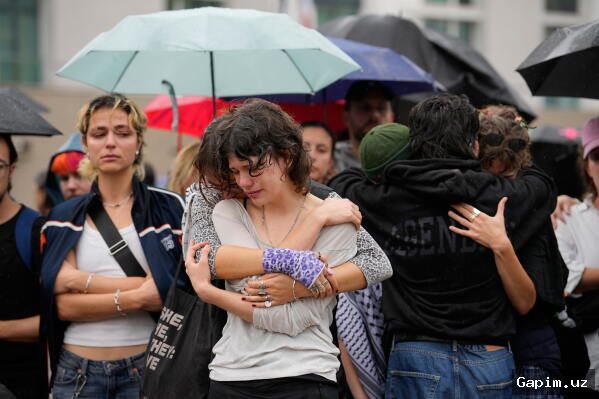
On the evening of July 25, according to German authorities, Abdul Ballout drove a white van into a crowd in Berlin's Tiergarten park near the Brandenburg Gate, where thousands were celebrating Berlin Pride. He then got out of the vehicle and began attacking people at random with a large knife. He killed a 65-year-old woman from Poland and injured her daughter, along with 30 other people, some of them seriously.
Many details have emerged about the perpetrator, his links to extremists, his criminal record and his family. Two days after the incident, he was shot dead by police officers while trying to flee during an arrest attempt.
The identities of the victims, and how they are coping after the attack on the event celebrating LGBTQ+ rights, are not publicly known. Still, many are likely to live with its consequences for months, if not years, to come. The only details disclosed by Berlin's governing mayor concern the age and nationality of the woman who was killed. Otherwise, Germany's strict data protection laws protect victims' privacy.
Victims can approach the media themselves at any time if they choose to make their stories public, Roland Weber, the German federal government's commissioner for victims of terrorism and extremist violence, told DW. He has visited some of the injured in hospital.
"What I saw there was distressing. But thanks to modern medicine, and because the doctors are optimistic, there is reason for hope that everyone will recover as fully as possible," he said. "In some cases, however, that remains uncertain. Only time will tell. Some of the injured have already been discharged from hospital and are now receiving outpatient treatment. Others will begin various forms of therapy and rehabilitation."
The Federal Commissioner for Victims and "Weisser Ring", a victim support organization, arrange trauma treatment, provide immediate financial assistance, and advise victims on long-term care and victims' pensions. In cases of terrorist attacks, there is also a special provision: victims can apply for hardship payments, funds made available by the Bundestag. Weber noted that hardly anyone knows about them, and making people aware of them is part of their job.
The victims of the attack are not only those who sustained physical injuries. According to VoT Germany's Kühne, even people who witnessed the attack from several hundred meters away may be considered victims. "There are people who do not develop problems until years later," she said. "They may suddenly begin to suffer from sleep disturbances, experience nightmares, develop panic attacks or struggle with social phobia. In some cases, these symptoms do not emerge until years afterward because those affected were initially either still in shock or had returned to their everyday lives and were therefore able, at least to some extent, to suppress what they had experienced."
Kühne also notes that survivors of previous terrorist attacks may be retraumatized by media coverage of the current attack in Berlin and find themselves in need of support once again. She knows this from personal experience: she herself survived the 2016 attack on Berlin's Christmas market, which ultimately claimed 13 lives and left more than 70 injured.
Weisser Ring, which supports victims of crime across Germany, believes that adequate compensation schemes and pension entitlements for victims of terrorism are now in place. However, not everything runs smoothly in practice, says Rolf Schmachtenberg, the organization's state chairman in Berlin. "In cases where people have suffered permanent harm, the assessment procedures are often quite lengthy. We also continue to encounter administrative bottlenecks, with some authorities still relying on paper files and fax communications. They then have to wait for information from other agencies, which can significantly delay the application process. In my view, the main problem is one of implementation."
Over the past decade, Germany has experienced 13 terrorist attacks motivated by Islamist or political extremist ideologies, leaving 39 people dead and 475 injured. The support provided by the federal government's commissioner for victims has no time limit. Roland Weber continues to assist people affected by attacks dating back to the 1980s.
For many victims, coming to terms with the horror and suffering also means finding answers to the question of why the perpetrator acted and why they, in particular, were targeted, says Weber. In some court proceedings, perpetrators have remained silent. In the case of the Berlin Pride attack, however, the perpetrator was killed, meaning there will never be complete clarity about his motives. In Germany, investigations are discontinued once a suspect has died.
"As a result, some questions will remain unanswered," Weber told DW. "The search for answers is something most victims have in common, but it cannot always lead to certainty."
Source: www.dw.com