Until recently, the Yukaghir people lived on the bleak, frozen tundra of northeast Siberia in the same way they had done for centuries, surviving on fishing, hunting, gathering and reindeer herding. Today, there are only 1,813 of them remaining, according to the latest census, after conquest, disease outbreaks and assimilation by Russian settlers as well as industrialisation during the Soviet era.
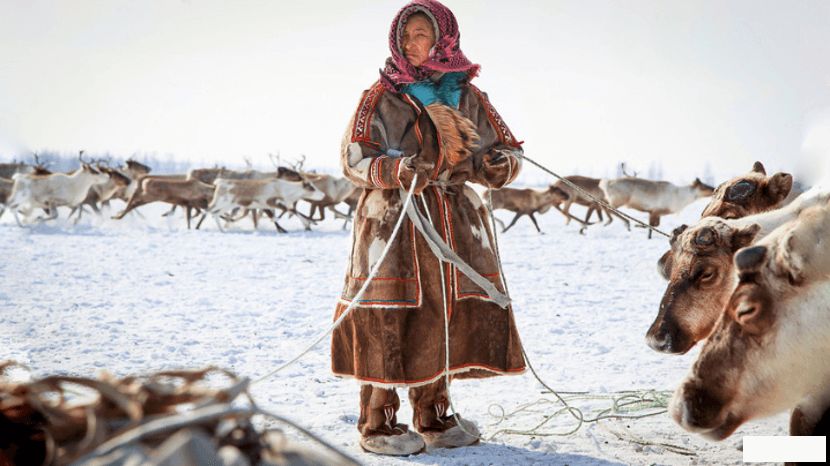
Now, what is left of their traditional lifestyle is threatened by the changing climate. "Any fisherman knows when the best fishing is in his area, what time, where the fish are and when they bite best. This is knowledge of the natural rhythms associated with a particular spot," Yukaghir elder Vyacheslav Shadrin told Al Jazeera. "Indigenous peoples also possess such knowledge, and based on this, we developed our survival strategy. This allowed us to exploit these natural resources effectively and in the most environmentally friendly manner."
But these weather cycles are no longer predictable, Shadrin said. "Most elders say that nature is playing tricks or deceiving us. They try to explain why this is happening – because we've committed too many violations." Temperatures in Russia – the fourth-largest emitter of greenhouse gases after China, the United States and India – are rising at more than twice the global average, leading to mounting environmental consequences not only for the Siberian tundra but for the entire planet.
As a result, a group of activists filed a lawsuit against the Russian government four years ago, first through the Russian Supreme Court, then the European Court of Human Rights (ECHR). Known as the Russian Climate Case, it argued that the Russian government has been irresponsible and failed to meet its international climate obligations. But in June, an ECHR judge ruled the case inadmissible without providing reasoning.
"No reasoning was provided," said Arshak Makichyan, one of the plaintiffs. "Our legal team obviously disagrees, especially since there were similar cases that the court considered and ruled on, so this outcome was quite unexpected for us. We can only speculate about the reasons. Personally, I think it was a political decision. I believe the court was reluctant to deal with Russia on such a serious issue." Makichyan noted the consequences risked by many plaintiffs; he and his family were stripped of Russian citizenship in 2022, which he believes was retaliation for his activism.
In Siberia and Russia's Far North, the climate crisis is an everyday reality. "Floods occurred once every three to four years, catastrophic floods once every 10 years," Shadrin said. "And now, a year without floods is becoming something of an anomaly, and forest fires happen every year." Wildfires burn millions of hectares of Russian forests each year; the worst season was in 2021 when nearly 190,000 square kilometers – larger than Syria or Uruguay – were incinerated.
Another issue is melting permafrost, which lies beneath more than half of Russia's surface. Permafrost stores vast amounts of greenhouse gases and organic matter over millennia; when it thaws, these are released, accelerating climate change and causing immediate complications. "Most of the transport links in the north are what's known as winter roads," Shadrin said. "In my village 30 years ago, the road was operational from November 7 to May 9. Now, at best, the winter road opens just before or after the New Year, and around mid-April, these roads are closed because of intense melting. In just 30 years, the lifespan of winter roads has been cut in half."
The thawing soil is a menace to infrastructure, and the reappearance of organic material can unleash dormant diseases. In 2016, an anthrax outbreak in Siberia was believed to have originated from an animal carcass that emerged on the surface. Officially, Russia remains committed to the Paris Agreement, pledging carbon neutrality by 2060, but experts argue that little is being done in practice.
Oleg Pluzhnikov, a former official from the Ministry of Economic Development, said: "If you look at this matter objectively without the government's rose-tinted glasses, then in reality, Russia is among the countries that are doing practically nothing about this." He added that most climate programmes exist only on paper, and policy is shaped with the interests of the fossil fuel industry in mind.
The departure of foreign firms after Russia's 2022 invasion of Ukraine has slowed investment in renewable energy, and sanctions have halted scientific cooperation. However, Pluzhnikov said sanctions are not an excuse: "Russia is now speculating on these sanctions to some extent. It says, 'We can't invest into low-carbon development because we don't have access to technology.' Well, we understand that this is complete nonsense."
The plaintiffs plan to continue their efforts via other avenues, including appealing to the ECHR's president and the UN human rights framework. Makichyan said: "We do not know what the situation with Russia will be in the future as a lot depends on political developments. But hopefully, at least on the international stage, people will continue paying attention to Russia's environmental and climate policies since there are many diplomatic and economic ways to put pressure on the country."
Source: www.aljazeera.com