Construction has begun in South Dakota, United States, on the underground cryostats for the Deep Underground Neutrino Experiment, known as DUNE, a major international physics project designed to study elusive neutrinos and help explain why the universe contains far more ordinary matter than antimatter. The facilities are being built at the Sanford Underground Research Facility, roughly 1.5 kilometers beneath the surface, with coordination by Fermi National Accelerator Laboratory and contributions from CERN and more than 1,500 researchers. The cryostats will hold huge volumes of liquid argon at extremely low temperatures to detect rare neutrino interactions.
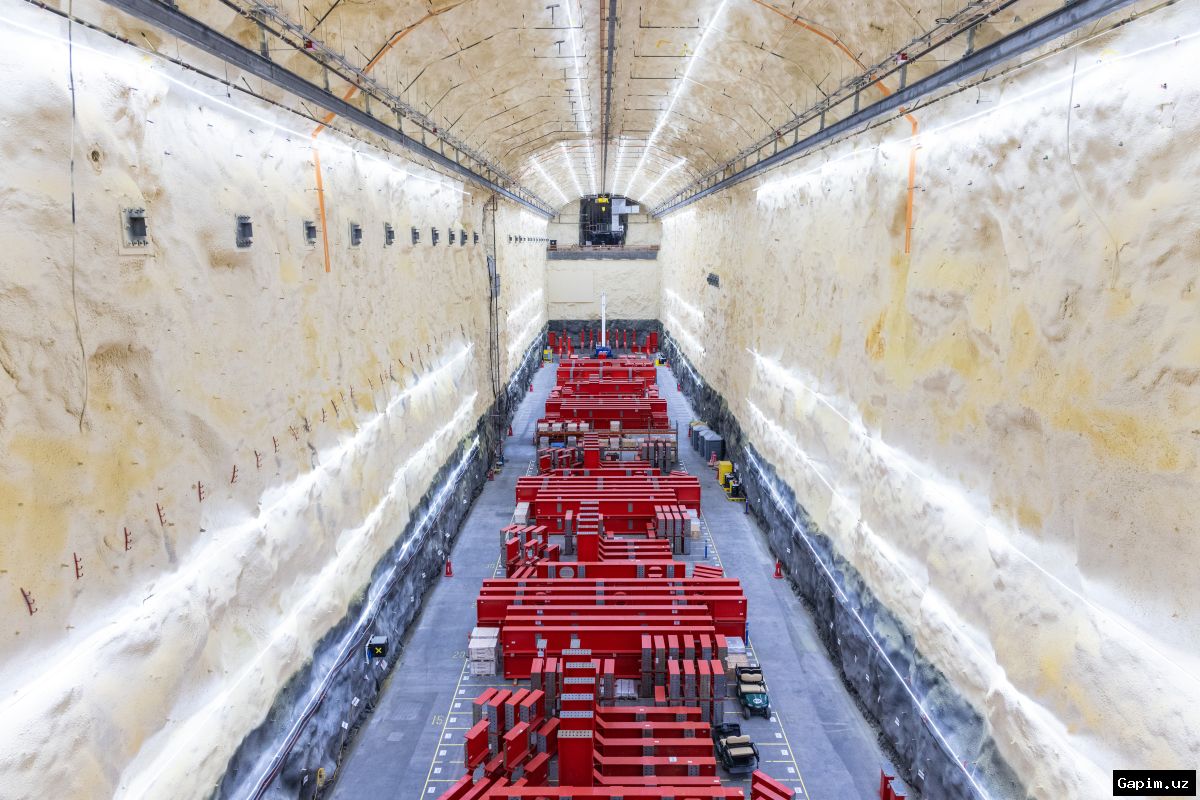
Key Takeaways: DUNE will use two massive liquid-argon cryostats about 1.5 kilometers underground in South Dakota, each designed to hold around 17,000 metric tons of liquid argon. The project brings together Fermilab, CERN, SURF and over 1,500 scientists, with detectors expected to be ready by 2030 and a neutrino beam from Fermilab scheduled to begin by 2031. Its central scientific goal is to clarify neutrino behavior and the matter-antimatter imbalance after the Big Bang.
Neutrinos are subatomic particles with no electric charge and extraordinarily small mass; they interact so weakly with matter that they are often called “ghost particles.” They pass continuously through the Earth and human bodies with almost no trace. Studying how neutrinos change from one type to another, and how tiny mass differences affect those oscillations, could shed light on why ordinary matter survived in greater abundance than antimatter after the Big Bang. The experiment also aims to test and refine the Standard Model of elementary particle physics, the framework that describes known particles and forces but leaves key questions unanswered.
The technical scale is immense. Each cryostat will be about 65.8 meters long, 18.9 meters wide and 18.3 meters high, and together they will require some 2,600 steel beams. CERN has provided more than 6,200 metric tons of steel as an in-kind contribution to the international project. Liquid argon inside the detectors will be maintained at approximately −184°C. Fermilab will send a neutrino beam roughly 1,300 kilometers to the underground detectors, while a nearby detector at Fermilab will measure the particles before they travel. Together, these components form the Long-Baseline Neutrino Facility.
Under the current schedule, the liquid-argon detectors are expected to be ready by 2030, and the first neutrino beam is due to be sent from Fermilab by 2031. The project is among the most ambitious and capital-intensive undertakings in particle physics, and its engineering, scheduling and cost risks remain closely watched. If successful, DUNE could deliver fundamental insights into the universe’s structure, the behavior of matter and antimatter, and the limits of current physics.
Source: kun.uz