During 2025, state filtering of political information on the internet was compared across 179 countries. According to the eighth version of the Digital Society Survey (2026), prepared under the Digital Society Project, Ethiopia, Algeria, Saudi Arabia and the United Arab Emirates received lower scores on this indicator than China (-2.82) and Russia (-2.00). The findings highlight sharp differences in the level of internet control among states and suggest that rankings may diverge from widely held assumptions about restrictions in different countries.
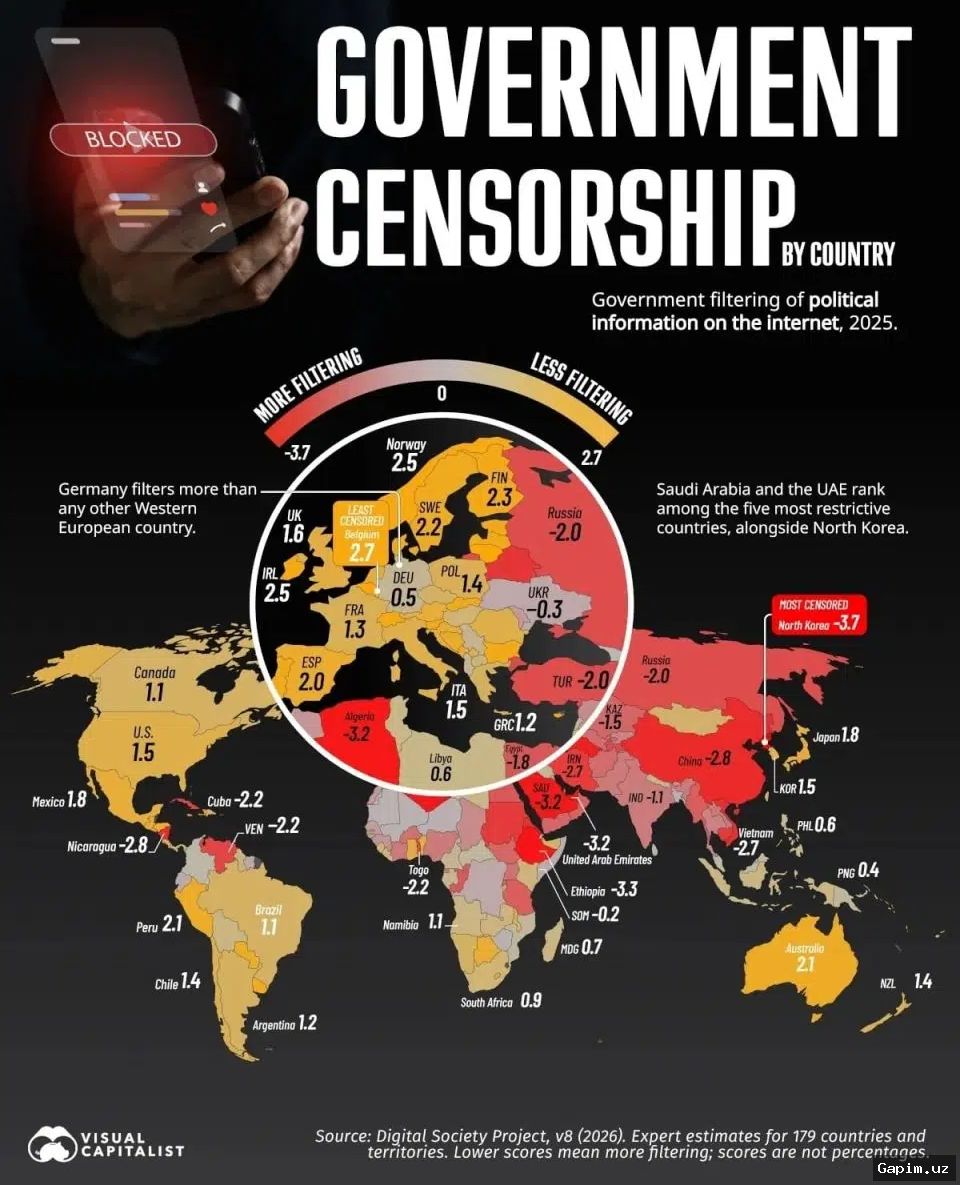
Key Takeaways: The survey covers 179 countries and reflects conditions during 2025; Ethiopia, Algeria, Saudi Arabia and the UAE scored below China (-2.82) and Russia (-2.00); Belgium (2.70) and Lithuania (2.56) were among the states with the lowest level of political information filtering.
Governments differ significantly in the degree to which they restrict access to political information online. In some states, broad control mechanisms determine what information users can obtain. This indicates that the balance between network access and state oversight is shaped differently across jurisdictions.
Saudi Arabia and the UAE illustrate the gap between internet access and digital freedom: both countries report 100% internet usage, with Bahrain and Kuwait showing the same level and Qatar exceeding 98%. Yet widespread internet use does not guarantee free expression of political views; authorities may block materials on politically sensitive topics, restrict access to certain websites and punish users for online criticism while maintaining broad network access. Restrictions on the dissemination of political information and arrests linked to online expression have been documented in various countries in the region.
In Asia, differences in internet freedom are especially visible: China (-2.82) and Vietnam (-2.71) filter information on a broad scale, while Japan (1.76) and South Korea (1.48) are reported to stand out with a relatively open internet environment. Governments in Southeast Asia are increasingly pressuring internet platforms to remove certain materials. This suggests that digital control mechanisms in the region are developing along different paths.
At the opposite end of the ranking are states with the lowest level of filtering political information, including Belgium (2.70) and Lithuania (2.56). Over time, these data may provide a basis for reassessing common assumptions about internet restrictions and tracking changes in states' digital policies. Future versions of the survey are expected to show where filtering levels change and how the gap between internet access and freedom of expression develops.
Source: kun.uz