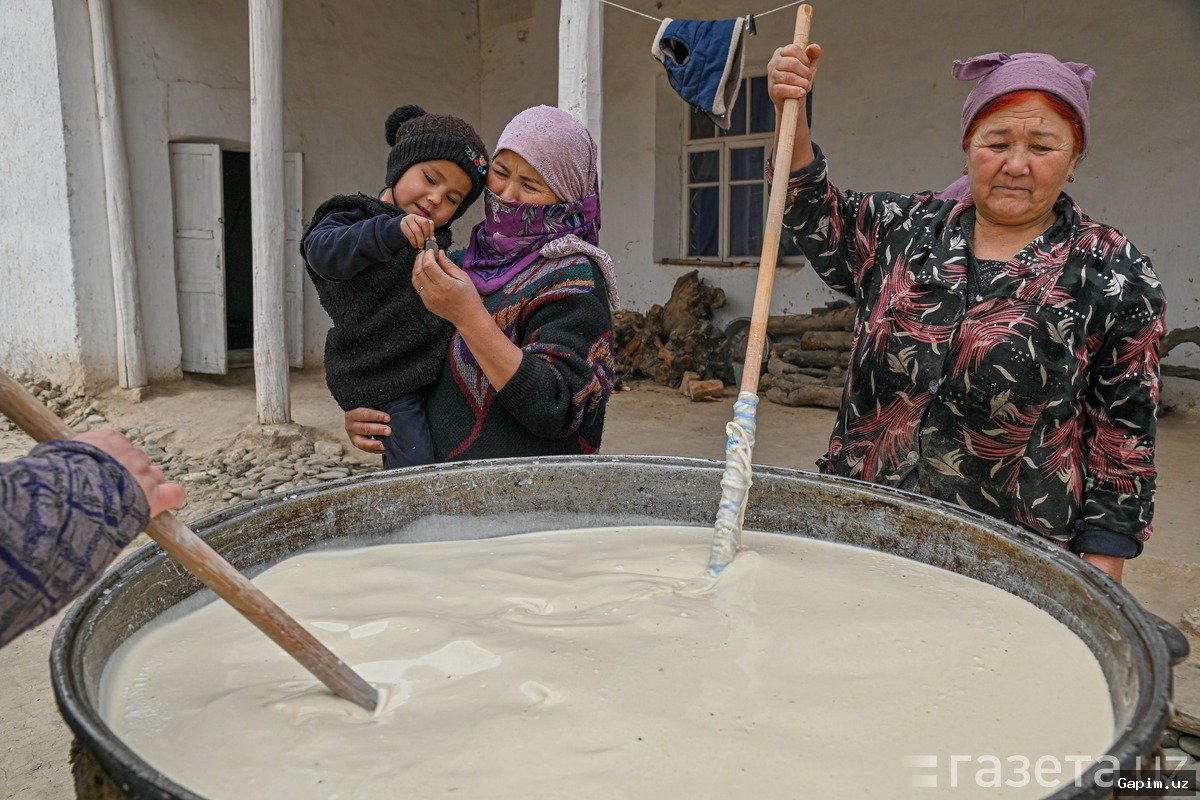
With the arrival of Navruz, the streets of Uzbekistan's cities fill with the characteristic aroma of smoke, caramel, and awakening earth. During these days, huge cauldrons are set up in mahalla courtyards, and everyday life comes to a halt for a full day. Sumalak – the main ceremonial dish of the holiday – requires not just culinary skill but immense patience and a special emotional state. In the traditional way of life, this space is exclusively a female domain. While men handle the technical aspects, bringing firewood and maintaining the fire under the heavy pots, the birth of the dish itself occurs within a close circle of women, where the division of labor conceals deep symbolism rooted in millennia of history.
To understand why this ritual has been safeguarded by women for centuries, one must turn to its origins – a legend that smells not of campfire smoke but of hope. It is said that the first bowl of sumalak appeared on the eve of spring from deep maternal despair. A widowed mother of many children, left without a single handful of flour before Navruz, watched her seven children weaken from hunger. In the storerooms, nothing remained but a handful of sprouted wheat that could not be ground. To somehow comfort the crying children and give them faith in an imminent meal, she placed a huge cauldron over the fire, filled it with water, and threw ordinary river stones into the bottom. All evening, overcoming her own helplessness, she stirred the bottom evenly – the clatter of stones created the illusion of meat boiling in the pot. She hummed lullabies and promised the children that "the food will be ready soon," until they, lulled by her voice, fell asleep.
She stirred the brew all night, turning exhausting labor into a continuous prayer. When, at dawn, the exhausted woman briefly fell asleep, thirty angels descended to her hearth, according to tradition. Moved by her selflessness, they breathed life into the meager grain, transforming the water and wheat into a thick, golden nectar, sweeter than anything the world had ever tasted. Upon waking, the family found not just food but a heavenly gift, on the surface of which a pattern resembling the sweep of wings had solidified.
Since then, sumalak has been considered a symbol of maternal strength, capable of creating a miracle from virtually nothing. Here, a woman acts not merely as a homemaker but as the primary guardian, knowing that just as that widow once turned stones into food, her patience will become the key to the family's well-being for the coming year. It is this belief in the creative power of women's hands that today transforms heavy physical labor into an elevated social rite.
In modern mahallas, the transformation of wheat "milk" into a thick caramel mass remains a process that knows no fatigue because it is driven by the energy of unity. This trial, lasting almost a full day, smoothly transforms into a ritual in women's hands, where there is no place for loneliness by the cauldron. Women – from gray-haired grandmothers to young granddaughters – take turns at the heavy wooden paddle called a "kepchi." Such continuity allows the process to continue uninterrupted for a single minute, creating an invisible thread between generations.
People believe that sumalak is sensitive to the surrounding atmosphere, so the night by the fire is always filled with songs, kind tales, and laughter. Feminine gentleness and pure thoughts become an essential ingredient here, as it is believed that if an argument flares up in the circle, the dish will lose its noble taste and color.
This atmosphere of involvement attracts not only those busy at the cauldron but also neighbors, passersby, and random guests. By tradition, everyone who approaches the flame must make at least a few circles with the heavy wooden paddle. To prevent the thick wheat mass from sticking to the scorching cast-iron bottom, a handful of clean river stones or walnuts in their shells are always thrown into the cauldron. It is at this moment, to the steady clatter of stones against the pot walls, that it is customary to make the most heartfelt wish.
However, the main intrigue arrives in the pre-dawn silence, when the many-hour boiling is finally complete. The moment the fire under the cauldron goes out, the most crucial stage begins – waiting. The cauldron is tightly covered with cloth, allowing the sumalak to "mature" in its own steam, and morning brings the long-awaited resolution in the form of patterns solidified on the surface. Only an experienced eye or feminine intuition can decipher these signs: in the intricate lines, people try to discern the outline of a flying bird – foretelling good news, or tree branches, promising an addition to the family. And the lucky one who later finds one of those "technical" stones in their bowl believes that their wish, made by the fire at night, will now certainly come true.
It is in this ability to sense the invisible that the answer lies to why the preparation of sumalak has remained exclusively women's work for centuries. Only a woman can wait so long, believe so sincerely, and see deep meaning in the ordinary awakening of grain.
Yet, behind the ritual mystery always lies earthly care. The result of this spring marathon is not merely a valuable vitamin gift, necessary for the body after a long winter, but a true hymn to solidarity. When the cauldron is opened and the first portions are ladled into bowls, the main moment of the holiday arrives – treating loved ones, neighbors, and random passersby.
In each such bowl, not only the thick wheat nectar is passed on but also the warmth accumulated overnight from women's hands, their songs, and the sincere hope that the coming year will be as peaceful, bright, and sweet as this freshly cooked sumalak.
Source: podrobno.uz