In June 2026, the first cohort of the Teach For Uzbekistan program completed their two-year teaching assignments in schools across the Kashkadarya region. Twelve young teachers instructed students in mathematics, chemistry, biology, English, computer science, and economics at four schools in the Chirakchi and Kokdala districts.
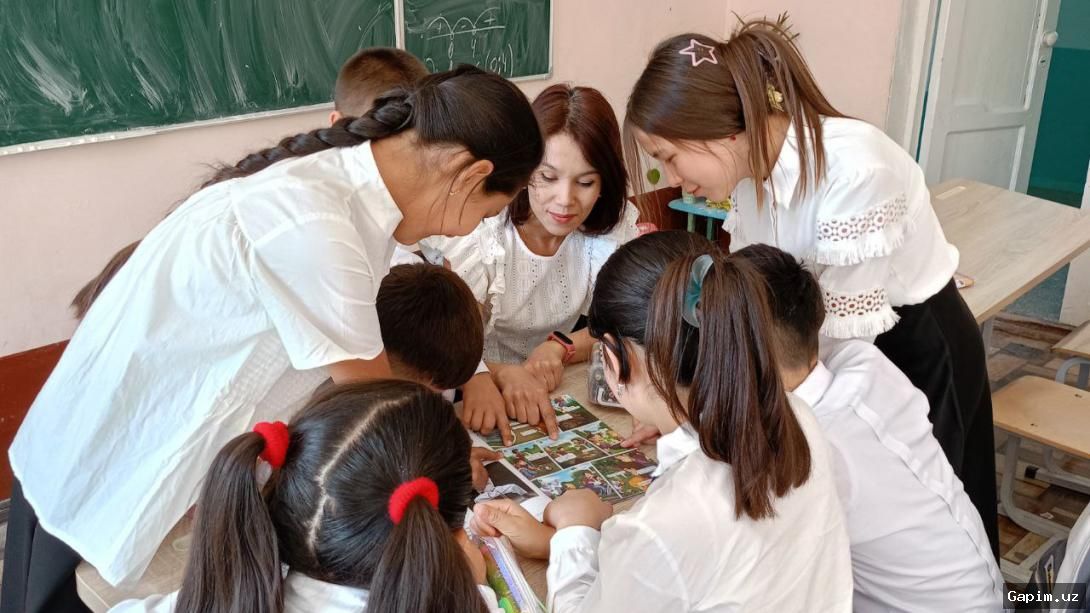
The publication interviewed English teacher Mokhirabonu Abdurakhimova, who shared what drove her to leave her job in the Fergana Valley and move with her three-year-old child to a school in the oasis region, the challenges and transformations she experienced over two years, her students' achievements, and the systemic issues she observed in the school system.
Teach For Uzbekistan is a partner of the global Teach For All network, which operates in over 60 countries. The program aims to reduce educational inequality, improve education quality, and develop young leaders by sending selected professionals to teach in remote schools for two years.
In 2024, 12 participants were selected from over 750 applicants, and in 2025, 28 from 1,074 applicants, through a five-stage selection process. They underwent a month-long summer institute for pedagogical training before starting work in schools in the Kashkadarya and Surkhandarya regions. The program is funded by international and local donors; participants receive a monthly stipend of $500.
Mokhirabonu Abdurakhimova was born in 1998 in the Khojaabad district of Andijan region. She graduated from Andijan Mechanical Engineering Institute in 2021 and later earned a second degree in English teaching from Andijan State Institute of Foreign Languages. She taught at School No. 4 in Chirakchi district under the Teach For Uzbekistan program.
Mokhirabonu recounted facing family stereotypes, being forced to leave a factory job, and transitioning to pedagogy. She discovered the program by chance, applied, and after a long wait, was invited to a training in Tashkent. Her decision to move to Kashkadarya met strong family opposition, but her inner drive prevailed.
At school, she chose to teach challenging 8th and 9th graders with low academic performance. Initially, students did not take her seriously, mocking and ignoring her. She decided to study child psychology and attended online trainings by international experts. She learned the importance of showing vulnerability and being authentic with students.
Once, when two students started fighting in class, she did not hide her fear: she closed her eyes and trembled. This stopped the fight, and the students apologized. Mokhirabonu sees this as an example of how admitting weakness can earn respect.
She worked individually with problem students. One boy constantly sought attention. Learning he practiced boxing, she enrolled her son in the same club and began publicly praising the student's achievements. Soon, the boy started keeping a vocabulary notebook and showed significant progress.
In lessons, she grouped students and organized online conversations with native speakers, including her sisters posing as foreigners. A mother of one girl thanked Mokhirabonu for igniting her daughter's interest in learning; the girl later obtained a language certificate and volunteers in international projects.
Over two years, Mokhirabonu taught about 50 students, six of whom earned CEFR B2 certificates. The rest achieved intermediate comprehension and conversational skills.
Mokhirabonu emphasized that the program helped develop students' soft skills: teamwork, independent problem-solving, asking questions, and seeking information. Most importantly, they gained intrinsic motivation and a thirst for learning. She believes this is the most crucial task of a modern teacher.
In Teach For Uzbekistan, Mokhirabonu found like-minded peers facing similar challenges. Sharing problems and seeking solutions together gave her strength. She notes that many young teachers, lacking support, give up and lose their inner fire.
Teach For Uzbekistan plans to expand to the Republic of Karakalpakstan in 2026 and increase the number of teachers to 55.
Source: www.gazeta.uz