President Shavkat Mirziyoyev of Uzbekistan participated in the opening ceremony of the 59th Annual Meeting of the Board of Governors of the Asian Development Bank (ADB) in Samarkand on May 4. In his speech, the head of state emphasized that hosting such a prestigious forum in Uzbekistan brings pride and honor to the country.
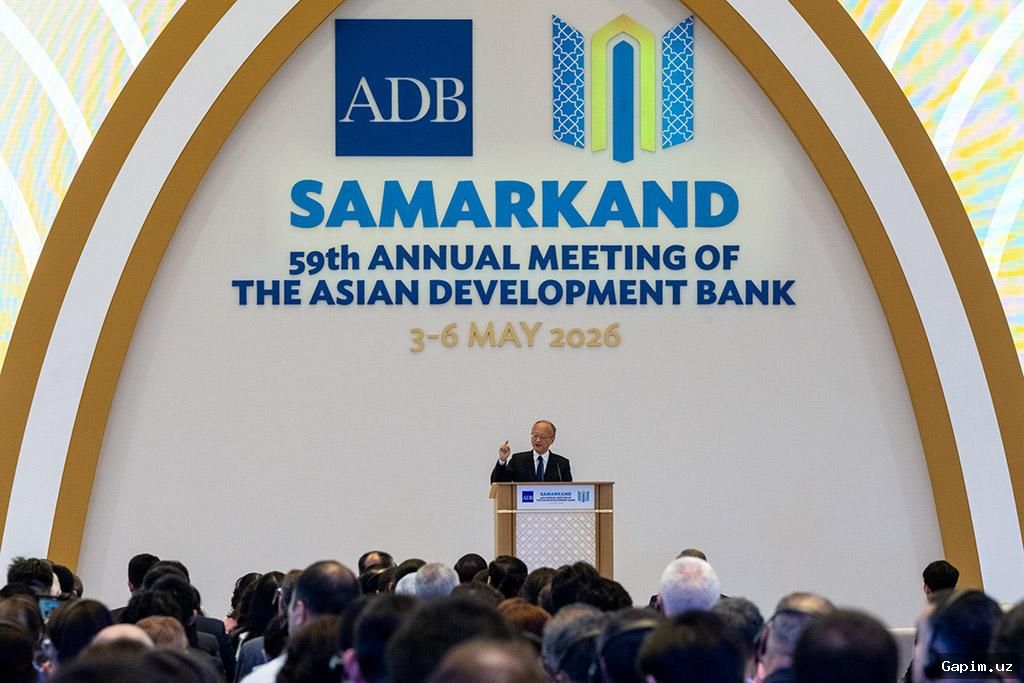
The President highlighted the results of ongoing reforms, noting that over the past years, $150 billion in foreign investment has been attracted to the economy, thousands of modern enterprises have been launched, exports of goods and services have tripled, and the national economy has grown from $50 billion to $147 billion. Uzbekistan also rose 14 positions in the Economic Freedom Index, entering the group of “moderately free” economies for the first time.
Despite global instability, the country’s economy achieved 8.7% growth in the first quarter. Mirziyoyev acknowledged the role of the ADB and other international financial institutions, stating that the joint project portfolio with the ADB has reached nearly $16 billion.
Addressing complex global economic changes and rapid technological development, the President stressed the need for new mechanisms and effective approaches in cooperation with the ADB to ensure sustainable development. He announced the establishment of an Artificial Intelligence Hub in Uzbekistan and the implementation of over 200 AI projects across economic sectors.
Mirziyoyev proposed developing a dedicated program under ADB auspices to scale up artificial intelligence in developing countries. He also announced Uzbekistan’s accession to the Bank’s “Digital Highway for Asia” initiative and proposed opening its regional coordination center in Tashkent.
In the energy sector, Uzbekistan has commissioned wind and solar power plants with a capacity of 5,600 MW, raising the share of green energy to 30%, with plans to increase it to 54% by 2030. Gratitude was expressed for ADB’s support in creating the Central Asia–Europe green energy corridor.
On transport and logistics, the President reported the start of construction of the China–Kyrgyzstan–Uzbekistan railway, which will reduce delivery times to 10 days and enable annual cargo transportation of up to 15 million tons. He proposed establishing a “Digital Customs and Logistics Alliance” under the ADB’s Central Asia Regional Economic Cooperation program.
In critical minerals, Uzbekistan has large reserves of copper, tungsten, molybdenum, magnesium, graphite, vanadium, and titanium. An R&D center has been launched with Korean partners, a “Technopark of Future Metals” is being built in Tashkent and Samarkand regions, and over 70 projects worth $1.6 billion have been initiated with companies from the US, China, and Turkey. Mirziyoyev proposed joining the ADB’s “From Critical Mineral to Production” program.
To combat climate change, the national “Yashil Makon” project involves planting 200 million seedlings annually, protective forests have been established on 2 million hectares of the dried Aral Sea bed, and the goal is to increase green coverage to 30% by 2030. A regional “Green Belt of Central Asia” project was proposed.
In tourism, the flow of foreign visitors to Uzbekistan has increased sixfold over ten years, reaching 12 million annually. The Center of Islamic Civilization in Tashkent and the Imam Bukhari Memorial Complex in Samarkand were highlighted. The President proposed creating a “Tourism Ring of Central Asia” to unite regional destinations.
Concluding his speech, Mirziyoyev stated Uzbekistan’s readiness to implement the proposed initiatives with the ADB not only through sovereign lending but also via public-private partnerships, guarantees, blended finance, and private capital mobilization. He proposed forming an innovative platform for financing regional projects.
Source: www.gazeta.uz