In June, the official exchange rate of the Uzbek som against the US dollar fell by 0.5%, according to data from the Central Bank reviewed by Gazeta.
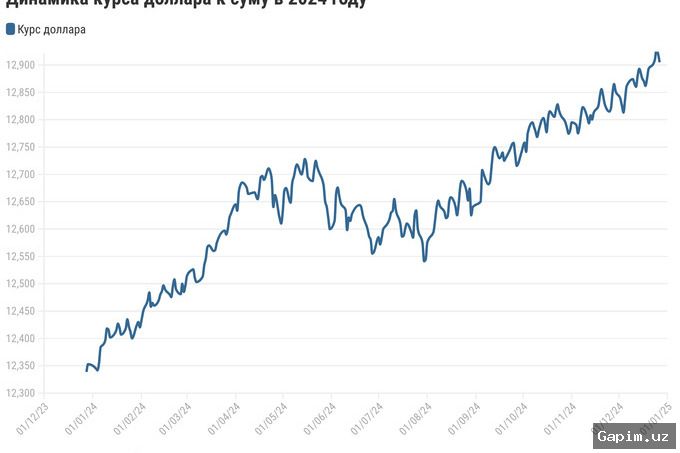
As of May 31, the official dollar rate was 11,997.83 som, rising to 12,060.84 som by June 30 — meaning the US currency appreciated by 63.01 som, or 0.5%, over the month.
For comparison, in April the som strengthened by nearly 2% against the dollar, while in May it weakened by 0.5%.
Since the beginning of the year, the national currency has lost only 0.3% of its value against the dollar. On January 1, the official rate was 12,025.33 som per dollar, so by the end of June the dollar had risen by just 35.51 som.
Economist Mirkomil Kholboyev, a master's graduate from South Korea's Chonbuk National University and author of the Telegram channel Mirkonomika, attributed the dollar's strengthening in global markets in June to expectations of further interest rate hikes by the US Federal Reserve (Fed).
According to him, before the Fed's meeting on June 17, 11 of the selected currencies were strengthening against the dollar. After the meeting, only two currencies managed to increase in value, while the remaining 32 depreciated.
The economist also noted that the weakening of several oil-export-dependent currencies, particularly the Russian ruble, was further driven by a drop in global oil prices following easing tensions in the Middle East.
Overall, of the 39 currencies analyzed in June, only four strengthened against the dollar, while the rest either remained unchanged (including fixed-rate currencies) or depreciated.
"The som depreciated by 0.5% against the dollar over the month, remaining one of the currencies with a relatively low level of depreciation among those selected," Kholboyev said.
For comparison, the Russian ruble weakened by 7.7% against the dollar in June, becoming the biggest loser among the analyzed currencies. The Kazakh tenge maintained relative stability, weakening by only 0.1%.
Among major global currencies, the Swiss franc fell 3.1% against the dollar, the euro 2.1%, the British pound 1.8%, and the Japanese yen 1.5%. The Chinese yuan, one of Uzbekistan's largest trading partners, declined by 0.6%.
The economist also highlighted a decrease in som volatility. According to his calculations, the average daily volatility of the national currency in June fell by 22.6% compared to May — from 0.31% to 0.24%.
Compared to June last year, volatility nearly halved.
After increased exchange rate fluctuations last year, the International Monetary Fund reclassified the som from a crawl-like arrangement (where the rate changes gradually within certain parameters) to a floating currency category.
According to Kholboyev, in terms of daily volatility, the som was among the most stable currencies in June.
For comparison, the daily volatility of the Russian ruble was 0.84%, the tenge 0.44%, while the Canadian dollar, euro, and British pound were close to the Uzbek currency at 0.24%, 0.29%, and 0.30%, respectively.
Source: www.gazeta.uz