According to a report by the Social Policy Laboratory under the National Agency for Social Protection, 33.2% of Uzbekistan's youth aged 14–30 fall into the NEET category (not in education, employment, or training). The report is based on data from the 2025 Household Budget Survey conducted by the Statistics Agency.
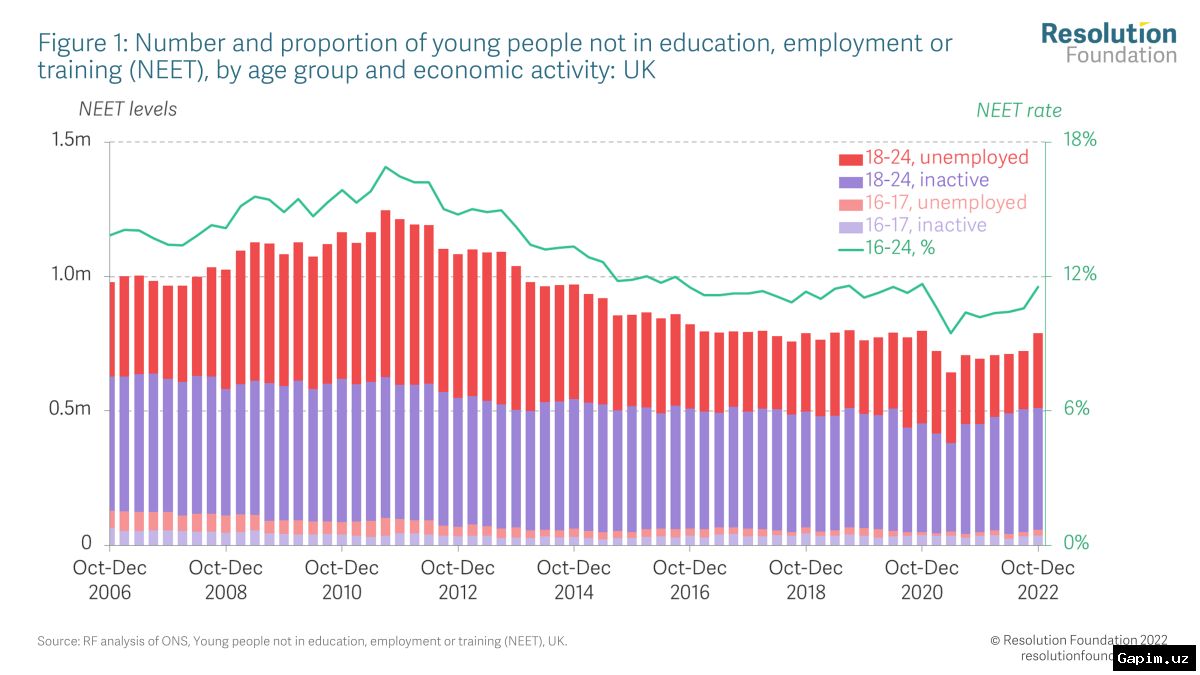
The study found that only 36.1% of young people are employed, while 30.7% are engaged in education or vocational training. The authors argue that the high NEET rate reflects the inability of the economy and education system to fully absorb the growing youth population.
Among young women, the NEET rate reaches 48.4%, 2.5 times higher than among men (19.4%). While educational participation is nearly equal (32.3% for women, 29.4% for men), a sharp gap appears in the labor market: only 19.3% of young women work, compared to 51.3% of men.
Marital status strongly influences NEET rates. Among married women, 70.8% are NEET, while 86.2% of married men are employed. Unmarried women have a NEET rate of just 10%, lower than unmarried men (13.9%).
Regionally, the highest NEET rate is in Samarkand region (39%), and the lowest in Tashkent city (25.6%). Rural areas have a rate of 34.4%, compared to 32% in urban areas.
A direct correlation exists between household income and NEET: 46.1% of youth in the poorest households are NEET, versus 20.8% in the richest. In poor families, the rate reaches 53.9%.
Researchers warn of a 'demographic dividend' risk: without sufficient jobs and education, a growing youth population could become a heavy burden on the social protection system.
Source: www.gazeta.uz